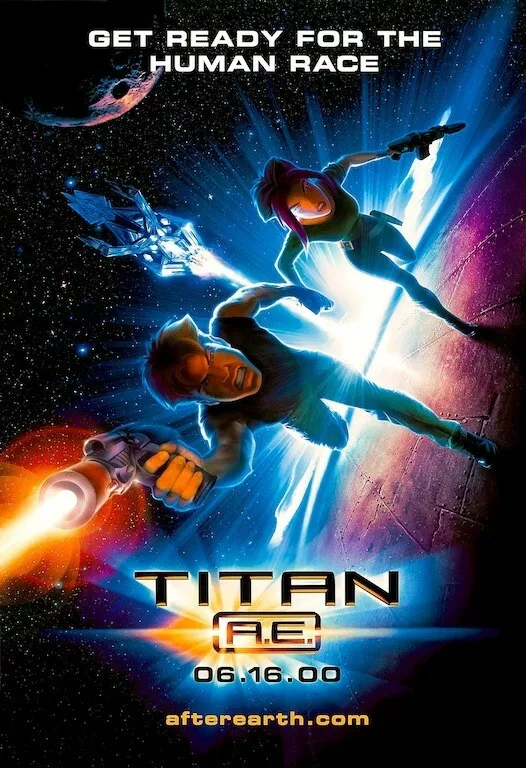
“Don Bluth” and “Science Fiction” is not an association you might automatically make even if, like me, you believe that An American Tail should rightly be considered part of the Giant Fighting Mech Animé genre.
And that would be entirely correct. Apart from his video game Space Quest, there’s nothing in Bluth’s oeuvre to suggest that he would ever make a big epic space opera. So, why Titan A.E?
Well, firstly we have to remember where Bluth was in his career at this point. After finding early indie success with Secret of NIMH, Bluth hit the big time by partnering with Stephen Spielberg. When that relationship broke down, Bluth floundered with a number of increasingly bizarre and often subpar films before finding a place with Fox’s new animation studio, essentially as a hired gun. So, if Titan A.E. seems like a complete break from Bluth’s usual fare, that’s because this was basically a work for hire job. And, at the risk of sounding like a heathen…good?
Look, I respect Don Bluth a whole lot, I think he’s a true auteur and one of the most important figures in American animation. But I can’t help but feeling that his best work was done when he was executing someone else’s artistic vision. The Land Before Time is very much a Stephen Spielberg film. Anastasia is transparently Fox demanding a Disney princess movie and Bluth dutifully providing them with one. It just so happens to be the best Disney princess movie that Disney never made and one of Bluth’s most accomplished films to boot. So if you tell me that a certain movie was just a job for Bluth and not a passion project, I’m actually more inclined to breathe a sigh of relief than shake my fist in impotent rage. Because I’ve seen Don Bluth’s passion projects.
Oh. Yeah. So, here’s the thing. Mini-Mouse has been asking to read my reviews so I’m gonna try and keep this one family friendly. Say hi in the comments, folks!


Okay, so, Titan AE entered production in the late nineties which was a weird, febrile and exciting time in American animation. The Disney renaissance was still very much in effect, but Toy Story had landed like a nuclear bomb and everyone was holding their breath to see whether CGI animation would supplant traditional animation or simply supplement it. Additionally, there was a cultural sea-change in how animation was viewed, being driven both by the ever increasing popularity of animé and the success of television animation aimed at adults like The Simpsons, Batman the Animated Series and Beavis and Butthead. In the new millennium, both Disney and its competitors would try to expand the core demographic for feature length animation from pre-teen and predominantly female and try to convince teenage boys that cartoons weren’t just for little kids and chicks. Of this little mini-genre, in which you can include Treasure Planet and Atlantis: The Lost Empire the first was Titan A.E.
(more…)
 unshavedmouse