This map is wrong:

That’s not to say it’s bad.
It’s very useful.
It’s informative.
It is even, when you take a step back and consider it, quite beautiful. But it’s wrong.
The continents aren’t that size relative to each other. Not even close. Of course, you could use a different projection that shows them the correct relative size, something like this:

But now all the continents’ shapes are distorted nearly to the point of being unrecognisable.
Every 2 dimensional map of the world is wrong because, obviously, the world is not flat (I swear to God if anyone starts shit in the comments…). Ultimately, any attempt to render a three dimensional sphere as a 2 dimensional rectangle is, well, a lie. It’s an attempt to simplify that will always lead to distortion one way or another.
I love historical films. I hate historical films.
This was going to be a review of Inherit the Wind.
It became something else.
Okay, here’s a bold, contrarian take for ya. People today are probably more historically literate now than ever before. Your average Westerner today knows more about world history than a professional historian would have a hundred and fifty years ago.
And some of that, sure, is better education and the internet and the ubiquity of the printed word. But a huge chunk of the credit actually needs to go to the medium of film. I mean, take even a film that is notoriously bad history like, say, Pocahontas. There is still a wealth of genuine historical data to be absorbed by watching that film. The colony was called Jamestown. The name of the tribe was the Powhatan. John Radcliffe was the governor. The story is a mixture of myth and pure Hollywood invention but you do learn truths. Of course, you don’t just learn truths.
This is something I’ve been chewing over in my mind for a long time now. Do historical movies have to be accurate?
Well, on the one hand, no. Absolutely not. Asking a historical film to be true to history is like expecting a two dimensional map to be true to a three dimensional world. Merely by making it a film you must flatten. You must distort. You must shrink. You must make the complex simple enough to understand.
Okay, but how much distortion can you accept? I mean, if every map is wrong, is there even such a thing as a bad map?

Relax, it’s a metaphor. Genre matters, of course. One of my favourite movies is Death of Stalin, a comedy based around the power struggle in the Kremlin after the death of the titular tyrant. And, like with Pocahontas, you will learn quite a bit about that period in history. But there’re also scenes like this:
Which I’m pretty confident in saying never happened.
But, that’s a comedy. The rules are different. It’s when movies start expecting to be taken seriously (a dangerous pastime, LeFou) that I think you need to take out the red pen and start marking down for inaccuracy.
Let’s start with the good. No, let’s start with the great.
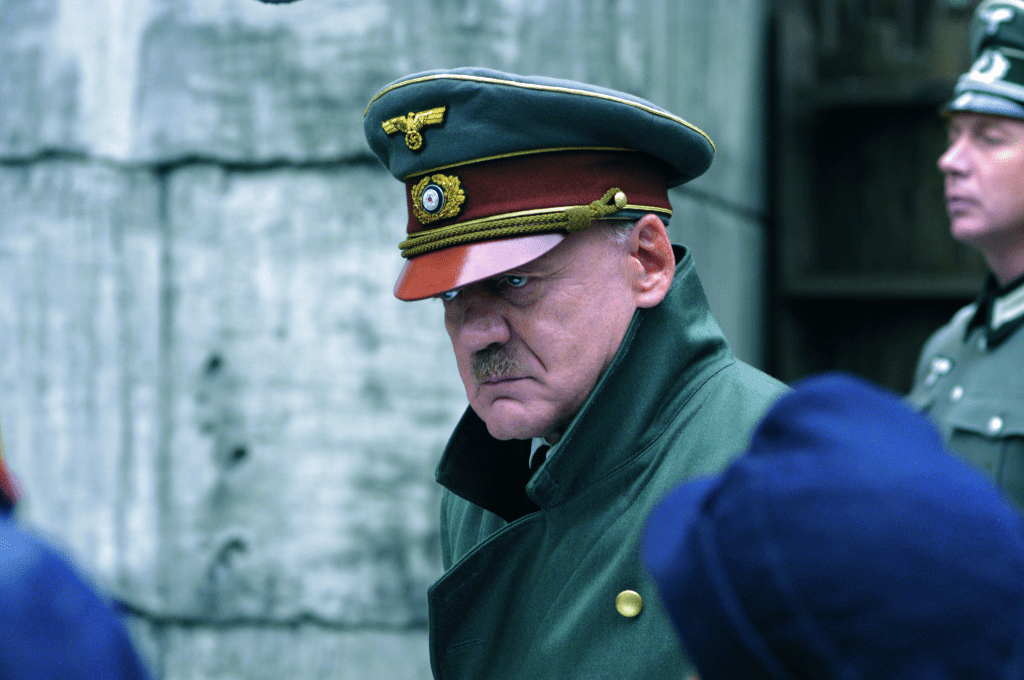
Fucking hell Downfall is so good. It’s the closest thing to time travel. Every detail, every performance was sweated over. In the the pantheon of great Hitler performances (and there have been some great Hitler performances) Bruno Ganz will never be touched. It’s a movie that gives me hope for the genre as a force of good and enlightenment in the world. It makes you believe that you can actually have a flat map of a round Earth.
Maybe it’s the setting. Maybe it’s the importance of getting this particular period right (or rather the potentially disastrous results of getting it wrong) that makes them really sweat the details. Another one that I think does a phenomenal job (and, maybe even more impressively, does it with an English script):
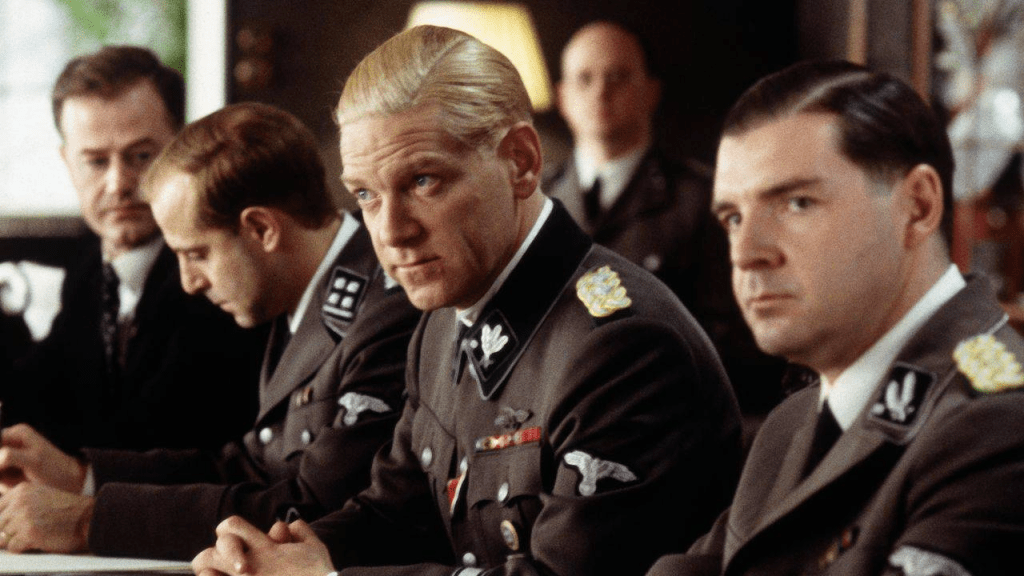
If I ever teach a writing course, this movie will be one of the key texts. Conspiracy is a dramatisation of the minutes of the Wannasee conference, the meeting where the arch-fiends of the Nazi regime met to decide just what form the Final Solution would take (in actuality, it was the meeting where the SS gathered the other interested parties in a room and said “This is what we’ve been doing. You’re all complicit now. Cool? Cool”).
It has what is to this day, the single most terrifying line of dialogue I have ever heard, the initial results of the use of Zyklon B blandly delivered by Stanley Tucci in the tone of a middle manager announcing the quarter’s earnings:
EICHMANN: And the the results are…well I have figures.
We’re at the demarcation point. This is murder on a scale that words can no longer render, and we must instead turn to mathematics.
Then there are movies that are not rigorously accurate but are still…good enough? Maybe?
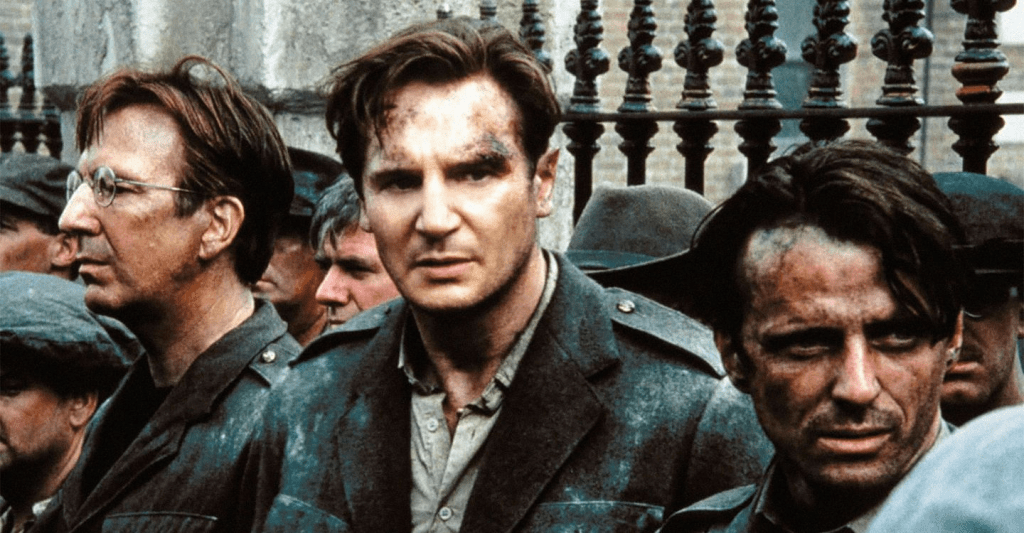
This scene is from the opening of Michael Collins. Michael Collins (Liam Neeson), Eamon DeValera (Alan Rickman) and Harry Boland (Aidan Quinn) stand outside the burned out wreckage of the GPO in the aftermath of the Easter Rising, waiting to be taken into custody by the British.
Now, this scene never happened. Collins and Boland escaped and were only arrested days after the Rising and DeValera wasn’t even at the GPO, instead commanding troops at a grain mill on the other side of the river. But I can forgive this because it’s good, efficient story-telling. It introduces three of our main characters. It explains the Rising and the men behind it and how its failure shaped Collins’ worldview and development as a military tactician. It lies about little things, to tell the truth about big things. And for the most part, I’m on board with it. For the most part.
Take for example, this scene:
Now, did this happen?
Yes…no. Yes?
There was a massacre of Irish civilians during a Gaelic Football game. It was called Bloody Sunday (not that one. Or that one. Or that one. Rough fucking century.)
British troops locked down the stadium, searching for Republican militants. Here, the stories diverge. The British troops claim they came under fire, the Irish civilians in the crowd claim that the soldiers opened fire without provocation (this happens a lot in Irish history. And Indian history. And African history. I wonder what the common denominator is).
Now, the movie obviously has to choose one account to dramatise and, after all, the film is called Michael Collins and not General Sir Cecil Frederick Nevil Macready.
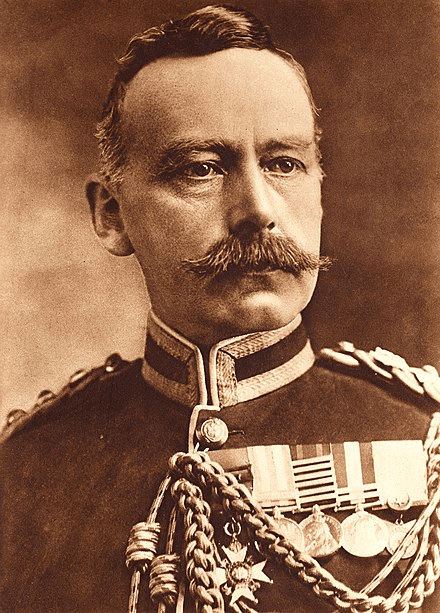
So, what’s the problem?
Well, the armoured car is the problem. That never happened. It’s a spectacular image. It’s a scene everyone remembers. But it’s not real. And…it does change things, doesn’t it? You can at least imagine unprotected foot soldiers, nervy and jumpy after a wave of assassinations just that morning (and, let’s be honest, PTSD’d to fuck from their WW1 service) thinking they’ve heard a shot and panicking. It’s quite another thing to watch that big green Dalek on wheels serenely mowing down fleeing men, women and children. Only a monster could do that.
Then again, you could argue (as director Neil Jordan did) that the reality was even worse. At least in the film, people were able to run. In reality, the gates were shut when the shooting started. There was nowhere to run.
Does it matter? I don’t know.
I do think that if you know nothing of the Irish War of Independence you can watch this film and come away with a good basis for learning more. There’s a reason it’s shown in Irish history classes. It gives you the broad strokes and I think it does more good than harm to the overall understanding of the period.

I don’t think I could ever write historical fiction. I’m terrified of getting the details wrong. Hell, the entire reason I became a science fiction writer was because I didn’t trust myself with history. There’s so much power. It can do so much harm. I know this from personal experience.
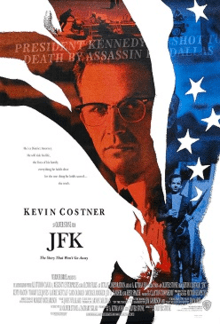
This. Fucking. Movie.
This thing turned me into a weird, conspiracy-addled, paranoid little shit. Because I didn’t understand that a movie this well made, this well acted, this well-scored, this well edited (and oh my God this may be the best edited movie ever made)….just this good. Could lie to me.
I couldn’t wrap my head around the fact that so many talented people could work this hard on a lie.
This film is to conspiracism what Triumph of the Will was to Nazism.
It’s not simply bad history. It’s history in a funhouse mirror.
Behold, Lee Harvey Oswald. A hateful, wife-beating , utter failure of a human being? No! A tragic hero, framed by the Deep State to cover their own crimes. Jim Garrison, a crank and charlatan who claimed that Kennedy was killed by a gay cabal as a “homosexual thrill killing”? Well here he is being played by Kevin Costner channelling the ghost of frickin Jimmy Stewart!
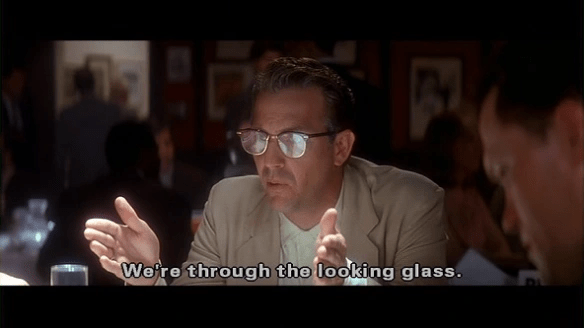
And I know, I know. It’s just a movie. And even thought I want to blame this one film for…well, for everything that came after. Pizza-gate. Nine Eleven Truthers. Q-Anon. January 16th…
I know that’s just how it feels like to me, because I drank this Kool Aid.
And whatever damage this movie did, time eventually will heal it, right? The truth will out, real history will assert itself eventually?
I’m not so sure.
Alright, let’s talk about Inherit the Wind.
The first thing that people think they know about Inherit the Wind, that it’s a re-telling of the Scopes Monkey Trial, is wrong.

The movie is a fictional story that draws very, very loosely on the actual trial. But none of the real historical personages appear. Clarence Darrow does not appear in this movie. Ditto HL Mencken. Oh sure, there’s a Darrow figure, and a Mencken figure. But the names, location and actual events are so far removed from what actually happened that it might as well take place in the MCU.
And yet, I think when most people think of the Scopes Monkey Trial, they picture this:
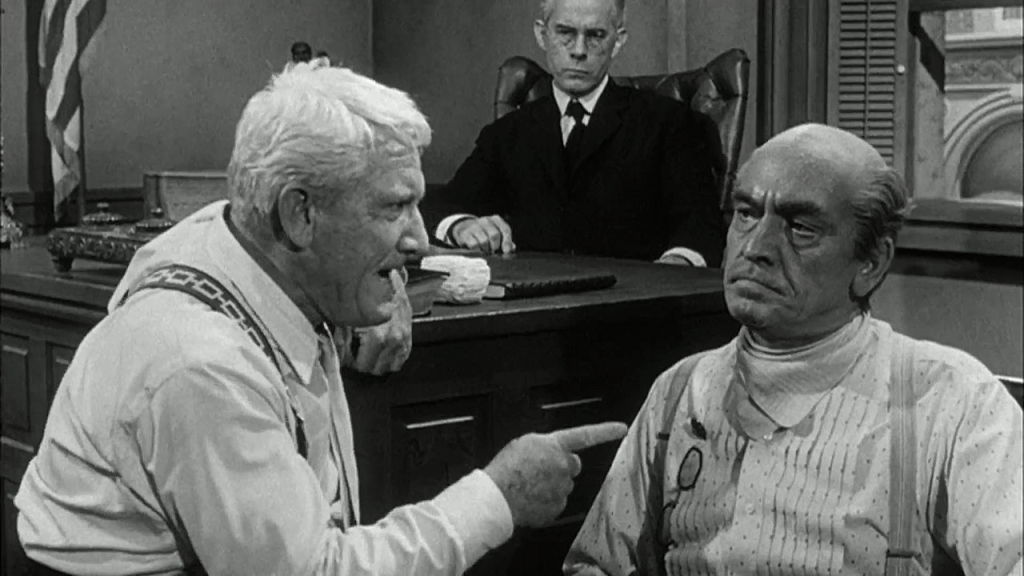
If, when you hear the phrase “Scopes Monkey Trial” you picture a principled teacher heroically smuggling copies of The Origin of Species into his Bible Belt classroom and then put on trial in a climactic battle of science and reason pitted against medieval superstition…yeah, you fell for it.
The trial was, in actuality, a cynical publicity stunt by the town of Dayton to get some national attention. Scopes may not even have taught evolution in his class, and if he did it was from a state sanctioned text book (which, as well as a brief description on evolution also instructed students on the importance of eugenics, racial hygiene and why Caucasians are just the tops). It was all rather sordid, is what I’m saying.
But that doesn’t make a good story. People need their stories. Their myths. Their simple parables.
Probably some irony there that I just can’t see.
And so, this is history now. The Earth has been made flat.
And look, it’s certainly not the worst film in its genre. It’s obnoxious, simplistic pap but it’s not like it’s hateful or malicious.
But ultimately, I didn’t review Inherit the Wind because, frankly, this movie terrifies me. It’s the ultimate expression of the awesome power of its genre. The ability to not just distort history, or mis-teach it, but to flat-out replace it.
We have seen, we see and we will see what happens when we start to think history is just a tool for our side to beat their side. History is the foundation of the present. If it fragments, it all comes down.
Inherit the Wind takes its title from Proverbs 11:29.
A better verse for this movie, a better verse for anyone who seeks to impart history through the medium of film might be James 3:1:
Not many of you should become teachers, my brothers,
For you know that we who teach will be judged with greater strictness.
NEXT UPDATE: 30 November 2023
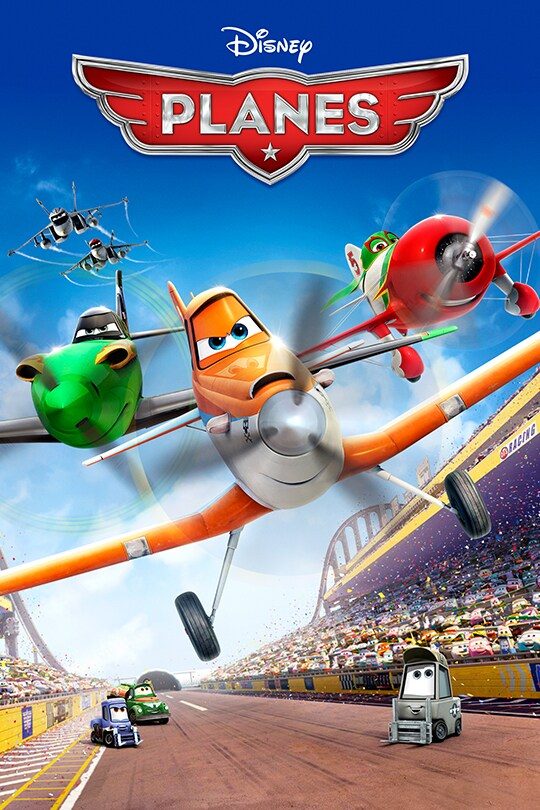
NEXT TIME: You know, there was a time when this seemed like the worst movie I could possibly review. How innocent I was, once.
 unshavedmouse
I really liked this review, Mouse. Thank you for writing it. And I wish you endurance for planes.
Movies and images seem to have a strong persuasive quality. I form the images myself in my head when reading words and so partake in creating the reality. And I am aware I read to someone’s voice saying all that. That may make it easier to realize this all, in the end, is still someone’s perspective.
But a movie? Especially sitting secluded in the seats in the darkness where the only thing existing is this sequence of images? If I am not critical, or know nothing about the movie’s subject, why, the images may just simply stream over my mind and settle there, certainly without doing research afterwards.
Images, especially of shocking events, are strong in provoking emotion. With words, I think, there is some distance still. It is still somewhat ‘there’. With the image, it is ‘here’. It must be, I saw it with my own eyes, after all. And if you can’t trust your own eyes…
It doesn’t discredit the medium. Images have an use and sometimes emotion *should* be provoked. But there is a limit to that use and it should be considered with caution, as you do with the historical genre. Because there is power there.
To be honest, I like to write historical fiction (aNd PuBlIsH iT oN wAtTpAd because I am not an professional writer yet) because I want to make people familiar with certain figures and events that not many people know (or don’t get Hollywood movies or are told every single time in the same vein).
That’s how I view history: as an interesting medium you can teach people, instead of just reminding them something they already know.
The word Based in “Based on a true story” can do a lot of heavy lifting .Michael Collins is a good film , but yeah a lot of liberties are taken to make it a cohesive story, I know for example that Stephen Rea’s character is basically about three or four real people combined into one person . I’d left school when Michael Collins came out , but I remember watching a videoed copy of an RTE/BBC drama in history about the Anglo Irish treaty of the 20s (called The Treaty) , Brendan Gleason played Mick Collins in it , and did a better job I think than Neason . Also Gleason was in Jordan’s Collins as well (as there was only so many serious actors working in Ireland in the 90s )in a minor role.
Oh and since Planes came out during my kids “lets watch the same film over and over again” phase , and I had to watch it , a lot I can tell you a useless fact :Theres one Irish plane , called Little King in the movie (for some reason in my head I’d thought it actually had Ri Beag stenciled on the side as well), which has precisely one line in the movie (I think he gives a plane part to the protagonist?) which is in a ..well spirited ,attempt at an Irish accent. After about the 10th viewing though I used to watch out for him , as it meant the movie was mostly over . Accent never got any better though.
I’ll keep my eyes peeled
That the most excellent Brendan Gleason did a splendid job as Michael Collins* surprises me not at all: what always amuses me is that, somewhat later in his career, he went on to play Winston S. Churchill (Which I think we can all agree is almost as perverse as going from playing Count Dracula to playing Van Helsing or vice versa).
*Here I would have made a joke about Mr Collins being the most notorious former employee of the Post Office, except that I have only just learned he was, in fact, an employee of the Post Office BANK – so the warning signs were there all along, as it were, since we EXPECT bankers to be successful criminals.
I appreciate the passion you put forward in this non-review, Mouse. At the same time, I’m sorry you decided not to review the film. As it happens, it’s one of my favorites and I was looking forward to reading your point of view, particularly on the individual performances. It’s always a treat when you take on classic cinema here. Your NIGHT OF THE HUNTER review was excellent!
Your concern about mistaking fiction for fact is well-taken, but if it helps at all, neither I nor anyone in my personal circle confused the film with actual history.
I hope you’ll favor us with another classic review (an actual review, that is) again soon. Best wishes!
Very well said.
I kind of dread any film that’s about real events, just because I’m so susceptible to Good Art and I know it, so I don’t always trust myself to question this stuff sufficiently. Lately I prefer films set in real places and times, with real events occuring in the background, but the story isn’t really about them. That way it’s easier to tell myself “This isn’t true, but maybe I’ll learn something cool to look up later.”
Interesting that you decided to make a post based on this movie instead of about the movie.
As for me, I thought this movie, in addition to retelling the events in a cinematic way, was focused on showing how religion can be used as a tool for control. Bringing people to attack, hurt and condemn others in the name of their God. Like when the Reverand is asking God to smite and/or damn anyone who sides with the teacher, including his own daughter.
Which is especially relevant over here, where a certain political party is trying to turn my country into a Christian theocracy.
This was a fantastic essay. I probably appreciated it more than if you had reviewed Inherit the Wind.
I think it’s very easy for people to say “I saw X and I didn’t think it was real history” and that’s fair enough. Not everyone is the man in the, possibly apocryphal, story of the mutineer, who upon seeing Battleship Potemkin for the first time said “that was me under the tarp.” There was no tarp in real life.
However, all of us have loads of ideas floating around in our minds that we can’t say how they got there. The kind of thing you preface with “I can’t remember where I heard this, but…”. A lot of them come from, or are dreamed up based on the influence of, the stories that float around us in our culture, and movies are one medium for those.
Does that mean all historical fiction, or fiction in general, is bad? Of course not. Does it mean that writers should constantly be sweating every thing they write lest it give someone the wrong idea? Of course not. Do I have a point? I don’t know. Shit’s hard.
I think your opinion on historical films depends on what you think the purpose of history is. When I was teenager I was very much a ‘fun fact historian’ (really, I was a ‘fun fact scientist’, but that isn’t relevant for now). I had an endless supply of historical trivia and anecdotes. Did you know Chinese Emperors had as many as several dozen wives in a complex hierarchy? Did you know Taft was so fat that he once got stuck in bathtub? Did you know that german homosexuals in the concentration camps when they were liberated were then sent to prison, because being homosexual was a crime?
It’s a great way to fill space in a conversation while appearing smart or knowledgeable. That’s pretty much just how history works, right? You know about stuff that happened and the more stuff you know the better historian you are? That’s how history is thought. Here is a list of things that happened and the people who did them. Memorize them and you’ll get a good grade. Well, I guess a historian job is to make the list bigger? It’s pretty much what I thought when I was in highschool. I loved history. After all, I loved trivia. I was good at trivia. History is basically just trivia. The whole class was just easy As (not American, we didn’t actually do letter grades).
Historical films are kinda like that. They can basically work as an extended historical anecdote. Sure, they aren’t entirely accurate, but why does that matter? Fun facts and anecdotes aren’t a matter of scientific rigor. You can modify a story to be more entertaining. Hell, it’s not like the history books weren’t wrong or misleading. Clearly, accuracy isn’t the point of history.
Well, I guess the point of history is to be a sort of social tool. Maybe that’s why they teach it in school? So everyone has this shared collective pool of stories we can swap?
I think it’s pretty obvious where I’m going with this. I’m not saying history *is* folklore. I’m saying that the history as it’s thought in mandatory schooling is (artificial) folklore. A lot of stuff that I learned in science classes weren’t really science. History was probably the hardest hit subject, but a lot of stuff that you get thought at that level are “lies for children”. Like the Rutherford model. It was disproven less than a decade after it’s invention, a century ago. Yet, I don’t know a non-Uni physics class that doesn’t teach it. It’s just so convenient. It’s simple, easy to visualize and easy to explain.
Hey, remember when I said my past as a ‘fun fact scientist’ isn’t relevant now, five paragraphs ago? Guess what, it’s now! It’s me, the Trivia guy! I have lots of Science trivia. About animals, plants, rocks, astronomical phenomena and more. I was quite educated if I might say so… and I can. I have an overinflated sense of my intelligence.
That paragraph got away from me. I’ll try to be more serious and straight forward. Science isn’t trivia. It’s not anecdotes. It’s about the whys and hows. How things work? Why are they like that? The thing about science… it’s hard. A real shocker, right? Stuff works in complicated, unintuitive ways on scales far too large or too small for humans to easily grasp and it’s all interconnected across different scales and between different elements on the same scale.
It’s really fucking inconvenient to teach to kids. To adults as well, but we didn’t make a society in which it’s mandatory to teach to adults. First through Twelfth grade got saddled with an impossible task. So, it found a work around. Sure, we have to teach these kids and then test them to prove they know stuff, but nobody said anything about having to /understand/ it. I’m personifying the education system here and doing some truly epic levels of generalization to make my point.
Mandatory education does teach important, foundational things. I’m not trying to claim the system is a waste of time and we should all go back to the farm. However, it weaves and dodges around ‘understanding’ like it’s an Olympic event. Facts are easy. Memorizing the Periodic table is way easier then understanding why it looks like that. More importantly it’s way easier to teach the names and atomic weights of the elements than the weird shit that defines atoms and *most* importantly it’s a hell of a lot easier to test for that.
There’s a hundred variations of jokes about how highschool students forget everything they have learned about a subject the moment they step out of the school grounds. I don’t think they forget it, I think they didn’t know it in the first place. They knew how to answer the questions on the test. That’s something different from actually learning physics or chemistry, or history.
And yet we’re more knowledgeable then we’ve ever been. We have microwaves. And satellites, nuclear power plants, a library of knowledge so impossibly large that it broke the very concept, infrastructure so vast that it reshaped the planet. But really the microwaves are the most important part.
I want to do a thought experiment. I don’t generally like them, but please let this one take up a bit of you brain space for a moment. Imagine you pluck some random person from history. The time and place don’t particularly matter, but he does need to be be decently well educated for our purposes. Let’s go with a 16th century Chinese bureaucrat. We’re going to need someone from the present as well. Someone who went through the full course of mandatory education, but no further and wasn’t particularly interested in self study. Oh, hey! There he’s is. A Chinese shop clerk. He even speak Mandarin Chinese! I admit, I /was/ worried about the language barrier for a moment. Now, lets put them in a room… with a microwave. Our modern compatriots job is explain how it works.
“So, um… it uses microwaves to heat things.” The shop clerk (let’s call him Zan Hao) turns on the microwave. There’s a glass of water inside.
“I don’t see anything. The glass is spinning. Is the spinning a “microwaves”?” Our 500 year old (chronologically) bureaucrat asks. Henceforth referred to as Zhou Fang. Because it’s his name.
“No. Microwaves are invisible. Uh… they’re radiation.” (Zan Hao is doing pretty well so far. Don’t you think?)
“I haven’t heard of “radiation”, but I know little of magic.”
“It’s not magic. It’s science. The microwaves heat up the atoms.”
“Ah, I understand now. It is alchemy. I have heard of the Greek philosophers who wrote of atoms. The smallest possible part of a thing. This device uses an alchemical array to warm the cup by changing the substance of the ‘atoms’ to ones that are warmer. I didn’t know you could do such a thing! My colleagues who are more knowledgeable in alchemy would love to study such a device. But what powers the transformation? What is the source of “microwaves”?” Zhou Fang questions enthusiastically.
“It’s powered by electricity” Zan Hao point at the cable. “The microwave turns it into microwaves and the microwaves heat up the things inside. It’s not alchemy. It’s physics… and um… technology.” (Is it only me or is Zan Hao getting a little flustered?)
“But my boy, what is alchemy if not science? And this device is powered by lightning? Than there must be a Yin element inside for lightning is as heavily charged with Yang as thing can be and Yang flows to Yin. It makes sense it heats things. Fire is also Yang natured.” (Zhou Fang is really getting in the swing of things! I don’t think it will be too long before he figures this alchemical process.)
Now, I think I’ve made my point (in the most inefficient way possible). We live in a educated society. We are educated. We have proof in the form of ‘fun facts’, and ‘Did you know’s. The science anecdotes work as a sort of shibboleth. Once the pencil is down and all the test are finished , what are you going to do with the more than a decade of random facts you’ve accumulated, except to use as you have always used them. Proof that you’re educated and intelligent.
Drifting back to original subject, (I know. It’s been so long. You thought I had forgotten) historical films aren’t history. They’re stories. People go watch a film about WWII. They have fun. A few months later while they are on their lunch break they say “Hey, did you know the Panzer II could be used for air defense?”. They aren’t really spreading fake history. The stories we tell about the past aren’t history. History is a science. It’s the study of what happened, sure, but more importantly it’s the study why it happened. How those societies worked and what shaped them.
The Birth of a Nation was an evil piece of shit, but the harm it did wasn’t caused by teaching fake history. No historians saw the film and went “Well, maybe I should rethink the last fifty years”. The time period the film was set in was vestigial to it’s message. It had a story to tell and there were a lot of people who were very receptive to that story. It did what art does and brought them together.
Spreading toxic or evil narratives isn’t exclusive to media which claims historical accuracy. Jack Bauer has killed people. In real life. Soldiers have done actual war crimes and quoted 24 as a justification. Shows like House MD have made people more reluctant to seek medical attention when they needed it. The stories we tell about the present are no less harmful then those we tell about the past.
P.S. I’m a crazy person. Why didn’t anyone stop me? Why I’m allowed to post a rambling multipage essay on epistemology and sociology in the comments of a movie blog? I got carried away and I got in too deep. By the time I realized what had done I couldn’t bring myself to delete this monstrosity. I want to apologize to anyone who was unfortunate enough to read this.
P.S.S. Words bracketed by / are supposed to be italicized.
Words bracketed by * are supposed to be bold.
Sorry, I don’t know how to do formating on WordPress. I know nobody cares.
Once you get done with Planes, I can’t wait to see your take on Wish.
I look at it this way:
A historical movie needs to be more authentic than historically accurate.
Take Waterloo (1970) or Lawrence of Arabia (1962), certain events in waterloo are rushed for time and there are some historical inaccuracies in lawrence of arabia (T.E Lawrence knew about the Sykes-Picot agreement very well unlike in the movie), but those movies feel AUTHENTIC, as if they brought Napoleon and Lawrence back to life.
Even great movies like Titanic (more of a disaster movie than a historical one because James Cameron) get it wrong. Bruce Ismay was nowhere near the bad guy that he was shown in the movie. Poor officer Murdoch’s character was frankly assassinated in the movie; he didn’t kill anyone and was probably the last ship officer on board still helping when Titanic sunk.
But I’d be damned if the ship and her sinking didn’t feel REAL. The way the iron hull groans and the metal bends under the sheer weight of the Atlantic ocean always sends chills down my spine whenever I watch it. Even Jack’s and Rose’s romance, shows how different Edwardian society was with the class divide and it is of course, great drama.
The cavalry charge in Waterloo felt as if we time travelled back to 1815, the way Lawrence of Arabia recreates parts of T.E Lawrence’s book, like the charge at Aqaba or the ‘no prisoners’ scene felt thrilling, horrifying and REAL in every sense.
So, a little backstory.
From the third grade all the way to graduating high school I attended a distinctly Baptist private school (think Protestant but with the unifying theme of “Everyone’s going to hell except us”). Morally, spiritually, and yes, politically conservative in every way, it’s fair to say that I stood out quite a bit and had to hide more than a few things in order to not get ostracized more than I already was.
One day I see that one of the Bible teachers had played this film for his class. I had already seen it and was a fan (I’d learn about the more nuance happenings of real life later), so partly to gush and mostly to get a few digs in, I struck up a conversation with the teacher. I expressed how much I liked the film, he nodded, I told him it was a fascinating historical film, he agreed. And then as innocently as I could, I said to him, “It’s scary to think of Christians behaving like that.”
The look that briefly crossed his face is something I’ll never forget. In that split second he had a moment of looking at his life from the outside, how there more extreme religious outlook looks like to the everyday people. In that moment it looked like he realized that he and his students were not the martyrs bravely fighting against the overwhelming humanist wave threatening to encroach them. He was teaching his students to sing “John Brown’s Body” and harass those that don’t align with their own. I don’t know where his own spiritual journey has taken him, but I hope that like the rest of us, he’s a better man than he was yesterday.
I love this film; no it’s not historically accurate, it’s historically relevant. When the play was first performed in 1955 it was a brutal takedown of McCarthyism. When the film was made it focused on the religious extremism that has unfortunately popped up again and again. We see good people like Matthew Harrison Brady get caught up in this in the vain hope of one last case of relevancy, we see neighbor turn on neighbor, parent turned on children in this hysteria. And for all it’s inaccuracies I can’t hate this film because its message still remains relevant. There is no passing a purity test, the only way to succeed is to direct judgment, ire, and hatred towards someone else.
I’ve lived through two “God’s Warriors” time periods, once during the Bush Administration and another through the Trump Administration. Chances we’ll see even more before the end. And when I think of that, I just get so tired. Tired that we’ve learned nothing, that Hornbeck’s “worm’s-eye view of history” is more accurate than I want to admit. That we’ve inherited the wind and instead of reflecting on that, we’re just fighting over breezes.
Say, Mouse, are you going to do a post review of Disney’s recent 100th Anniversary short Once Upon a Studio? I’m just saying, that by the the time you get to do Wish, this might well serve you as a nice little introductory post to your devoted readers (like me).
“The British troops claim they came under fire, the Irish civilians in the crowd claim that the soldiers opened fire without provocation (this happens a lot in Irish history. And Indian history. And African history. I wonder what the common denominator is).“
Well for one thing it tells us that people prefer their villains to have British accents (Speaking of which, THE MARVELS was quite a lot of fun – saw it on a whim and had not a single regret afterwards).
On a less glum note, the more I learn about Conspiracy Theories attaching to the Kennedy Assassination the more I suspect the only real conspiracy would be the Secret Service (and other US security agencies) doing their damnedest to obscure the fact that the late President Kennedy was the FOURTH US President to be assassinated in a single century – Lincoln, James Garfield, William McKinley, JFK – and that only one of those assassinations was the work of an organised conspiracy.
No matter what Oliver Stone may tell you, the most successful assassins are always the lone gunmen, at least when it comes to gunning down US Presidents (Heck, less than twenty years after Kennedy Ronald Reagan nearly became another footnote in Presidential histories through the work of a lone gunman).
Meanwhile, the last (and only) British PM to be assassinated was Spencer Perceval, back in AD 1812 – which is quite impressive, when you consider how acutely disliked Great Britain has been over the years.
Well, Wish is out, critical response has been, say it with me, MIXED, so…We shall see…
*checks reviews* Oh shit. Damn, the really needed a win too.
Yeah, it’s annoying. Don’t let it bias your take though. Hey, wouldn’t be the first time you’ve gone against consensus. And, for what it’s worth, audiences seem receptive.
If anything, that’ll work to its benefit. I was waaay too nice to Chicken Little.
Unshaved Mouse reviewing Planes? Has Hell frozen over?
Hell is a more temperate location. This is Hell’s Kitchen.
are we not men? we are devo
I know it’s late and the year is already gone, but I just couldn’t let this one pass without comment, especially given that I recently finished re-watching this movie at the library after first watching it off TCM as a teenager.
Because… I have to say, you really are missing the point if you think this film, and others like it, are attempts to teach literal history. They aren’t. And yet you come so close to reaching it at the beginning of your review when you hit on the fact that every map of the world is false because the world is not flat. And yet many people supposedly believed the world was flat, at some point. There are somehow people to this day who will try to argue this. Some people believe now that “every word of the Bible is true” exactly as written, despite the simple impossibility of this.
In real life William Jennings Bryan was actually a more rational Christian who believed in the argument Tracy’s character makes in the film, that the days in the Bible do not correspond to our current 24-hour days, but were actually much longer periods of time. If so, this could account, possibly, for the many years of evolution necessary for both views to co-exist.
What’s important to note is that both views DO have a place. People will always believe things that are flat-out wrong, that the world is flat and that creationism and literal interpretation of a book with multiple authors that has been translated multiple times from dead languages is necessary.
But even these beliefs have some basis in truth, and are worth learning from, because they all reflect the one quality that truly sets man apart from other animals: his eternal search for truth and meaning in the world around him. Even an ape would never have the concept of the world being flat or indeed that there is a larger world beyond its immediate environment or that this world exists in outer space.
Even the educated people who knew the Earth was round, of which Columbus was just one of many, were very ignorant in hindsight, in terms of how small they believed the Earth to actually be. Even evolutionists have had much more to explain and discover since the days of Darwin. But both views are valuable, because both reflect the search for truth.
Inherit the Wind does not depict the literal truth of the Scopes Monkey Trial, but it did depict a truth that was more powerful and more important than conveying exactly what was going on in that one period of history, it conveyed what was going on at the time. The reality of McCarthyism is that free thought was being stifled. In the name of progress, man will stifle any attempt to think differently because we all believe that our way of thinking is the one that is correct. The way that another does things is wrong, and any new ideas must be greeted with fear.
There was nothing fabricated about this, the idea that lies at the heart of Inherit the Wind, not in the original play, not in the screenplay, and not in Spencer Tracy’s unrestrained tour de force acting. This is a truth that will always be, as long as man exists, for his fundamental natures will remain the same.
There’s a reason why the movie ends with Henry Drummond casting aside the cynicism of Hornbeck and clapping both the Bible and The Origin of Species together as he walks off. Both views have their place, and both views need to be taught. Because even if one view was profoundly wrong, we must still remember that man was wrong, for we are still man, and may still be wrong, about many things, in the many centuries that are still left to man. And we must not hide from this fact, and we must not forget it.
Or else, if we do not learn this lesson, we shall only inherit the wind.