You have probably never heard of Theodore Kaufman, an obscure American self-published author who wrote in the 1940s. Hell, even if you’d been living in America in the 1940s you almost certainly would never have heard of him. However, if you were a German living in the Third Reich during the war you would absolutely have known who he was, and would have believed him to be one of the most dangerous men alive.
In 1941 Kaufman self-published Germany Must Perish!, a bright little volume about how Germans are pure evil, just bad on the genetic level, and that the only way to ensure the peace of the world was to sterilise the entire nation and let them die out. Now, you might (I really hope you wouldn’t, but you might) argue that race-based genocide is fine if the other guy started it first, but that’s because you forgot about Goebbels.

Goebbels milked Kaufman’s little pamphlet for everything it was worth, using it to turbocharge Germany’s propaganda machine and convince ordinary Germans, even those who hated the regime, that the war was a literal battle for their survival as a people. Goebbels presented Kaufman as FDR’s Svengali, the intellectual driving force behind America’s war against Germany. When, in reality, he was the forties equivalent of the least unhinged political Tiktoker. Germany Must Perish! was such a gift to Goebbels that the American journalist Howard Smith remarked:
“No man has ever done so irresponsible a disservice to the cause his nation is fighting and suffering for than Nathan Kaufman.”
Which is why, even at the risk of friendly fire, it is so important to call out people on your own side of the aisle who are saying evil, crazy shit. Not just because it’s evil and crazy (though that should be enough reason) but because it’s tactically vital.
We can dismiss Kaufmann’s thesis out of hand, just as any racially essentialist argument should be dismissed out of hand, but that still leaves the questions:
Why Germany? Could it have happened anywhere and Germany just drew the short straw? Or was there something particular about Germany that made its local manifestation of fascism so uniquely malevolent? And if so, how much blame do ordinary Germans bear for the actions of the regime?
My, this is a fun one, isn’t it?
It’s not something that can ever be objectively proved. I’ll keep my own answers until the end of the review but they’re just, like everything else on this blog, my own opinion. Today’s movie grapples with those very questions. And it begins within a man arriving in the ruins of Nuremberg, as the ashes of the last war still cool, and a cold wind has begun to blow in from the East…
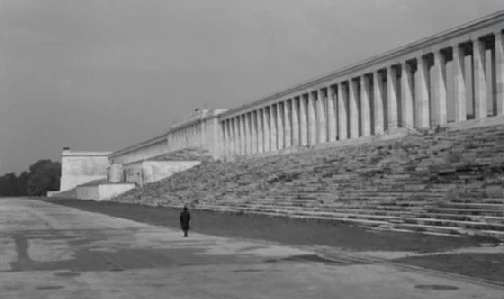
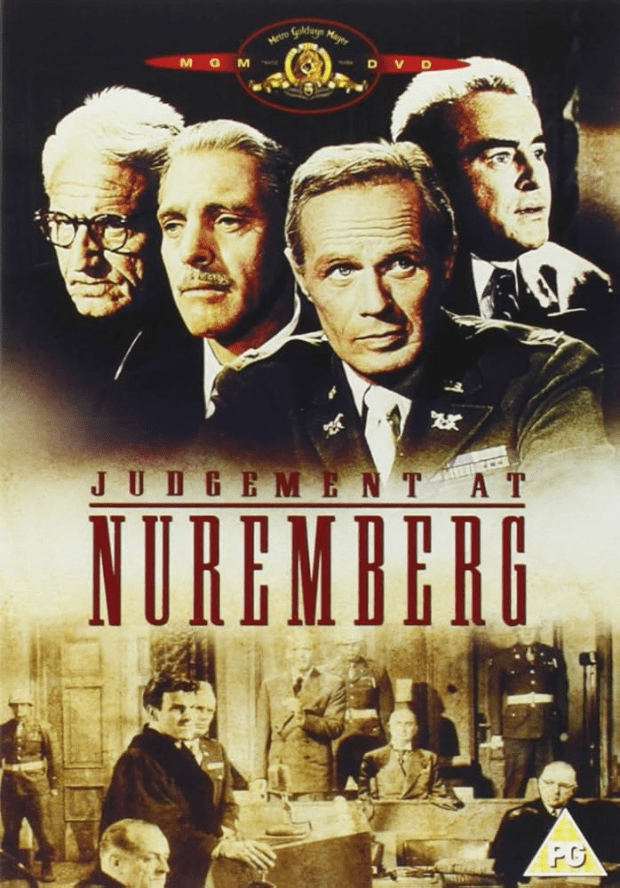
Judge Dan Haywood (Spencer Tracey) has been summoned to Nuremberg to serve on a military tribunal trying four German judges and prosecutors for their alleged crimes during the Nazi era. These four men are Emil Hahn, Werner Lampe, Friedrich Hofstetter and Ernst Janning (played by Burt Lancaster). Now you might be, as I was, under the impression that this movie is a dramatization of the famous International Military Tribunal held by the US, UK, France and the USSR between 1945 and 1946 where the top surviving Nazi and military leaders were tried. But, it’s actually a fictionalised version of the Judge’s Trial of 1947. This is a major theme of the movie. It’s been two years since the war ended, all of the really big-ticket Nazis (at least those who aren’t dead or in hiding) have been tried, jailed or hanged and now all that’s left is the relatively little fish. And the question hanging over everything is: what’s the point of all this? How far down the food chain are we willing to go in a country where everyone, essentially, could be argued to bear some responsibility? Public opinion in America has largely forgotten that the trials are even still going on and it really would be nice to have the Germans on our side when the USSR starts knocking on the door. So, again, what is the point of all this? Even Haywood himself is proof that enthusiasm for the whole enterprise is starting to wane. Back in America he’s not even a judge anymore, having lost election and as he tells his aide Byers (played by an impossibly young, impossibly charming William Shatner) he wasn’t the first choice for this job or even the tenth. He’s just the one who was willing to schlep all the way to Germany.
One man who isn’t ready to pack it all in is the prosecutor Colonel Tad Lawson, one of the soldiers who liberated Dachau and who is determined to see every last Nazi brought to justice for what he saw. On the opposite side is German lawyer Hans Rolfe who is defending all four of the accused. Rolfe is played by Maximillian Schell, who originated the part when it was televised as a play in 1959. Schell was one of the few actors to be retained from the original cast and you can absolutely see why, and why Schell got the Oscar for this performance.
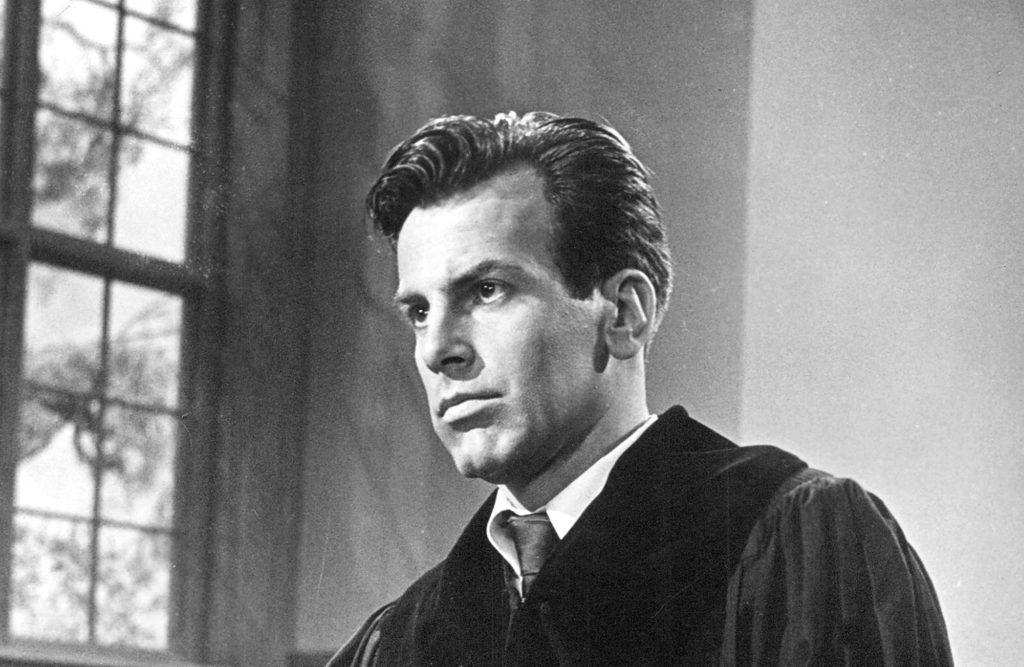
Rolfe is the most interesting character in the story. A young, idealistic German who is appalled by the atrocities of the Nazis but despises what he sees as the hypocrisy of the Allies presenting the the Germans as uniquely wicked while glossing over their own atrocities, failings and collaboration with Hitler prior to the war. Rolfe idolises Janning, and hopes, no, needs to prove that Janning was a good man doing the best he could in an impossible situation. As Rolf says him himself, it is not simply Janning on trial but all of Germany.
But this desire to exonerate his nation leads Rolfe down an extremely dark path, as his cross-examination of the prosecution’s witnesses leads him to commit the same sins as the Nazi jurists who preceded him. He argues that a man sterilised for his political beliefs was actually sterilised for being mentally deficient (because that’s better?). He does occasionally land a palpable hit, when reading a tract calling for sterilisation of undesirables to ensure genetic health of the population, he notes wryly that it came not from the Third Reich but from the State of Virginia.
He crosses a terrible rubicon when the prosecution calls Irene Hoffman to the stand. Hoffman is wonderfully played by Judy Garland, in her first film following A Star is Born seven years previously, during which time she’d suffered immense, health, emotional and professional difficulties.

This role won her a second, and final Oscar nomination and it was well deserved.
As a teenager, Hoffman’s elderly neighbour, a Jew, was falsely accused of having raped her and was tried in Janning’s court. In a desperate attempt to prove that Hoffman was in fact raped and that Janning’s sentence was justified, Rolfe re-traumatises Hoffman, trying to force her to recant her testimony and accuse her neighbour, just as the Nazis did.
Finally, Janning is so disgusted by Rolfe’s actions that he addresses the court, and fully admits his culpability.
Lawson closes his case by showing the court actual, real-world footage of the scale of death and suffering in the death camps. I will not describe them.
As the three judges deliberate, the US military subtly pressures them for leniency as the Soviets have begun to roll down the iron curtain and the top brass want to start focusing on the next war rather than to continue litigating the last one.
But Haywood stands firm. All four defendants are sentenced to life in prison. After the trial, Rolfe visits Haywood and makes a prediction; not one of the defendants sentenced today will serve more than five years. Haywood sombrely agrees that that may be the logical choice, but not the right one.
Before leaving Germany, Haywood visits Janning in prison. Janning tells him that he has his respect but begs him to believe that he never knew what following the Nazis would lead to.
Haywood replies that he should have know the first time he sentenced an innocent man to death.
***
So. What do we think?
You have your own thoughts, I’m sure. Personally…I think the average German’s culpability is fairly low.
They didn’t know? I mean, sure, I don’t think it stretches credulity that a 65 year old hausfrau in Bremen wasn’t getting top level briefings on the inner workings of The Final Solution. I think very few people in the civilian population who knew the full scale of what was going on.
Ah but, they knew enough!
Sure. Enough to do what? Those quick to remind us that this was a regime that did not punish a single person for failing to shoot a jew should also remember that it was also a regime that guillotined a 21 year old woman over a leaflet. It is, perhaps, a touch disingenuous to suggest that resistance carried no risk.
Ah but they elected Hitler, didn’t they? No. He never won a majority of support in a free and fair election. And those that voted for him, well, how could they know how bad he would be? It wasn’t as if he had previously been elected, shown his true colours and then been voted back in with even greater support.
They supported him, though? Sure. After some stunning foreign policy victories and years of relentless, mind-numbing propaganda. Good thing propaganda doesn’t work on us.
But I don’t think it’s true either that Hitler could have happened anywhere. I don’t blame ordinary Germans for Hitler. But I do blame Germany.
Hitler was no great original thinker. Hitler was a sponge. There was nothing new about Hitler, nothing that was not already thick on the ground in the Germany of his youth. Eugenics, German nationalism, Scientific Racism, Misogyny, Anti-Semitism, Anti-Clericalism, the utter abhorrence of the Christian concept of morality, Houston Chamberlain, Nietzsche, Rosenberg, Wagner, deGobineau, he hoovered them up and filtered them through an obsessive resentment that could crush coal into diamond. But there was nothing new there.
He was a man utterly of his time and place.
He was Germany.
He was the country that made him. They always are.
Next Update: Man, if I had two cents for every time a review of a black and white courtroom drama starring Spencer Tracy turned into a long discursive historical essay, I’d have four cents. Not many, but it’s weird it happened twice. Anyway, I’m going to be spending Lent trying to make some progress on my next novel so I’ll meet you back here April 20th 2025
NEXT TIME: So in the sequel does Maui say “when you use a bird to write it’s called “x”ing?”
 unshavedmouse
I feel like I’m going to be spending the next few years, and I pray it’s only that long, apologizing profusely for my country and its leaders.
I spend a lot of each morning subjecting my mental health to the acid bath that is doomscrolling, looking for the little crumbs of good news. There are some. They keep losing court cases, including a Supreme Court one just today. His approval rating is plummeting at record rate. Other nations seem to have him figured out as a bully and coward who backs off sniffling at the first real sign of resistance. Also he’s an old, fat, drug user who’s clearly in terrible health and all of his heirs apparent have the charisma of jock itch and likely won’t inherit his cultish devotion.
But I’m no Pollyanna, people will be harmed. People are being harmed. People have been harmed. This isn’t okay, and it won’t be, maybe for a good long while.
And for that I am truly sorry.
As a fellow American, I am also sorry. I am doing what I can, donating money to political campaigns that I hope will reduce the felon’s power and being a ray of light for everyone who needs it, but I know it will take more than one person to actually enact change.
Time to hand out some leaflets before they can guillotine me for it.
Also…
Not to be that person…
But if you have two cents per Spencer Tracy courtroom drama, and you review two Spencer Tracy courtrooms dramas, then you don’t have two cents, you have four cents.
“You forgot about Goebbels, you utter chump.”
Oh, I certainly haven’t. Not when, I swear to God, we have what can only be described as his reincarnation worming his way through Washington in the form of Stephen Miller. Peddling some new but familiar bigotry in another country.
The sheer scale of death shown in the footage of the camps can’t be described but must never be forgotten. Nor the looks of of those who watch it in the scene. The disgust from some, the disinterest from others, the few who are trying their best to hold back tears. And the weariness from Lawson, who undoubtedly had to review that footage many times, go over the statistics many times all to make sure the memory of those atrocities are burned into the brains of the court.
And into ours as well.
I’m not going to lie, watching this film after reading a number of BERNIE GUNTHER novels makes for an interesting experience – it also left me firmly convinced that the film CIVIL WAR by Alex Garland badly needs a sequel to put all the cowboy violence in the film into proper context (because without some kind of historic context all this sound and fury signifies very little – we need context so we can fully understand the consequences of a US Civil War, on a human and a national level).
As it is, the film is mostly about a painful inhumanity on all sides.
On a lighter note, it amused me to see your remark about Young William Shatner, mostly because it made me reflect on the fact that it took them roughly fifty years to come up with an actor who could sell Christopher Pike the way Shatner sold James T. Kirk (No shame to Mr Bruce Greenwood or Mr Jeffrey Hunter, especially the former, but they’re no Anson Mount).
No wonder the man became an institution.
Dear Mouse, apropos of absolutely nothing I have been introduced by Tumblr to the fact that one Ibrahim Sedef (An agricultural engineer in Turkey), on learning that a bear had been raiding production facilities under his supervision, decided to make that bear part of a BLIND TASTE TEST.
Please, please look this up and confirm that sometimes life is a cartoon without the ink.
Again, definitely topical. Harrowing and and amazingly-acted piece. And you’re right, it’s good to note that for all his monstrous actions, Hitler was an inept product of his time and country who didn’t actually pedal anything new or unique. He was a sponge-y monster of Germany’s creation. Just like our current president is a monster of our own creation. Makes ya think, is all. Wish us the best for the next few years.
All this is to say, this is for sure a more interesting, enjoyable and thought-provoking movie to talk about than the one you’re taking on next. Best of luck as usual with your novel.
I do think claiming that the Nazis winning 35 to 43 percent of the vote in a parliamentary system with a dozen parties and leading the 2nd place party by over 10% of the vote doesn’t count as being elected is silly. But other than that, I’d agree with this take on German guilt.
This film appears on the American Film Institute (or AFI for short)’s* 10 Top 10, where it made it to the category Courtroom Drama, meaning that the AFI decided it was amongst the 10 best films in that category of the last century. And you should know that I am a sucker for courtroom dramas**, and even more so when it’s about such importantly historic moments as this. I’m certainly interested in seeing it, is what I’m saying.
*They’re the guys behind the Oscars, right?
**Oh yeah, I studied Law, don’cha know?
Part of what is so shocking about Nazism is that Germany up until that point was considered one of the most civilised cultured countries and the fear was, if one of the most civilised cultured countries in the world could do this, then there was no hope for anyone else. It didn’t make sense that they would degenerate to this. And I would argue that ordinary Germans and Austrians did absolutely, by 1943 realise where ‘the undesirables’ had gone. They knew that the disabled had been disposed of and they did realise where the regular packages of ‘new’ clothes, toys, trinkets and musical instruments came from. They knew it had been repurposed from Jews and everyone else who had been sent away. I have many thoughts on the matter, like how Sweden and Switzerland were not as neutral as they pretended to be (giving iron ore to the Nazis, sending men to the Russian front as mercenaries and insisting that the J was stamped on passports to make sure Jews were identified and the quota sent back to their deaths just for starters). Don’t even get me started on the gleeful collaboration in the Netherlands and Poland, no matter how many righteous among the nations are recorded (Poland passed a law somewhat recently that made it treason to suggest that many Polish did exactly that which is absolutely ridiculous). I’m not cutting any of them slack. All these people online these days saying that they would punch a Nazi and they would have hidden the persecuted back in those days, their words mean nothing. Not only are so many people enabling some of the worst antisemitism since the holocaust right now, the righteous among the nations numbers less than 29,000 people to date. You can imagine how absolutely tiny this percentage is in Europe. It’s a scant amount of people. After everything that’s happened in the last year a half, I trust no one.
Uh, Mouse, is the reason that you’re not replying currently to comments being that you’re too busy writing for the now?
More too busy with life that includes some writing. What’s in your mind?
Oh, just this
!!
`´
(that’s supposed to be an arrow pointing downward, sorry)
And lastly, I’d like you to watch and review the entire Pokemon animated series.
I mean, yes, it IS a silly gimmick and it COULD be better in parts in regards to payoffs and interesting concepts and it is NOT particularly known for taking big risks, but I can also tell you that if you watch it all the way to the end, you will find yourself most glad to have been a part of the adventure(s) with Our Protagonist and will be satisfied with all the experiences you had with him and perhaps will pronounce yourself as it being good to have known him.
Even though I’ll also ask you to stick only to the original Japanese version for I think that’s the only way to truly experience the series as it should be, this time I’ll ask you to use the English terms for whatever and whoever you see on the screen (at least for the names of the characters and Pokemon) for I have come to be sure that the English language is the lingua franca of the world-wide Pokemon community, and, since I’m sure the larger part of your audience uses the English terms, it would help us all to understand what’s what*1. If you don’t know what to call a character or a Pokemon in English, just look it up. I think TvTropes may help much with that. Even so, pretty much everything I’m going to tell you is going to be based solely on the original Japanese.
Although I call it a series, making it seem like it’s a singular piece of work, the truth is more complex than that, for you see, it would be more accurate to call it several series that make up one single overarching story of a single pair of protagonists, albeit one which increasingly ignores what happened previously in continuity after around the third series. But you just never mind about that: do like me and accept that as the number of episodes increases the less willing the writers are going to be to either look through it all or look through any of it at all: they’re just human and as I said, these series would be much better appreciated as their own entities apart*2.
Though you’ll certainly already know this, the series is an adaptation of a series of very popular Nintendo videogames (and not the only one for that matter, but this particular one is THE adaptation as far as most people are concerned*3) and it’s about a boy whose name in the original Japanese is Satoshi but who is better known in the rest of the world as Ash: for this message I have decided to preferably refer to him just as Our Protagonist. He is a boy who travels the world catching fantastic creatures called Pokemon and then using them to battle other Pokemon (and for those with ethical concerns, it IS clarified down the line that the Pokemon do battle of their own free will and that it benefits them and that they do love their humans) in order to become the best in the craft. He is accompanied by several different companions, often with goals of their own and which can even be not all that different from Our Protagonist’s.*4
Also, especially for this series I’m going to ask you to apply a special ranking system for each series, to be given when you are done with each and which is to go like this:
Animation: ?/10: Same criteria as that which applies to your other animated reviews. I mean, yes, I know this is going to be TV show-budget, so obviously we can’t expect all that much by itself, and that’s indeed what happens at the first, back when everyone thought it would be a silly passing fad. But in time, you will see the animation quality improve by leaps and bounds in the later series, thus making the Pokemon experience all that much more pleasant to watch. Also, this category is to be used as well for you to give your opinions on the character’s and Pokemon’s design as well as (possibly) the choreographies.
Adaptation: ?/10: Alright, this one’s a bit of a mean category, considering these series are not particularly known for following the games they’re based on all that closely. Nevertheless, I am including this category in anyway, so you can see how this multimedia franchise does when translating games with a story (admittedly, the story in the very first generation of games was so slight to the point of virtual inexistence, which did give the show ample space to add anything else; after that, they continuously added and refined each next generation game’s story, thus giving you something more worthwhile to look at for your comparisons), as well as see how they did with adapting each games’ mechanics, gimmicks, characters, and overall worldbuilding into a televised serialized format. After all, for a long time, the Pokemon series were considered pretty much the sole succesful video-game adaptation there ever was, weren’t they?
Main Characters: Human: ?/10: The humans are indeed the main characters of the show, for after all it’s them who we follow. Nevertheless, I have come to think that their Pokemon’s also share the protagonism spot even if they have the junior status in the protagonism picture, so I have decided to split this category in order to more accurately portray the protagonists the way I see it.
Main Characters: Pokemon: ?/10: The poor Pokemon themselves who are part of the main cast do not generally have the same spotlight as their humans, with some particularly notable expections, which I think is a pity, for I have come to consider that they deserve as much insight-on-observation as the other half of the cast*5. I tell you this so you can focus on them from the start and judge them as their own section of the cast.
Main Characters: Overall: ?/10: This one summarizes the previous two categories into a single one that says what you thought of the protagonists all together.*6
Rivals: ?/10: For a show that is about honing your Pokemon skills, naturally it should be logical that there be people to prove yourself against, so without question, this should get it’s own category here, as it’s been also done in other sites. This category covers the rivals to either Our Protagonist and his companions*7 and how well they functioned in their roles. The same goes for their Pokemon teams, if they merit it.
Villains: ?/10: This one actually means “How does Team Rocket fare in this one (and how do other villains do as well)”, for indeed Team Rocket, or more accurately, the Team Rocket Trio (or Quartet if you will), are THE series’ villains for many, however silly and ineffectual they often are. Many people love them*8 so it will be just right that they get your deserved reviewing due per series. (This category also goes for what you thought of their Pokemon teams per series.) However, they are not the only bad guys in the show. Just for one, they are actually the members of a larger organization whose other members our heroes occasionally face, although their proliferance decreases considerably in the mid-late series. Furthermore, there are other villains in the series as well: Other evil organizations*9 and the occasional solitary criminals, sometimes one-off, sometimes reccurrent.
Other Characters: ?/10: And lastly, there are those characters (not all of them human) who are not bad guys or rivals and who are not part of the main cast but who still make constant appearances throughout the series, often to aid our protagonists or give them advice. This also covers one-off non-villain characters.
Music and Voice Acting: ?/10: Although there is music, I don’t think it’s enough to justify a full category here no matter how catchy it is. Thus I have decided to expand this category to include something that I think deserves to be a part of your ratings system: the craft of voice acting. As you and many others know, an important part of making an animated piece work is the character voices, so I think such a key component deserves it’s own space in the audial category.*10
Writing: ?/10: And finally, this last qualification is for those things related to storytelling things, meaning generally things like plot development, the quality of the dialogue, the general structure of the episodes, the humor, and overall, the schematics of each series as they turned out, whether they deserve to be considered masterpieces of this category or not good enough.
Now, on to the series themselves:
Each series has its own themes, characters, gimmicks, mechanics, and particular settings, thus making each indubitably distinct from the other, each covering (with few exceptions) a generation (or gen for short) of the games. Another important thing you have to know concerns the division of each series: You see, we don’t split each series the same way as the Japanese do. Whereas we divide them into seasons, as we do with any other show of ours, in the land they came from, they don’t bother with that, considering their animated series run continuously week-to-week*11; instead each series is regarded simply as a single piece of work (however long it may be), to be split into sub-series if the occasion requires it. When they were shipped overseas, the dub split them into seasons and gave each its own (remarkably unmemorable and undescriptive) name to help the viewers navigate through each series and better memorize them. Thus, it has to be admitted that certain purists claim these foreign divisions into seasons are purely artificial and not to be taken into serious consideration. However, I have to admit that the divisions into seasons are indeed placed in logical places that do indeed feel like season finales even if just sometimes, so I’m going to use both systems simultaneously, hopefully making things all that clearly to you. Also, just so you know, the series began in 1997, a bit over a year after the games themselves debuted, and is still ongoing*12. The first series lasted five years, the next two 4 each, and every series since then has lasted three years each neatly (for they have to keep apace of the releases of new generations of games, you know) on an average (the one that doesn’t end as neatly on the third-year mark is the one that’s just finished).
I am now going to once again give you an approximate description of each along with my own opinions and commentaries as warrant. Thus:
the one the fans generally call The Original Series(some may title it just Pokemon 1997, for better clarification): 5 seasons, divided into 3 subseries: This is the only one of the series to encompass more than just one generation, for it covers two: the first generation is adapted into two sub-series: one that covers out pretty much the entirety of the contents of the first games and one that was made solely to keep the fans happy while the next games were still being prepared (thus, many people dismiss this season/subseries as little but filler*13), thus we might say that this season is basically a post-game story!; the second-gen part is only one sub-series in the original, but here we have split it into 3 seasons. The one that began it all, the one that for many defined the Pokemon series, and for many still, THE Pokemon series. Admittedly, compared to what came later, it’s pretty lacking in some key concepts and doesn’t have the polished writing and characterisations that later made the show so endearable, and although the characters dynamics are good and entertaining to watch, Our Protagonist’s companions do feel more like support players than proper co-leads whereas most of the Pokemon of the main cast have virtually no personality at all: Indeed, the show, particularly in its earliest parts, has a remarkably rough-hewned, slapdash, improvised feeling, like they were trying to figure out what they wanted the series to be. But however it may feel different from what came later, I’d still consider it a gateway to the world of Pokemon*14 and I think it’s not all that bad as a debut: Even though I watched episodes of this one on the TV when they were still “current” a long time ago, I’m basing all my opinions on the detailed re/watch I’m currently doing: I’m currently up on episode 68*15: if I’m not higher up, it’s because finding a site that shows all of this series in the original Japanese is a much bigger chore than one would think…
Advanced Generation (it would appear that its true name is Ruby and Sapphire (the games it’s (supposed to be) an adaptation of) and Advanced Generation is just the name it was given in the dub; however, I am sticking with referring to this one as Advanced Generation (or AG for short), in part, because I’m not 100% sure whether Ruby and Sapphire is the only correct way to refer to it, and also because this series does more than just adapt Ruby and Sapphire): 4 seasons, divided into two subseries: The first 3 seasons are an adaptation of the games Ruby and Sapphire (and eventually their combined synthesized version, called Emerald) and are set in these games’ region; however, the fourth season that covers the second subseries, both called Battle Frontier*16, instead did it differently, for they now roundaboutedly adapted this generation’s remake games of the first gen along with a celebrated post-game feature of Emerald, which means that Our Protagonist travels back to the first series’ first region with his companions*17 and with a different goal in sight (also, travelling to a different or previous region than the official gen’s is pretty much the exception rather than the rule). The last series that I regularly watched on TV, this one basically set the template for future series. Just to name the most important and trascendent, this was the first series that truly gave at least one of Our Protagonist’s main companions a true stand as a co-protagonist, giving them goals, dreams, and rivals of their own that differ yet are surprisingly similar in spirit to Ash’s; also, this series codified if not started the tradition of Ash (and to a lesser extent, Team Rocket) completely replacing his Pokemon team (with the exception of the ever-lovable Pikachu) with each new region and series and generation*18*19, as well as this being the series that actually started to adapt its base games more closely (though sometimes its devotion was merely nominal). You should also know that, classically, I considered (and maybe I still do?) this generation as my favorite. And yet, even though it was experimental on a degree that I’m not completely sure was ever tried again, looking at it in the larger perspective of the entirety of the Pokemon series, this series also quite feels in my purview to have more of a bit of a middle-of-the-road view of opinion of its quality to me. Just to be clear: along the road this series became like the least referenced of the series in the Pokemon anime (sadly, in no small part, because of situations far beyond the showrunners’ control) and that’s about half of what’s informed my feeling of this series being mid-tier, the other half being my suspected certainty of it being, as can be ascertained, a transitional series between the more rough-hewned, episodic Original Series and the richer, more polished later series; what I mean to say is, that right now I’m in no rush to properly see/rewatch this series from start to finish so don’t consider my opinion as gospel truth.
Diamond and Pearl: 4 seasons*20. In certain ways, this can be considered Our Protagonist’s first series finale, for, as several fans say, an unbroken sense of continuity that started in the Original Series ends here. And however way you look at it, this is certainly a fan favorite among the Pokemon series, and, having seen this series complete, I pretty much agree. No wonder this series is so praised, for this series is even now one of Pokemon’s most mature, having one of it’s best companions, its best rival (a guy who is the very antithesis of Our Protagonist), among its best battles (at least as regards storywise), arcs and characterization for individual Pokemon*21, and, generally, it has amongst the show’s best overarching storylines and individual episodes. This is also even where Team Rocket begin to become actually bearable characters. Regarding any quibbles I may have, well….. just for one, I think or feel that in some matters this series is not as memorable as the previous one; I also think that (what here is termed) the last season feels a bit too rushed and thus crammed, no doubt due to the imminent release of the new generation and thus resulting in some last-minute developments that don’t get to have time to properly develop and in some character traits and promises that ultimately don’t get recalled or remembered in the end whereas Our Protagonist’s concluding climactic actions, whereas unquestionably epic, don’t turn out to be completely satisfactory for many fans, and I have to admit that I also do feel that his participation in that final stretch can’t avoid but feel a bit…. truncated, even if just from a logical and analytical point of view*22.
Best Wishes/Black and White/BW (the exact way to refer to this particular series remains a complicated affair to me: this gen’s games are called Black and White, however, in Japan the corresponding series was titled Best Wishes instead and I honestly haven’t gotten to properly look at why this change happened (concerns about seeming racist, perhaps?); apparently it seems that the dub called it Black and White overseas… but did they wound up calling it Best Wishes later on anyway or did the original Japanese rechristen the series as Black and White further on along the way? (I told you it’s a bit of a confusing affair to me!) either way, the acronym for both is BW so it suits me for keeping it simple): 3 seasons, if we follow the Japanese standards, this series is comprised of 3 subseries as well; however, this time it’s different from previous times: the first subseries actually covers the bulk of the series and is covered all the way to the first part of the third season; then, because of the hectic and scrambled development of this series (read further), what we call its third season comprises not only the last episodes of the first subseries, but also covers other two supplemental subseries: one that tries to belatedly tell the games’ story, and other that from what I’ve read is little but a stopgap filler of episodes to keep the audience entertained until the next generation could drop (just as it happened during the first series, only more pointless it seems); because of their placement and relative brevity, I do say it is potentially viable to ignore this series is actually divided into subseries. All I’ll say of this one is that it’s got a bit of a bum rap. This series, just as the games it was adapting, was meant to be pretty much a soft reboot of the Pokemon experience*23 and it set out with bold promises in mind. However, things turned out differently, both because of how this game generation wound up developing and because of real-life issues and even national tragedies (the big 2011 earthquake/tsunami/nuclear disaster happened early on in this series’ run), stunting this series’ potential growth and ultimately leaving us with a relatively unsatisfactory series with several plot threads, character developments, and tantalizing promises left without a polished conclusion if at all. The characters in this one are not among the most popular with most fans, either way. This is also the last series I ever saw on TV even if only in glimpses (I may have seen snippets of the next series there, but it’s not something I would gamble upon) so I can have a bit of weight on what the fans say; and what I say is that I do think that what the fans say does have a bit of believability to me, and even though I actually do have to watch this series fully from beginning to end to be completely sure, let’s say that because of its reputation this one ranks somewhere among the bottom of my watch series priorities list (just for one I’m not a fan of this series’ (and, indeed, this gen’s) graphics and designs).
X&Y*24: 3 seasons (although see footnote). Even if just by comparison with the immediately precedent, this series is pretty universally considered a masterpiece (trust me, this one’s fans are incredibly loud) and a return-to-form (there’s certainly no more would-be reboot experimentation, from my point of view). And having seen this series complete from beginning to end, I think it very much deserves its status: the animation is at its prettiest and most gorgeous, the fights are incredible and among the series’ best, Our Protagonist is at his most mature*25, it has what in my opinion are the best group of companions he ever had and with the best intergrupal dynamics as well*26, its character development is among the series’ absolute best (and yes, the main party’s Pokemon are very much not exempt from it at all this time around), and even its standalone filler-ish*27 episodes are absolute series highlights. And yet, it must be admitted that even this mature masterpiece does have quite a few hitches: Just for one, I know I just talked about the wonderful character dynamics, but it was also my experience of observation that one of our protagonist’s group never felt fully integrated within them, feeling more like she was traveling with them than being a part of them. This series is also one where the fans think Our Protagonist was cheated of success at the end, although I am not as bothered by that as many others. Rather, I think I’d rather have an issue with the development of the story of this generation’s evil team. I think that, given how slowly it took for an actually serious storyline to show up (see the footnote, remember), we were left with an actually virtually plotless series for most of its run and then in the last third we’re crammed with a pointedly interesting storyline that I still feel would have been better served if it had taken place through the entire series all the way thorough. Also, when you pick up this series, you ABSOLUTELY MUST NOT MISS the 4 Mega Evolution Specials: These are episode-length specials that focus on protagonists apart from Ash and his group who investigate Mega Evolution, this generation’s gimmick (for, from this one onward, every generation has their own gimmick for the battles that enlivens and spices up the tried-tested-and-true mechanic, thus (theoretically, at least) keeping it from becoming too stale; this gen’s battle gimmick, Mega Evolution, remains one of the most popular ones (if not THE most popular one, though I also have to admit I have never fully understood why it has remained enduringly popular to this day)). These are must-see for the reason that several of the things that happen here influence the main series’ story eventually and these specials’ protagonist enters its cast in the much-vaunted third season.
Sun and Moon: 3 seasons. This one is considerably different from the ones that came before it. Just for one, when you look at it, you notice that for this they radically changed the art style, making it more colorful even if a bit simpler; this reflects that this time they changed tack considerably and turned the show from a traveling series to a sitcom, or if you want to stick strictly to anime terminologies, to a slice-of-life, now sending Our Protagonist to school and generally set in a single place-city-island even though he and his (school) companions also get to travel to this series’ region’s other islands as well: This time they wanted to appeal to a younger crowd after what was the previous series, thus also giving us a series that has a tendency toward haminess and overdrawn face closeups. So, before you go in, I have to warn you thus that if you like, you don’t have to be looking at Our Protagonist’s face all the time if you like; at least such is in my case, for even after all, I know that I still haven’t got fully used to this series’ design. However, the people who bravely soldiered on and decided to give this show a chance, reported that this series was basically a masterpiece of characterization and story, and that, when you look past its childishness, it gave us some of the series’ most legitimately heartfelt moments and some excellent arcs, and it’s certainly one of the series that best treats Our Protagonist, giving him several of his best episodes and even giving him some much deserved rewards. Having also seen this series complete, I very much agree that it is a Pokemon masterpiece. If you were to ask me what its main themes are, I’d say they are friendliness, social spirit, and “home is where the heart is”*28. If I must mention a single complaint, it is that, since this series is the one with the highest number of companions to serve as the main cast along Our Protagonist (five this time!… at the least count… usually they’re just 2 or 3…), it certainly results in some of them considerably getting more focus and action than others. But, all things considered, I still maintain that this series is pretty much an excellent experience.
Journeys (technically speaking, this one’s officially just called Pokemon (or Pokemon 2019): it were the dubs which called it Journeys, which is the name everyone calls it): 3-4 seasons (read further on; I’m not completely sure if the potential fourth season is a subseries or even a brief series of its own completely). The series that is the “current” one: I add quotation marks because it’s actually just finished; I have seen it all the way through from the beginning and am going to finish the last episode when I’m done sending you this message. A series that is no doubt going to be considered a legend in the annals of Pokemon, although being honest, that estimation is kinda almost a 50/50. You see, after all the good that the previous series did to Our Protagonist, it appears that the showrunners weren’t very sure of what to do with him now or if even they wanted him around any more. Thus, for this one they introduced a completely new character*29*30 who was meant to be based this time on Pokemon GO (don’t act like you don’t know what Pokemon GO is/was!), down to the name, as a de facto new protagonist, with Ash merely hanging around as little but the new guy’s best buddy. This resulted in a pretty aimless series and long-time fans (including me) weren’t as appreciative of this new series as they expected it to be, for the new guy was nowhere as compelling as Ash. But that changed before too long and Ash got something to do, and slowly but relentlessly and increasingly steady, this series made it’s way to becoming a legend. This series is the sublimation of Our Protagonist’s Pokemon experiences, the one where all our years of watching Pokemon come together in a series that sees many previous characters returning on a scale never seen at any previous point in the series and that travels to every (then-)extant region in the Pokemon world*31, the most fitting conclusion to our boy’s adventures that ever could have been thought of (and so it proved). And this series also found eventually something actually interesting for the other boy to do. Featuring some of the series’ greatest animations and fight choreographies and strategies, you shall see Our Protagonist pretty much rise all the way to the very top of the world of Pokemon at the very end and you’ll certainly love his Pokemon team for this series so much, it’s truly a team of winners. Nevertheless, on behalf of truth, I also have to state that this series is not perfect: Not only is there the aforementioned slow beginning and the co-protagonist who I’m not entirely convinced ever becomes as interesting to watch as Ash, there is also the fact that this series also has an official third member of the main human cast but whose deal is that she is not as adventurous as the other two (hence, there are several episodes where she doesn’t appear; there are even a not-small number of people who don’t believe she is a part of the main cast) and that she doesn’t know what it is she wants to do until the end of this series, thus resulting in a character that honestly feels like a waste of time and space most of the time which is a shame because she definitely has genuine potential for being an engaging character. If we add that to all the aimless time spent with Ash’s co-protagonist, I’d say that perhaps as much as 50% of this series’ total content we could honestly do without (and if you ever want to blame the pandemic for this series occasionally feeling like it could have done more, that’s totally a viable position). But the other half, the half with Ash, is the part that is completely unforgettable and unmissable*32. After that series there is a 11-episode mini-series called Mezase Pokemon Master or Aim to be a Pokemon Master, which I’m unsure if it’s part of Journeys or if it constitutes a series of its own, I’m mentioning it in here for convenience’s sake. This whole little series is Ash’s last adventure and his proper sendoff (along with the Team Rocket Trio (or Quartet)), where he travels with several of his past Pokemon (which is something that he hadn’t done for around 10 years) and reunites with his first two companions, from the Original Series, the two who still hold a special place in the heart of many, in a relatively laid-back trip that is also on a small scale an overarching story, where he is supposed to discover what exactly his perennial and elusive goal that he’s had ever since the beginning exactly is. I have also seen this mini-series, being half-way through the last episode, which I’ll finish seeing when I’m finished sending you this message (boy, it took a LONG while between the initial planning-out of this message and it’s actual finished typing, didn’t it?), and I have to say that I find it moving and epic. Overall, I’d say Journeys is definitely a recommendation, albeit one better appreciated by watching the previous series.
Horizons (same deal as previous: officially it’s just called Pokemon (designated as Pokemon 2023, to get specific) and the dubs called it Horizons, which is the name everyone refers it to): The new upcoming Pokemon series, to be released on April 14th (…..of 2023…. boy it DID take a long while!), and starring completely new and different characters as protagonists.
To all this, I’d say you’d have to add the side-series/spinoff series Pokemon Chronicles, which (by the most conservative account) ran from around the last season of the Original Series to the middle of Advanced Generation. It’s a series of stories that focus on characters who are not a part of Our Protagonist’s current group*33, giving us lateral episodes that are half about them getting in new and exciting adventures of their own, half about giving us an idea of what their daily routines are like in a somewhat candid way. I definitively appreciated the existence of this series and what it was trying to do*34, but it appears that it failed to keep interested a large enough part of the viewers to justify its continued existence and so it was canceled as an ongoing series in 2005 after only 2 seasons’ worth of existence by our parameters. However, don’t believe that we’re done with the side stories. Even after that, there are still plenty of episode-long stories that don’t focus on Our Protagonist at all and which aren’t technically counted as part of the official list of episodes but which I might as well consider part-appendix of Chronicles: they’re usually epilogue episodes to individual series and these lasted all the way to the end of X&Y (I think). As I said before, get informed in knowledgeable and certifiably reliable sites so you can plot them out.
You should also look out for the Pokemon movies too. With the franchise and series’ popularity, it was pretty much inevitable that a film would be made, and it was such an enormous success that from that moment onward every year/season had it’s own accompanying movie. These films were usually (but not always, I think) accompanied by a short film featuring Pikachu and the other Pokemon of the group as they stood at that moment in time getting into silly and lightweight adventures: these shorts are termed “Pikachu shorts” and remember to get informed as to where were they located and what they were called. The films are, the way I see it, about Our Protagonist and his companions stumbling onto a epic adventure heavily involving a extraordinary and singular Pokemon. My opinion on the movies in general is that, however epic they may be, I think they are of lesser quality to the series in the things that actually matter. It’s just that the movies are not exactly part of the flow of the series but rather are stand-alone stories that just happen to take place at the same time as their season. Also, from my point of view, it seems to me that Our Protagonist and friends have pretty much no real reason to get involved other than altruism, for it seems to me that these films are actually about the film-only characters and the series’ characters honestly have pretty much always felt extraneous to them. There’s also the fact that Our Protagonist gets the lion’s share of the focus in a disproportionate way in comparison to his companions: it’s only occasionally that it seems to me that they’re actually there as true characters rather than merely cross-promotional features. Most importantly, the things that happen in the films do not influence the events of the series at all and they only seldom are even referenced. Indeed, I have come to seriously believe that these films are not actually canon, but to a non-insignificant surprise to me, they still have a pretty vocal resilient contingent of fans….! As Pokemania first wound down, the films’ popularity (financial and otherwise) also waned, becoming increasingly less successful and known, and then the third film of X&Y (the XYZ film) was deemed such a flop that they decided that Pokemon films from then on would no longer be side-epics as I’ve been describing, but rather they would now be revamped and refreshed by having them now being set in their own continuity. The first of these films was made to celebrate 20 years since the anime’s debut and I have to say that I like the idea of it very much*35. The film means to tell the story of the beginning of Our Protagonist Ash’s adventures in the world of Pokemon*36 but this time as its own epic story. As it was meant to be from that moment onward, Ash and Pikachu were pretty much the only characters from the series who were brought onto this new continuity which featured completely new film-only characters as fellow traveling companions*37. The second film*38 continued in this way: Called Everyone’s Story in Japan and The Power of Us in English, this time it’s about the denizens of a city where Ash and Pikachu just stumble onto. I liked this movie so very much: The key reason I did was because everybody we followed here was a protagonist and Ash himself was unquestionably neither a bigger nor a lesser part of the ensemble but a true equal; I also appreciated very much its’ main theme of community solidarity. However, for the what was supposed to be third film in this new series, they instead did a computer-animated remake of the first film (computer-animated films have not exactly taken off in Japan, of all places). It’s basically a shot-for-shot redo (I think they even reuse the original audio) and the only differences are the occasional updates to reflect new realities. I think it was done solely because of a rights issue (it’s certainly low on my list of watch priorities). For the next film, they went back to the Ash-only new continuity of films and in a most heartfelt way. But tragically, the year the film was going to be released in was 2020, which meant that due to the pandemic the film could not be released in the usual slot reserved for the films (in July), which resulted in it being pushed back several months and even when it was finally released it underperformed. Ever since, there have been no further forthcoming Pokemon movies ever since*39, and if you were to ask me for my verdict, I’d say that there shall no longer be any more films. And honestly, I’m perfectly fine by that.
So, well, there you have it. Eight series, nine generations, at the very least, and all in all an interesting adventure of adventures set in a world of fantastic beings. A series of series that I think deserve a critical and even academic analysis already. And a series where I’d like to hear your particular invoice on it. This is a large franchise and I don’t want you to go too in deep in it, so I’m hopefully being the most threadbare and concise recommendation-giver I can be while also saying the things that need to be said, namely, a summation of what’s there along with my personal views. I hope I have not made this whole message a chore to read. I do not want to overburden you with further explaination and I hope I made myself clear enough without giving away too much. Just give this a read and tell me what do you say!
Best of regards,
an Owl
*1 Nevertheless, I’m still going to insist on you having the Japanese version be the only valid one in your mind, no matter how good the dubs may be (and I’ll admit they can be quite good). Make it so in your mind firmly. Make it so until when people ask you who voices Our Protagonist your sole answer be Rica*40 Matsumoto.
*2 But this doesn’t mean that continuity would disappear from the show for-ever. At least half of the just-finished series is made of call-backs to the past.
*3 There are of course other adaptations of the game out there, including but not limited to, mangas (one of which people say is the best way ever of experiencing Pokemon, although I don’t think I have right now the time for reading it thoroughly) and other animated adaptations (and even… hey! you did review the Detective Pikachu film, right?). However, I want to keep this message as brief and simple and unburdening as possible.
*4 I honestly have failed to come up with an English name for these groups of protagonists that I find completely satisfactory. Thus, it seems that there is truly no other way to refer to them other than Satoshi-tachi. But hey, is that really that bad of a term?
*5 Mind you, some main-cast Pokemon are considerably more interesting than others…
*6 For this one, I would suggest simply adding the previous two categories’ ratings and splitting the result in two. But I also admit it could not be as simple as that.
*7 Only very rarely has there been somebody who is a rival to both Our Protagonist AND one of his companions.
*8 Not I. I actually find them irritating and obnoxious and a drag on individual episodes especially when they butt in where they are not necessary or wanted. Matter of fact, I’m certain they were at least one big reason (if not THE reason) for why I stopped watching Pokemon on the TV, for I came to realize that their story was going nowhere and that wouldn’t change for the foreseeable future. I have to admit, however, that they do function suitably as villains when the occasion requires them and on my current re/watches I’m finding their antics more tolerable, particularly after they stop having them appear in every episode.
*9 All taken from the games. I honestly don’t remember right now if there are show-only evil organizations but I am finding it increasingly less likely that they exist.
*10 But might this category also be used for things like audio quality?
*11 It’s the typical Eastern mentality of always exceeding expectations production-wise that makes this possible.
*12 And just so you know, this whole series is supposed to be all a single work as well as it’s own individual series. Thus, the first episode of the second series is styled as both AG001 on it’s own space (easier to locate that way) and as 0277 of the whole (yes, four digits now! it’s quite a loooong series!)
*13 But I say this is an unfair assessment for this season. It does feature important character development for Our Protagonist’s Pokemon and it ends up giving him an important milestone in his story. I mean, it’s nobody’s fault if the show pretty much wound up not mentioning this ever again after a while, right?
*14 Of course, there are several other options, which could be just as viable as this series (I’m not exactly an expert on these things, so take it for what it’s worth).
*15 By the time I finish this message, this number will doubtlessly be higher.
*16 Bafflingly, the fourth season, the one that is officially called Battle Frontier, actually begins a bit of the way in the Battle Frontier subseries. Thus, what I would suggest is that for your AG fourth season reviews you begin where the Battle Frontier setting actually starts*41 even if it means you’ll get a considerably shorter third season. If it’s any comfort to you, you must know that although on the regular every season is around the same length, it also happens that due to the hitches of keeping up with the games (with a few exceptions, every Pokemon series is supposed to begin and end with a new generation’s release) and other productions complications, there are some seasons that are a bit longer than others along with considerably shorter ones, as we’ll see in the next series…
*17 As a rule, Ash’s companions only last for a single series, the series they’re introduced in, and then they leave for their happily-ever-after (I have decided that this is for the best, for this gives the overall anime experience distinct senses of varieties). There is an exception, though: He’s one of his companions in the Original Series and he left for the second season of that series and his place was taken by another guy; however, when that season ended, this first guy returned to travel with Ash for the rest of the series (the guy he replaced left the group to become a recurring character for a few generations) until it ended and all of our present non-villainous human characters all went their own ways home; but surprisingly, he was brought back to Ash’s new group during the first episodes of Advanced Generation and again he stayed on as a main human character for the whole of the series, and he was brought back again for the next series. I honestly don’t know why they kept bringing him back: maybe they liked him?*42
*18 A trend that had actually begun throughout the second half of the Original Series. It’s only in here that it became codified.
*19 However, it still became tradition that at the end of a series Ash would bring back previous Pokemon to aid him with their experience (although as time passed they stopped doing that).
*20 The second generation’s remake also happened during this generation. Fortunately for us, all we got out of it in the anime were the momentary inclusion of two characters from that region (one of whom was one of the protagonists of these games, even) and an influx of that gen’s Pokemon.
*21 But also for the humans, don’t think I’ve forgotten!
*22 Many fans feel that Our Protagonist got very unfairly cheated out of ultimate victory in this series’ climactic conclusion. I am not as bothered by it as many others are (or at least that’s what I want to believe) but I definitely see their point.
*23 Indeed, a key point of this generation was that this time only this gen’s region’s Pokemon would appear…………….well, at first, at least. In the show, this meant that only two recurring Pokemon characters stayed on……….well, at least at first, again…………..
*24 Yesee, for two-thirds of its run, this series was just like any other ordinary Pokemon series, with two seasons with forgettable names under its Western belt and otherwise being a bit of an ordinary Pokemon series. However, for what we term the third season, called XY&Z, it’s like they revamped the series. In here, they introduced an actual plot, with an evil team as recurring antagonists and it’s actually in here that this series’ most memorable traits are found. I’m honestly not sure if it’s still the same series (or a subseries within it) or if it’s actually a new series: some people act like it’s one or the other; I have decided to still consider it part of XY even if just for simplicity’s sake.
*25 Yeah, funny thing about Our Protagonist’s age: In all 20+ years of being in the show, they ALWAYS said he was 10 years old, even when there undeniable periods of time involved. This came to frustrate many of the viewers very much and I’ll have to say I’m kinda one of those who feel like that. However, I think this can be ignored: just ignore all the times they explicitly state his age and assume he keeps growing, even if admittedly there are series where he appears to significantly de-age; just chalk it up to one of those things that happen in cartoons and that are not worth thinking much about. (They were going to say onscreen that he was 16 here in XY but that ultimately did not happen, not sure how.)
*26 Although…… keep reading!
*27 Now I am going to talk about something that’s pretty much an ineludible staple of long-running animes like this: the filler. You see, between all the story beats and driving plot, the writers also put in plenty of quiet moments scattered about each individual series that don’t seem to advance the story or the characters at all. It has to be said that the overall Pokemon series does suffer from a large portion of filler (though when the overall plot is often so slight, it can well be argued then that the classification of filler episodes can be quite as broad as the viewer considers) in between all the important beats. However, unlike what (I’ve read) happens with the filler of the other anime series*43, I actually don’t mind Pokemon’s filler at all: For one, from my point of view, these episodes often serve to showcase individual Pokemon who are not included within Our Protagonist’s party, keeping happy (or should be keeping them happy) both the games’ purists with showcasing their moves and strengths and the non-games’-purist fans with giving them characterisations and showing how they are a part of the series’ world. And also, our protagonists deserve all the quiet moments they can get, dont they? It’s not a bad idea, showing them have days when they don’t have to think about their goals, their problems, and challenges, and just have silly fun instead. I mean, it’s not like these other series, where the lessons the characters learn in the fillers don’t seem to actually stick or ultimately matter given the direction the plot goes, is it?
*28 Yeah, it has to be said that, out of all the regions Our Protagonist goes to, this one is the one where he’ll feel more at home, perhaps even more so than in the one he hails from (I don’t want to go too much into detail here, but this region is based directly in a place that prides itself in welcoming all kinds of foreigners and in it’s amiability and indeed in all those values/themes I have just mentioned).
*29 Unusually this time, instead of the main character of a series after Ash being a female, this time it’s a male.
*30 Main characters who are show-only and were not based on anybody from the games are generally a rarity.
*31 Although a bit more of an emphasis is given to this generation’s new region (some say not enough, though).
*32 This series also includes the 4 Arceus specials during its third season. These specials were made to help to cross-promote the new main line game Pokemon Legends: Arceus and are not technically part of the official list of this series’ episodes. These specials are not actually unmissable but I’m telling you about them so you can be mindful of all there is to see.
*33 Although it does feature past companions of Ash as protagonists in some episodes.
*34 Which is to say, branch out the world setting, make it feel even more like a real place where people really live in, making it clear that Ash is just a part of it and not it’s centerpiece…
*35 I have only seen the first part of this film, but I intend to eventually watch it complete some day.
*36 I mean to say, the first part of the film does the same thing as the first episode of the series, but only to a certain degree. After that, though, it becomes its own original tale.
*37 But however promising these characters are/may be, they only appear in the films they are introduced in and after that, so it seems to me, are not even mentioned again.
*38 Which I have seen from beginning to end.
*39 And just so you know, at the same time Journeys was ending, they also released an episode-length short film that is meant to serve as a finale and last chapter to this parallel continuity of films as well.
*40 Seriously, why do we spell this with a C? I mean, the C and the K letters denote the same sound*44, and when it comes to languages where English gets to determine the rules of transliteration, it’s logical that any such sound be written solely as K. I mean, why it should not be better written as Rika?
*41 Also, the (Western) break-up point is also the point where a new dub set in which replaced completely (as far as I can ascertain) the dubbing cast. All the westerners I’ve met in the web agree that it’s a very jarring experience. Good thing we’re not following the dubs, huh?!*45*46
*42 Yes, many people love this character, but I honestly seem to find him a weak and often lacking in substance character who, when you get down to it, only offers aloof hands-off advice. What really mistifies me is why he was constanly brought back when more interesting characters were not*47. (I have only seen over a third of the total content where he is a part of the main cast, so I may yet be surprised.)
*43 I haven’t seen much if any of these other anime series with the filler problems, so don’t take this assessment at face value.
*44 Well, with exceptions…
*45 Meanwhile, in the original Japanese they don’t replace VAs, for better or for worse. Only once during the run of XY was the VA of a main character temporarily replaced and then she came back like nothing had happened.
*46 And it’s better this way, for not all of the series’ (and then some) content was given an overseas dub.
*47 This last point is not meant to be a complaint: I have become perfectly fine with Ash’s companions only being main-cast for the duration of the series they are introduced in.
have you considered writing your own blog rather than a novella-length exhortation for someone else to do it for you…?
Not to be snarky, but why don’t you review it yourself? You clearly have a lot of love for the series, and a lot of knowledge to share. It’d fill a real niche on the internet and there are several sites you can make your own website for free. Mouse has a HUGE backlog of stuff to review, a full-time job as a writer, and two children to help take care of.
If you feel strongly enough that someone else should do it and not you, there’ll probably be another Deathmatch or Patreon thing in the next few years, and you can request a review then.
I’ve never seen this, but It’s a Mad Mad Mad Mad World used to be my favorite movie, so I am really amazed that you wrote this entire article without mentioning director Stanley Kramer once. But keep up what you’re doing. This is a really interesting way to branch out!
“Now, you might (I really hope you wouldn’t, but you might) argue that race-based genocide is fine if the other guy started it first”
*sigh* Israel apologists sure seem to like making that argument.