Comedy

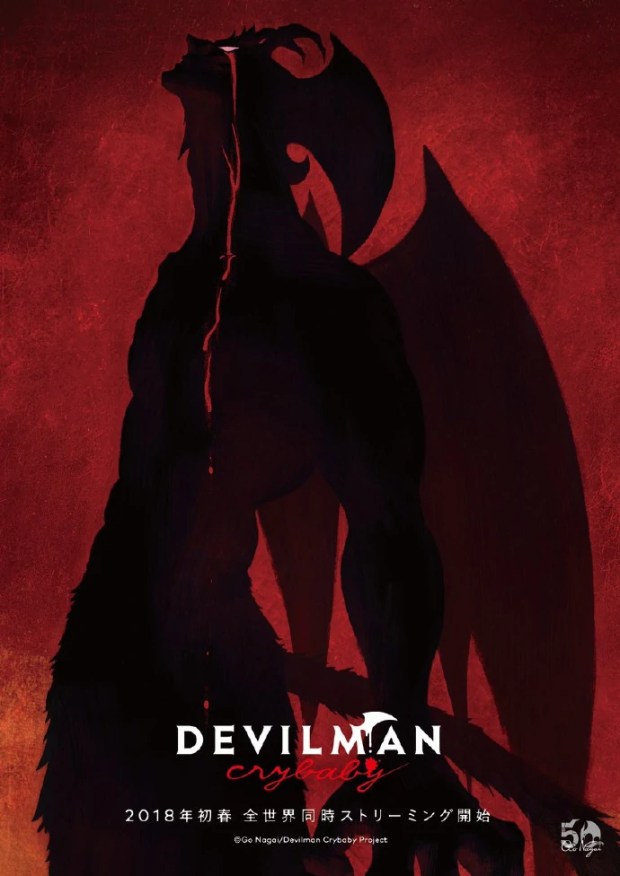
Devilman Crybaby (2018)

If you’ve spent any time reading about animé you will have come across the name “Osamu Tezuka”, almost certainly accompanied by the phrase “Godfather of animé/manga”. And that’s true, as far as it goes. Tezuka absolutely kickstarted post-war animé as a genre. But…it kinda feels like we’re missing something, doesn’t it? How exactly did we get from this:
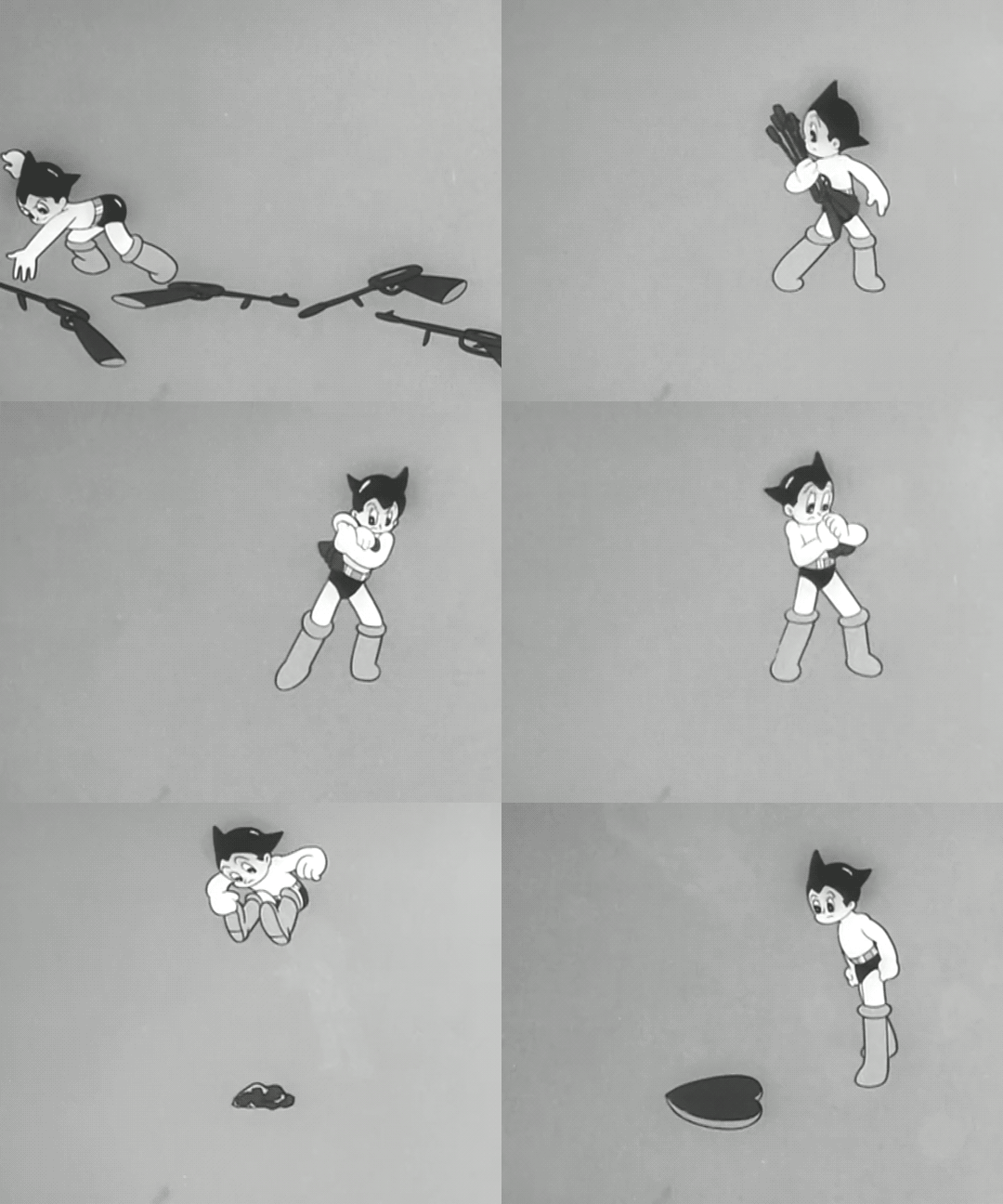
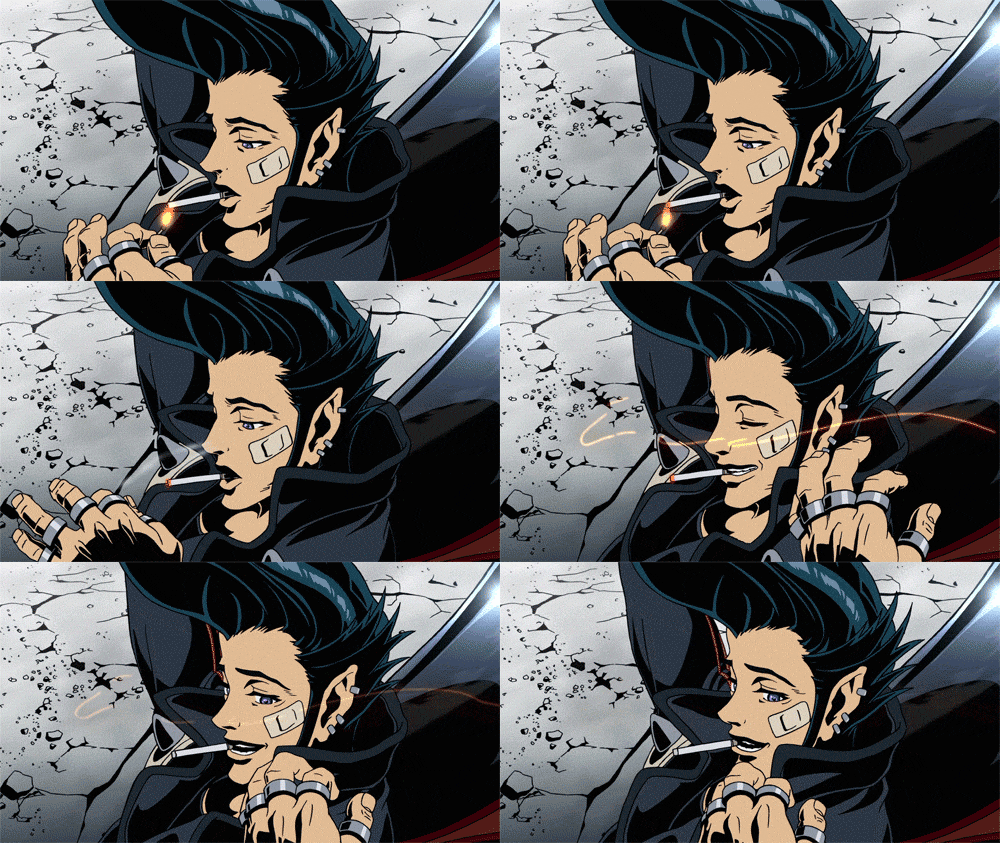
To THIS:
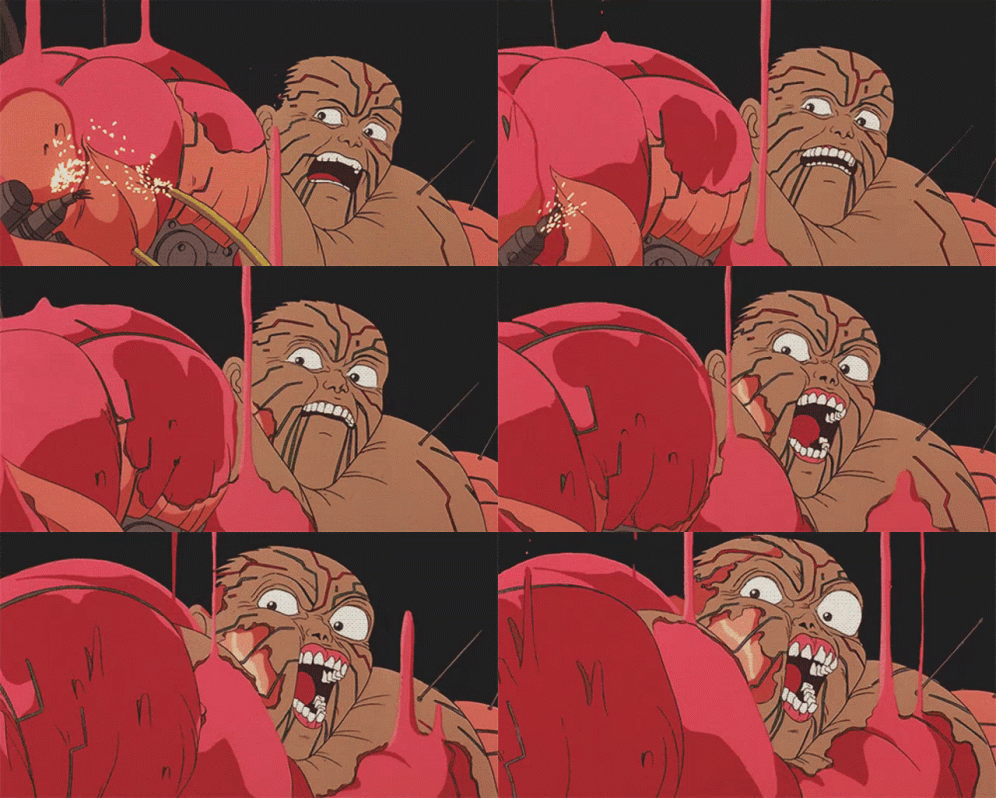
Well to understand that we need to talk about the other godfather of manga and animé. For Osamu Tezuka created animé as a beautiful, innocent garden. But into that garden, there came a serpent. There came Go Nagai.

Hired as a writer and illustrator for Weekly Shonen Jump in 1968, Nagai became an instant cultural lightning rod and enfant terrible of manga with his series Harenchi Gakuen. An erotic comedy set in a school, the series attracted massive controversy in Japan (damn prudes!) with its boundary smashing depictions of nudity and sexuality in a comic ostensibly aimed at children (sometimes have a point!). Nagai’s entire career has been one long game of seeing what he can get away with. His work is categorised by coarse humour, extreme violence, body horror and a pessimism often bordering on nihilism.

“What’s nihilism?”
“Doesn’t matter.”

Also, Nagai is notorious for a, shall we say, somewhat cavalier attitude to the ethics of depicting sexual assault against women. To put it another way, much of his work is rapier than a full orchestral production of Blurred Lines at the Global Fencing Championships. Shit. Gets. Messed. Up. And his influence cannot be overstated. If you’ve ever watched some disreputable animé late at night and found yourself wondering…why?

Go Nagai. Go Nagai is why.

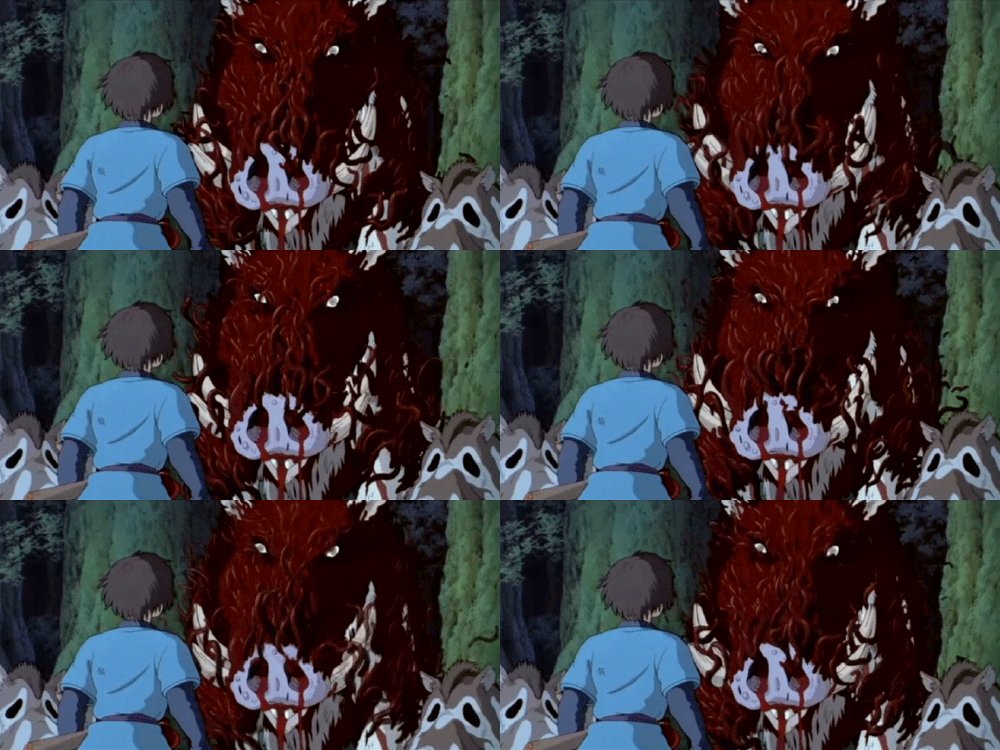
Go Nagai is why so much of animé is so violent, so weirdly horny and frequently so goddamned awesome. It’s a…complex legacy, to be sure. And much of Nagai’s work is definitely not for me. But he also blazed a trail that was followed by many of the most important and respected creators in the medium, like Katsuhiro Otome and even (I would argue) Miyazaki.
Now, the most important part of Nagai’s oeuvre is the massive Devilman franchise, a constellation of manga, animé adaptations, remakes and spin-offs. There’s a lot of overlap and differences between the various iterations but it usually goes like this; Akira Fudo is an ordinary Japanese schoolkid who gets recruited (or sometimes just duped) by his childhood friend Ryo Asuka into a war to protect humankind from demons. In order to do this, Ryo has Akira become possessed by an ancient warrior demon named Amon to fight other demons. Akira then becomes a superhero named “Devilman” (pronounced “DEEEEEEVILMAAAAAAAAAAAAAANNN!!!!”). From there, the story usually proceeds through a few monster of the week episodes with certain series-standard demons appearing to get the ever-loving demonic shit kicked out of them before taking a sharp left turn with humanity becoming aware of the existence of demons whereupon things get fucking dark.

Very violent. Very horny. Not for everyone. Go Nagai.

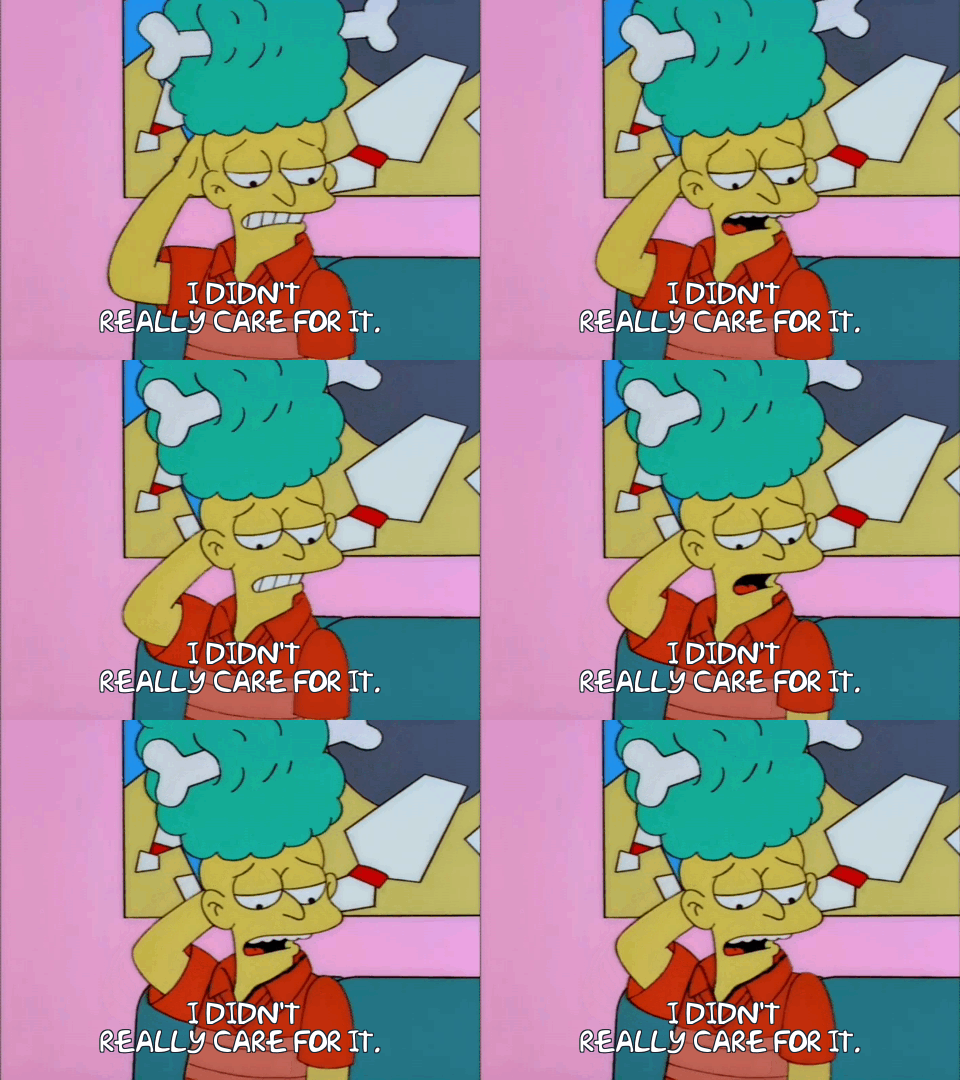
Now, there have been several animé adaptations of the original 1972 manga. There was the ridiculously toned down seventies Toei series which was kinda like if The Human Centipede was remade as a Saturday Morning Cartoon about a bunch of people who change into a giant centipede to fight baddies through the power of friendship. Then there was the far more faithful (and pretty damn kickass) OVA in the eighties, a couple of other OVAs in the nineties and early aughts and finally the subject of today’s review Devilman Crybaby, a mini series created by Science SARU for Netflix. Now, one of the reasons I pushed this review back to Halloween (other than just to have a horror themed review for Halloween) was that I knew nothing about this franchise and had a suspicion I would need the extra prep time. And I’m glad I did. Devilman Crybaby was an absolute juggernaut when it was released, becoming one of the most watched and successful animé series in years with a rabid fanbase. The kind of thing you really need to research and read up on before you come out with something like “I watched it and I didn’t really care for it”.

Anyway. I watched it.
(more…)

Sailor Moon R: The Movie

This is one of those reviews where I feel like literally every single person interested enough to read it already knows far, far more about the topic than I do and is just waiting for me to make a massive ass of myself. I never watched Sailor Moon growing up and was only vaguely aware of it as the animé that most people think of when they hear the word “animé”. So I went on a rather fascinating tvtropes binge (did you know that the entire Japanese magical girl genre was inspired by the American sitcom Bewitched?) and I’m proud to report that I’ve gone from being absolutely clueless to loveably befuddled in record time.

Okay. So. Let’s start at the end and work our way backwards.

What is Sailor Moon R: The Movie?

Sailor Moon R is a movie based on Sailor Moon R.

What is Sailor Moon R?

Sailor Moon R is the second season of the Sailor Moon animé.

What is the Sailor Moon animé?

The animé adaptation of Naoko Takeuchi’s manga about schoolgirl Usagi Tsukino who discovers that she is the reincarnation of an ancient warrior princess from a kingdom on the Moon. As Sailor Moon she battles evil monsters with the help of other girls/reincarnated warriors such as Sailor Mars, Sailor Venus, Sailor Mercury and Sailor Jupiter. It’s a fusion of the magical girl genre with the sentai superhero genre.

What is best in life?

To crush your enemies, to see them driven before you and to hear the lamentation of the women.

Why don’t girls like me?

Because you’re not actually a person, you’re just a rhetorical device I’m using for this review.

What? Wait come back!

(more…)

Redline (2009)

“Hey Mouse have you seen the new Pino..

Nope. Not gonna do it. Not gonna watch it. Not gonna blog about it. Not gonna contribute to THE DISCOURSE. Not, in short, gonna give the bastards the satisfaction.

Here is what I am going to do. I am going to talk about my new boo.

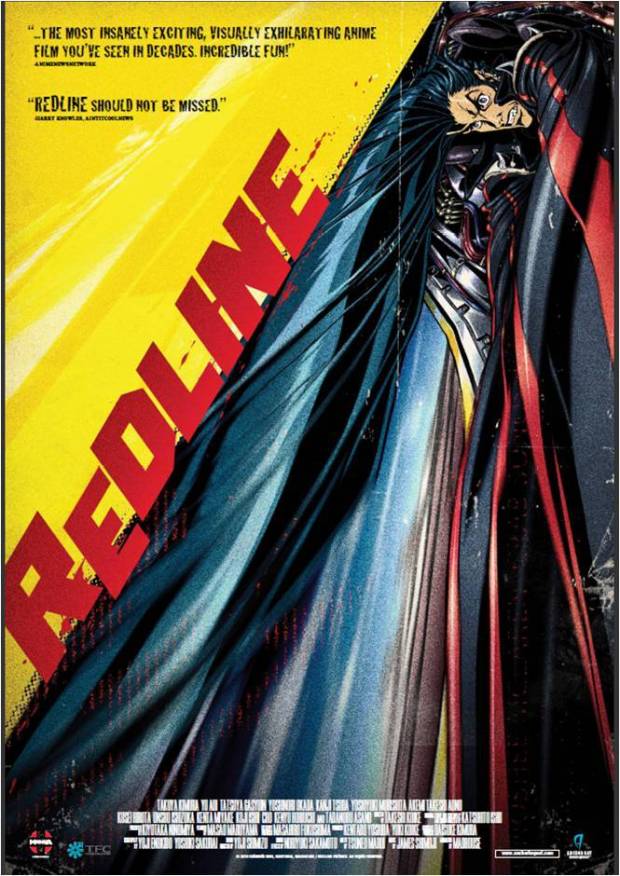
Redline, a 2009 animé movie released by Madhouse, instantly became one of my all time favourite animations and it didn’t even break a sweat doing it. Which is not to say that it’s one of my favourite movies, necessarily, but as a perfect sugar rush high of the purest joy animation can deliver I struggle to think of its equal. This thing took 7 years to make, comprising 100,000 cels of some of the most gorgeously detailed hand-drawn animation I’ve ever seen.

The movie is the debut feature of animator Takeshi Koike, whose Animatrix short World Record I reviewed a few weeks ago (all part of my cunning plan). But what is this “Red Line”, you ask. What’s it all about, eh?

Okay, so take 2000 AD comics, the works of Jack Kirby and Moebius, Mad Max and pretty much every Franco-Japanese Saturday Morning cartoon from the eighties and put them in a blender. Take enough LSD to turn into a pineapple and serve. That’s Redline. It is AWESOME. If I had seen this when I was ten years old I might have actually died from excitement.

(more…)

“Another Batman killed, eh? I hope that this is the last of them.”

Hello everyone, and welcome to a new series here on Unshaved Mouse where I review every Batman movie except for the ones that I’ve already reviewed. Well, most of them. I mean, some of them. Look, the character’s been featured in over eighty films at this point and I have a life, allegedly. But let’s kick this off with a thematically appropriate question. Riddle me this! What is the first superhero movie?

Well, not to get all Bill Clinton on ya, but that really depends on your definition of “movie”, “superhero”, “first” and “the”. You can argue, and many do, that the superhero genre has always been with us. That Superman and Batman are just the latest iterations of characters like Enkidu, Herakles, Thor and Cúchulainn. At the opposite end of that maximalist take is the concept that the first superhero was Superman, because he was the first to embody three fundamental elements; a secret identity, superhuman powers and a comic book origin. And between these two poles there are characters that are kinda liminal, sort of superheroes and sort of not. Characters like Zorro and The Shadow. Pulp heroes? Superheroes? It’s not entirely clear. I know one guy who claimed that the first true superhero was Baroness Orczy’s 1905 creation the Scarlet Pimpernel. And since that guy was frickin’ Stan Lee. Yup. Good enough for Mouse.

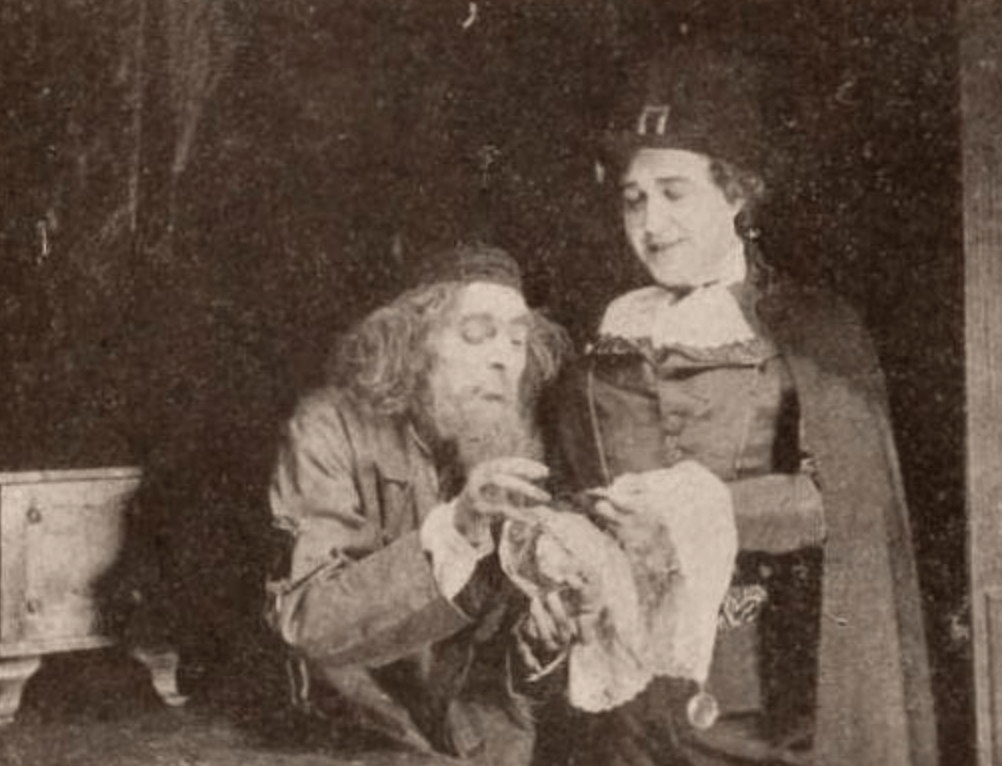
If so, that would make the now-lost 1917 silent film The Scarlet Pimpernel the first superhero movie.

Well, clearly all the pieces are in place.

So, (if you’re willing to stretch your definitions), the superhero movie genre is over a century old, and even pre-dates superhero comics. And yet, if you ask the average person what the first superhero movie is, what do you think they’ll say? 1978’s Superman? The 1966 Batman? Why has around half of the genre’s history been essentially memory holed?

Well, part of the problem is that most superhero cinema prior to the 1950s came in the form of serials. Serials were essentially the precursors to TV shows. A cinema would screen a new episode every week. Each episode was typically between 10 and 30 minutes long, low-budget and would end with a cliff-hanger to get you back in next week. In the forties, many famous superheroes were adapted to the form, including Captain Marvel, Captain America, Superman and, of course, Batman.

The second reason why this era of superhero cinema is so obscure is that they were all mostly terrible.

Okay, let me walk that back a little. They are products of their time. Because of the nature of the format, serial plots tends to cycle in place for around ten episodes before abruptly sprinting to the climax. This makes them, as you might imagine, not exactly bingeable.

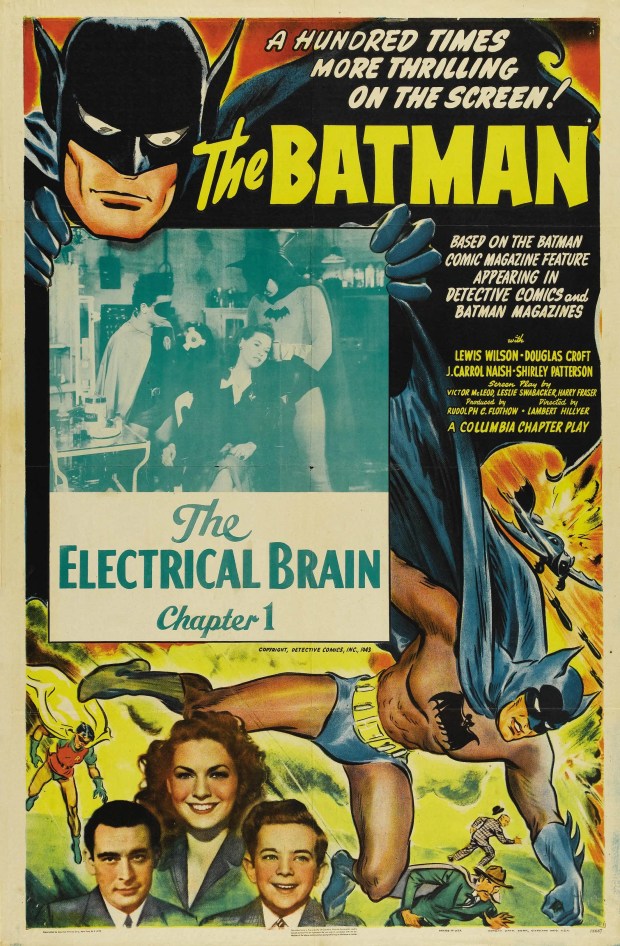
And yet, I feel like Colombia’s 1943 picture The Batman should have a bigger pop culture presence. It’s the first Batman film, after all. And it was influential, in its way. It created several hugely important parts of Batman’s mythos. And the sixties series was arguably more an adaptation of this serial than the actual comic it claimed to be based on. And yet, if fans even know about it it’s usually “that weird old Batman movie that’s super racist”. And you know what? That’s unfair.

It’s not just racist. It’s also very boring.

And look, I’m just going to say this up front. I’m not doing my usual scene by scene analysis on this one. Why?

BECAUSE THIS BEAST IS THREE AND A HALF GODDAMN HOURS LONG

(more…)

Shortstember: The Final Flight of the Osiris

Studio: Square Pictures

Director: Andy Jones

Writer: The Wachowskis

Wha’ happen?

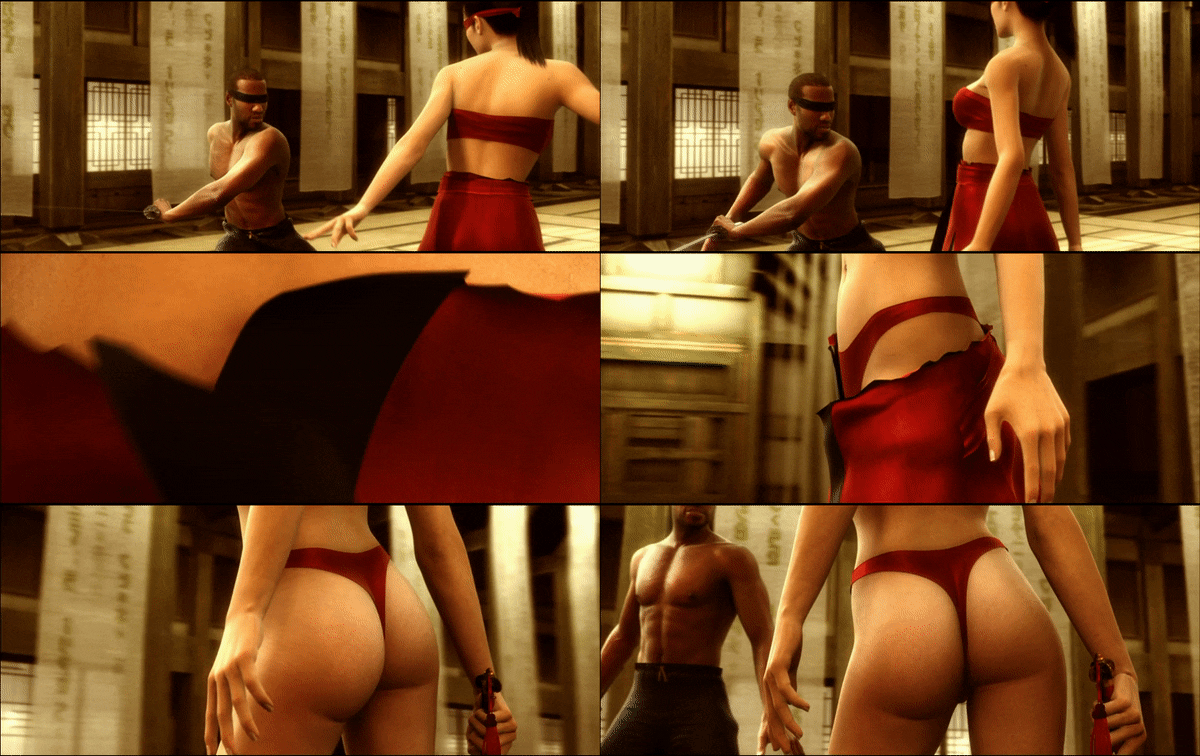
In a sparring programme, Captain Thadeus of the Zion hovercraft Osiris and his first mate (in more ways than one) Juen swordfight while blindfolded. This doesn’t, as you might expect, result in horrific injuries but instead with them just getting progressively more naked.

This ass is important to the story, shut up.

They’re interrupted when the Osiris comes across an army of half a million machine sentinels and a big fuck-off drill, burrowing into the Earth’s crust right over Zion, the last human city. Rushing to warn Zion, the Osiris flees the pursuing sentinels. Juen volunteers to enter the Matrix leave a message in a dropbox. The sentinels overpower the Osiris but Juen manages to relay the message before the ship is destroyed and she drops dead.

How was it?

Probaby the least “animé” of all the shorts, this one feels most of a piece with the original trilogy. Everything from the score to the colour scheme to the dialogue feels like it could just slot very neatly into the films. One thing I really admired about the Wachowskis was their commitment that everything mattered. There was no “expanded universe”, every part (whether film, short film or computer game) was equally canon. Sure, you don’t have to see Osiris to make sense of Matrix Reloaded but if you have seen it you’re never in any doubt that it happened in this universe. The events here are referenced and are always consistent with the rest of the franchise. I like that. The animation was some of the most jaw dropping CGI I had ever seen in 2003 and in 2022 it holds up amazingly well. Sure, the sword striptease might seem like shameless pandering (and it is) but it’s also a demonstration of technical power. The flesh of these characters moves realistically and organically, these bodies tense and flex and sweat organically. It’s mighty impressive today. Twenty years ago it was bloody witchcraft.

It’s light on story, lighter on dialogue and pretty insubstantial. But as a visually stunning, slick little thriller it gets the job done.

Shortstember: The Animatrix

What is The Matrix?

The Matrix is everywhere, it is all around us.

Well, okay, it’s not. But it used to be. In those weird few years surrounding the turn of the millennium the Matrix was an absolute phenomenon, genuinely one of the most influential movie franchises of all time. In fact, I’d argue that it was a victim of its own success. Its aesthetic was so instantly iconic and easily replicable that it quickly became cliché. Movies don’t look like the Matrix anymore because so many movies released around that time aped its look and suddenly it wasn’t cool anymore. And make no mistake, the Matrix was all about being cool. Less a story than a vibe.

No, that’s not fair. The Matrix’s intellectual depth may have been exaggerated but if you’d never heard of Descartes it could and did give an entry point into various philosophical ideas. Its language and concepts have filtered into our discourse (red pills, bread pills) and has gone on to inspire many a modern science fiction writer (DID I MENTION RECENTLY I WROTE A BOOK?). It’s a damn impressive legacy for a series that, if we’re brutally honest, consisted of one good (if by no means flawless) film, two mediocre sequels and a filmed cry for help.

This movie has a scene where Lana Wachowski’s self-insert cries in the bath because Warner Brothers (WHO ARE MENTIONED BY NAME) are forcing him to create a fourth Matrix. I am not making a word of that up.

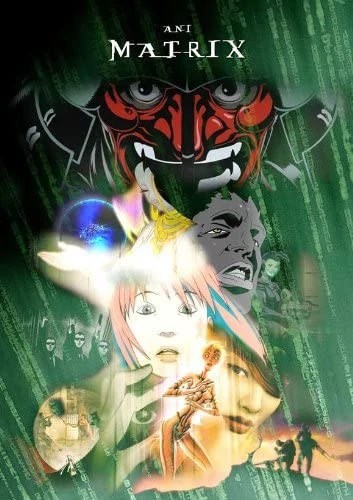
Oh, and it also gave us the subject of this years Shortstember, the Animatrix. This is an anthology series that came about when the Wachowskis visited Japan to promote the first Matrix and visited some of the animé studios that had been such a huge influence on their work. They then commissioned those studios to create nine short films set in the world they had created, which were then released on DVD and on online to promote the second film, Matrix Reloaded. For something basically created as an advertisement for another movie, The Animatrix went on to become the most critically acclaimed part of this entire franchise with the exception of the original film.

So join me this Shortstember as we review the Animatrix. Which ones are good, which ones are bad, and which ones are like wiping your arse with silk.

“You break the rules and become a hero. I do it and I become the enemy. That doesn’t seem fair.”

“And I know he’s here…”

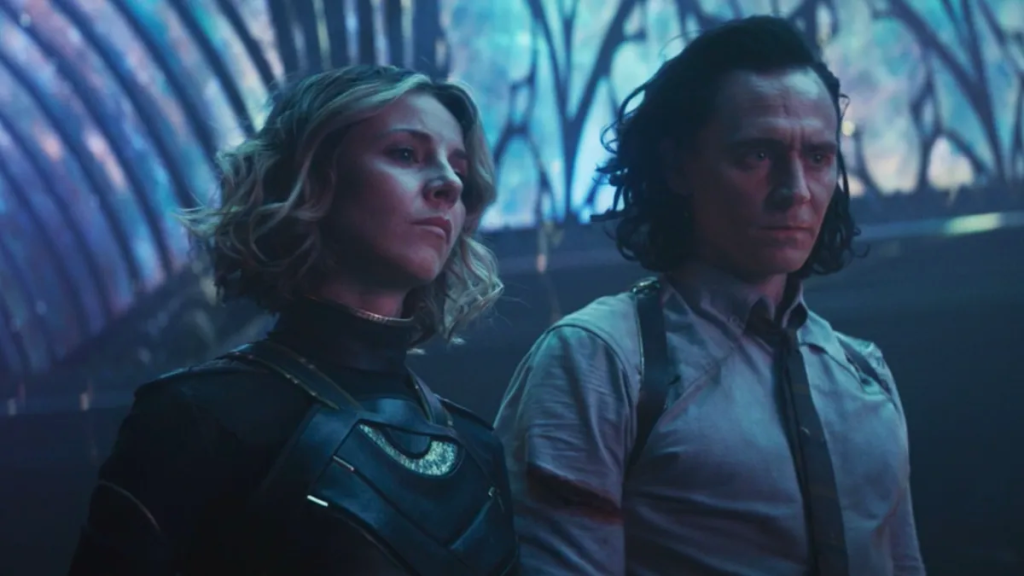
I had a realisation when I heard that line. In the eighth episode of Wandavision, “Previously On”, Wanda Maximoff enters SWORD Headquarters to try and retrieve the body of her lover, the Vision. And something about how Elizabeth Olsen delivers that line. Some mixture of ragged sorrow, aggrieved entitlement and barely contained rage…like a soul that’s been crushed into diamond-hardness by life’s cruelties. It’s absolutely terrifying. And that’s when I realised that Elizabeth Olsen is the best actor in the MCU.

Now, a while back I said that I would be reviewing all of the Disney Plus Marvel shows as part of this series, but, in my defence, that was before I had seen most of them. In fact it was right around the time that Wandavision had me convinced that it was one of the most exciting, radical genre TV shows I’d seen in years. That’s…not how it turned out. The Wandavision finale wasn’t terrible, by any means, but for something that was shaping up to be the MCU’s answer to Twin Peaks to end in just another CGI blob fight in the sky…

Well, I wasn’t angry. But I was disappointed. And it turned out that Wandavision was the highpoint, so let’s just breeze quickly through the rest.

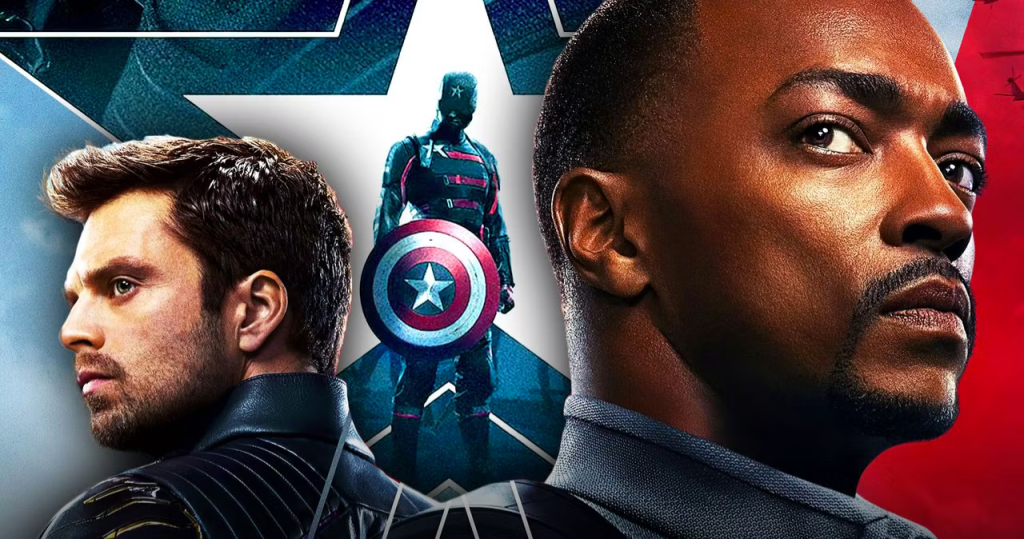
Not bad, really liked the John Walker arc, the Isiah Bradley stuff was cool but the villain was just nails-on-a-chalkboard and the two leads were the least compelling part. C+

Didn’t see it. I mean, I watched it but the whole thing was so underlit I don’t even know what happened. Picked up a bit towards the end with the Kang reveal but the writing needed to be a lot sharper for a show about the MCU’s wittiest character. C-

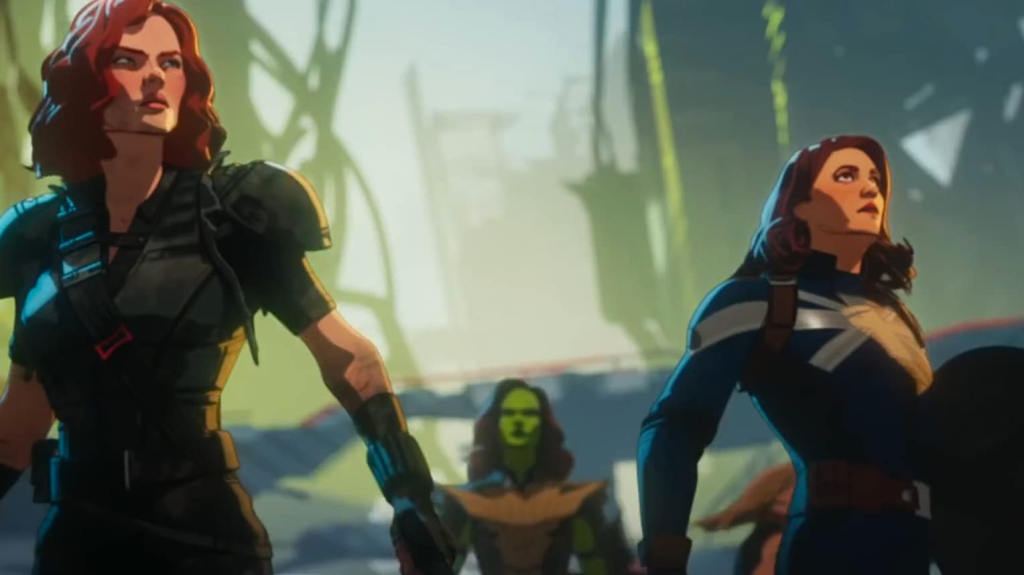
Damn, Marvel just does NOT like Star Lord, huh? This one’s hard to judge, any anthology show is going to have ups and downs. Overall, I think it balances out to be a B-.

Quit after episode 3. Automatic F.

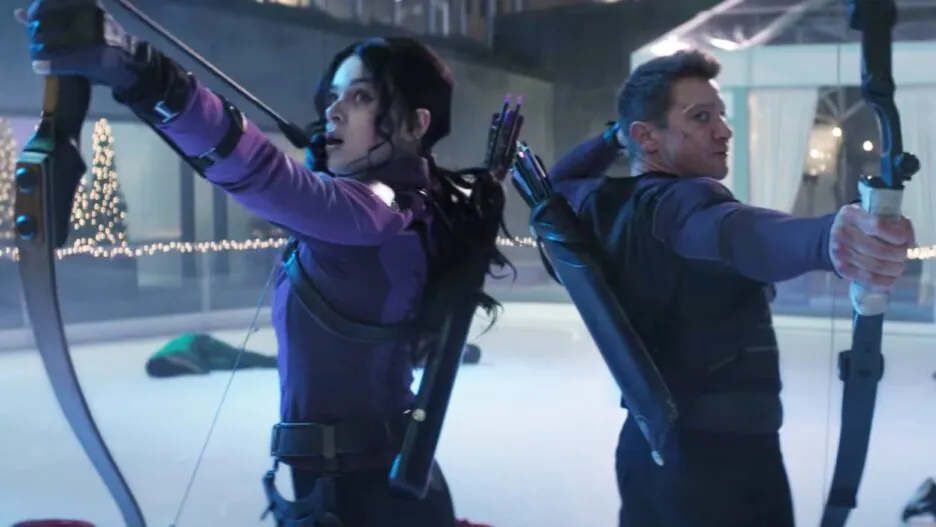
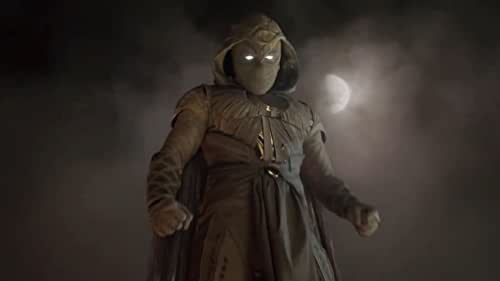
Okay, a Hawkeye series is a tough lift. Fair enough. But how do you fuck up Moon Knight? I quit this twice. I tried to power through because I love the character but life is too damn short. Two Fs.

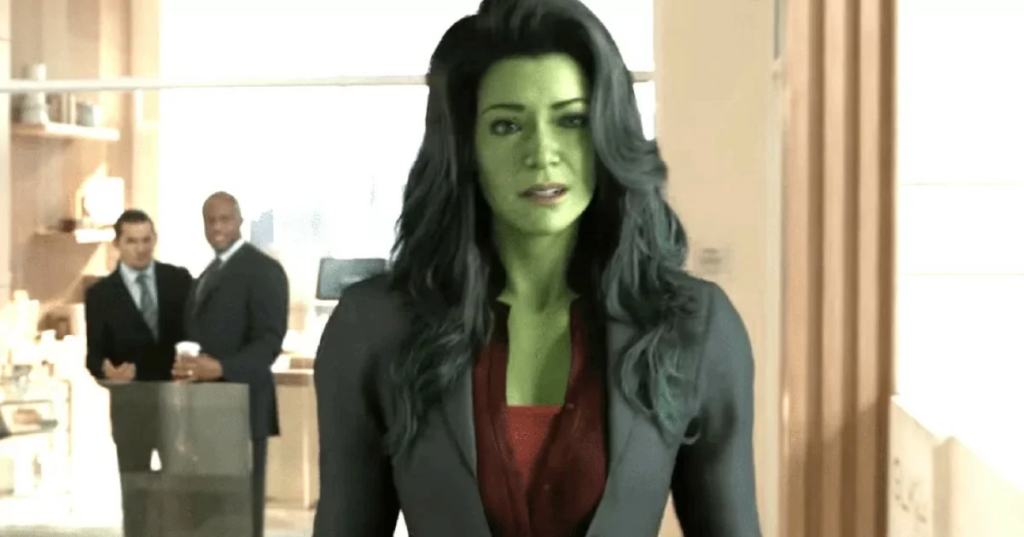
And I haven’t seen Ms Marvel or She Hulk yet.

Oh, but it looks GREAT.

So that’s us all caught up.

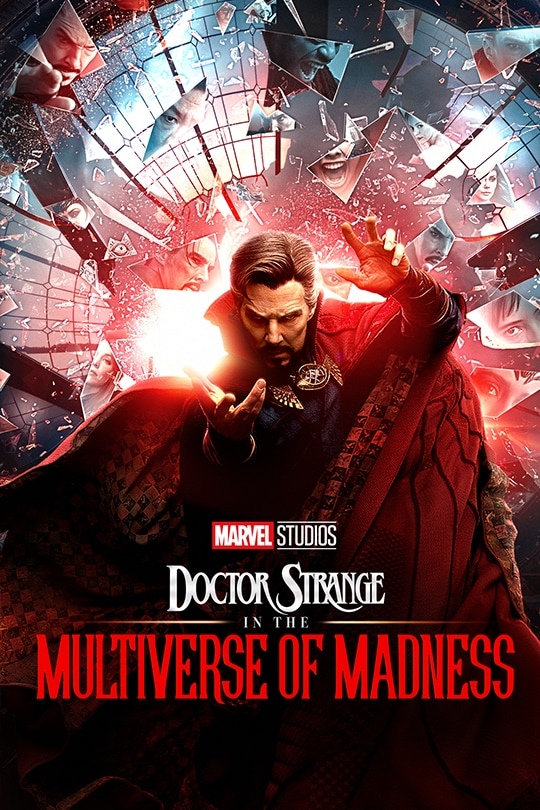
Multiverse of Madness is basically a thrown gauntlet to the audience. Prior to this, the TV corner of the MCU (whether that was on ABC, Netflix, Hulu or Disney +) was completely vestigial to the films. In fact, prior to Charlie Cox showing up as Matt Murdock in No Way Home, I can’t think of a single instance when the TV properties were even acknowledged in a main series movie (prove me wrong in the comments, folks). MoM though? If you are not at least fully caught up on Wandavision, Loki and What If?

(more…)

Disney Reviews with the Unshaved Mouse #60: Encanto

Seagoon:
Any objections?

Milligan:
Ohhh yes! If we build this mountain on England, England would sink under the weight.

Seagoon:
Sink? In that case, this mountain would be invaluable, people could climb up the side and save themselves from drowning!

Milligan:
Mercy, you’re right. Hurry and build it, before we all drown!

The Goon Show: “The Greatest Mountain in the World” (1954)

“Mouse, you explain that opening quote RIGHT NOW!”
“What, I can’t reference classic British radio comedy to open my review?”
“Listen to me. Encanto is the one good thing to come out of this miserable fucking decade and if you try to ruin it for me…”
“Ooookay, how about we take a deep breath?”

Alright, let’s just dispense with the usual dancing around.

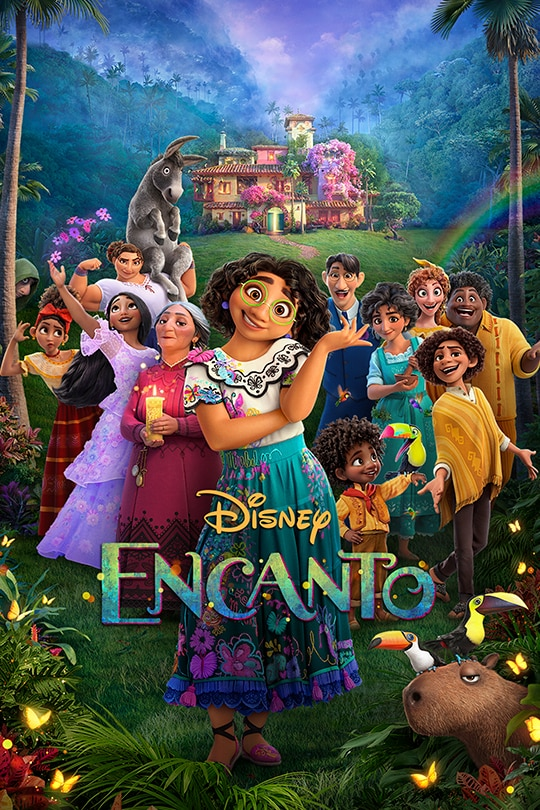
Encanto is great. It’s a great piece of animation. It’s an excellent musical and it’s without a doubt my favourite canon movie in a long-ass time. It’s walking out of here with a good grade, don’t nobody worry ’bout that.

But…

I have to confess that what really fascinates me about Encanto is how it keeps making the most basic, obvious mistakes in screen-writing you can imagine (trying to build a mountain that will cause the country to sink), and instead of just fixing them in a sensible way (just not building the mountain) by doubling down and solving those problems in the most ridiculously over the top way possible (actually building the mountain). And it works.

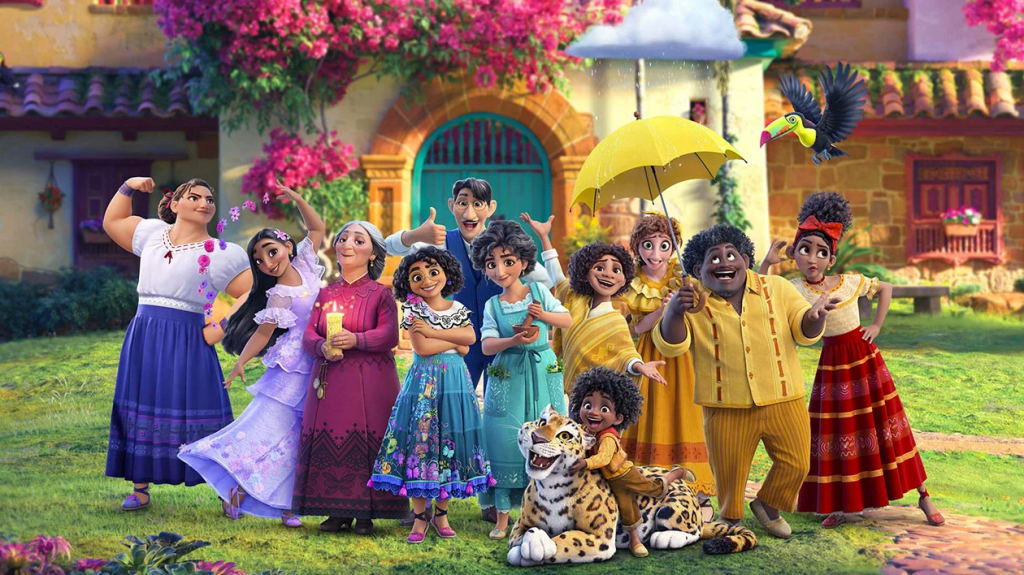
The best example of this is the first song Welcome to the Family Madrigal.

There are twelve named speaking Madrigal characters, all with unique personalities, powers and familial relationships to keep track of. That is, quite frankly, bananas and any sensible screenwriter would have gone through the cast with a machete looking for who could be cut.

Way I see it, for this story you need Mirabelle, two older siblings to establish the pattern that Mirabelle broke by not getting a gift, and then a younger sibling to get a gift to show that Mirabelle really was a fluke. You need Abuela, obviously, Bruno and Julietta. Augustine doesn’t need to be there and Pepa’s entire family is extraneous. And yes, obviously, that would really suck to lose those characters but that would be the sensible choice. The sane choice. But that would not be the Encanto choice.

Encanto instead decides that it’s going to have an opening song flat out admitting “yes, our cast is far too big and complicated and our premise is weird and clunky so here is a song to help you remember”. It shouldn’t work. It really shouldn’t work. But simply by dint that it is a phenomenal song it does. They built the goddamn mountain.

But I get ahead of myself. So about that premise.

(more…)

Live Action Disney Reviews with the Unshaved Mouse: Alice in Wonderland

Guys, be honest.

Am I just an unpleasable asshole?

A rule I really, really try to stick to in reviewing movies is this: never criticise someone else’s work unless you can articulate what you would have done differently. This is not to say that I have no constructive criticism of 2010’s Alice in Wonderland. I would, in fact, venture that I have quite the stack, teetering precariously in the corner as I write these words, ready to crush my tiny little mouse bones at the slightest inopportune breeze. And yet, I can’t help but feeling that a lot of what I am about to say might come across as a touch hypocritical if you are a long time reader of this blog.

“Mouse! Good news! We’ve remade Alice in Wonderland!”
“That’s bad news! I famously despise Lewis Carroll’s inexplicably beloved original novels!”
“Good news! The movie simply takes the setting and characters and works them into a new live action adventure!”
“That’s bad news! The only screen version of this story I enjoy is the original 1951 Disney feature and I hate your modern live action bastardisations of classic cartoons!”
“Good news! The movie borrows NOTHING of the original cartoon and attempts to forge a bold new path with its own aesthetic and continuity!”
“Did I…did I make you happy? PLEASE tell me I made you happy!”

So I kinda feel like I’m not reviewing this in good faith. I mean, is this movie a travesty of Carroll’s original work, crunching it into a generic Lord of the Rings rip-off slathered in a thin veneer of anachronistic corporate feminism to appeal to the broadest possible global audience so that Disney can bank another €1 billion dollars for the death ray fund?

Yes. It is that thing I said.

But how the hell am I supposed to make that argument? If this is a bad Alice, then what would meet my definition of a “good” Alice, considering I can’t stand the source material? (It occurs to me that I haven’t actually read either of the novels in two decades. I may need to go back and give them another go).

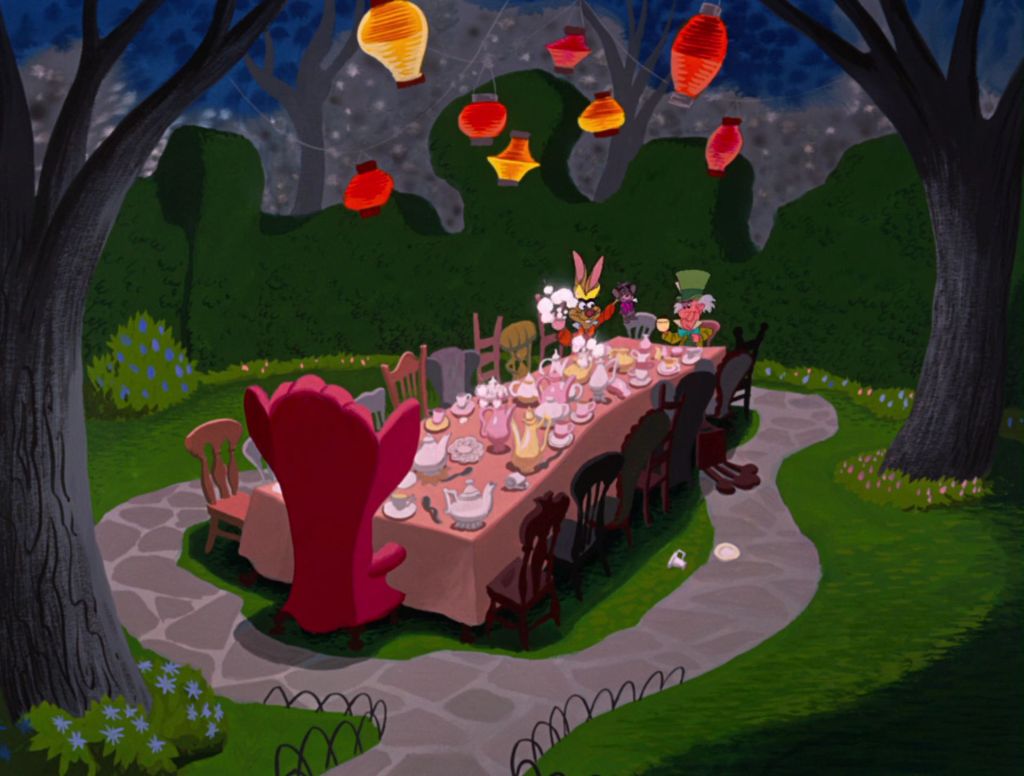
Well, I suppose it would be a movie that was able to do what the 1951 movie did, make me like the story of Alice through sheer artistic brilliance. I love the ’51 Alice not because it’s an Alice movie, but because it’s a Disney movie, possibly the most Disney movie of that era.

You’ve got Mary Blair on backgrounds. Verna Felton, Ed Wynne, Sterling Holloway and J. Pat O’Malley on vocals. The Nine Old Men directing animation. Music by Oliver Wallace. The movie works because it takes Carroll’s novel, sands off the creepier and more unpleasant elements, and uses the episodic nature of the story to allow some of the most talented men and women to ever work in animation to go buck wild. So I suppose, that’s what I want from an Alice in Wonderland adaptation. Something that can overcome the weaknesses of the source material by just being really, really beautiful.

“OH SHIT!”
(more…)

Live Action Disney Reviews with the Unshaved Mouse: Cinderella

“Hey Mouse, what do you think about all these live action Disney remakes?” is a question I have never been asked because I am a relic of the 2010s internet and have been irrelevant to fandom discourse for quite some time.

But if they did ask for those opinions, boy, do I have opinions! Nuanced and interesting opinions? Not really, by and large I think they’re hot garbage at best and actually morally reprehensible at worst.

“Hey, when are you going to review me?”
“Fine. Nice costumes. Tangentially complicit in genocide. No stars.”

I hate the whole scene, man. I hate the lazy nostalgia milking. I hate the rehashing of old songs and characters in ways that are always inferior to the originals (the 2016 Jungle Book is, I admit, a pretty fine movie but I’ll be deep in the cold ground before I say it’s an improvement on the ’67 cartoon.). I am real sick of Disney cynically trumpeting minor gay characters whose presence would have been real daring thirty years ago to earn gushing publicity. And I really hate that the biggest entertainment company in Western history is apparently unable to understand the simple fact that just because a character is a great villain doesn’t make them a great protagonist. In fact, it means the opposite of that.

AHEM.

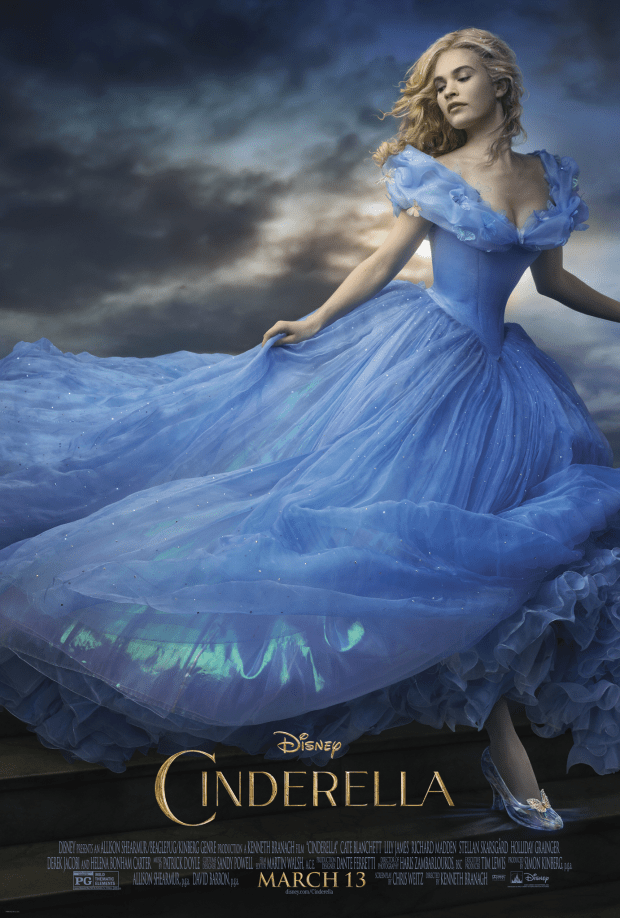
That said…I’ll admit the announcement of 2015s Cinderella provoked a lot less bile and profanity to gush forth than it usually would. Mostly that’s a lack of skin in the game. The 1950 Cinderella is a film with which I am on perfectly cordial terms, but it’s not and never will be as important to me as something like The Little Mermaid or The Lion King. Plus…it’s Cinderella, you know? The Disney Cinderella may be the most famous film version but it’s certainly not the definitive version, because there isn’t one and never will be. Cinderella is one of the absolute pillars of world folklore, with versions spanning thousands of years across the breadth of Europe and Asia. And there have been Cinderella movies as long as there has been film. The earliest version I found was from 1913 (called, hilariously “A Modern Cinderella”). Cinderella has been played by everyone from Julie Andrews to Brandy to Betty Boop to Jerry Lewis. It’s a timeless story that’s remained popular despite decades of bad, pseudo-feminist critique (the story is not, and never has been, about marrying a prince. It is, and always has been, about escaping poverty and domestic slavery). So, whatever, I say. Disney want to make another Cinderella movie? Fine.

I am willing to acknowledge this movie’s right to exist, Disney. All you gotta do is make a good movie.

“OH SHIT!”
(more…)