There’s an episode of Blackadder Goes Forth where Captain Edmund Blackadder is being courtmartialed for eating a carrier pigeon. He’s not worried, though, as he tells his jailer that he’s retained the services of Massingbird, the greatest lawyer of the age:
Jailer: I hear he’s a dab hand at the prosecution as well, sir.
Blackadder: Yes, well, look at Oscar Wilde.
Jailer: Ol’ butch Oscar.
Blackadder: Yep! Big, bearded, bonking, butch Oscar. The terror of the ladies. 114 illegitimate children, world heavyweight boxing champion and author of the best-selling pamphlet “Why I Like To Do It With Girls.” And Massingbird had him sent down for being a whoopsie.
That scene kept running through my mind as I watched Metal Fish with its depiction of Hans Christian Andersen as a flame haired, barrel-chested adventurer of the deepest depths of the sea and not, as he was in real life, a wee Danish pastry who spent much of his life in an undisclosed location hiding from his own erections. But I get ahead of myself.
“Hey Mouse. I did you a solid with that Ursula episode, right? So how’s about you don’t rag on me quite so mercilessly from now on?”
“My my. Am I already at the part where I hallucinate that the series I’m reviewing is talking to me? How time flies.”
“C’mon Mouse. Isn’t there enough negativity in the world? Just give me a good review and I’ll make it worth your while.”
“Lie to my readers? Why that’s…I couldn’t possibly…NO! GET OUT! GET OUT OF HERE! LEAVE ME ALONE!”
“Suit yourself. It was only a suggestion.”
Wha’ Happen’?
Of all the nerve! I’m going to be absolutely brutal on this one. Wish Upon a Starfish begins with Sebastien looking for Ariel and telling her she’d better be studying for her “Crab Philosophy” test…okay, I already have a million and one questions here.
Ariel is receiving some kind of education? Sebastien is her tutor now (why am I not surprised)? But most importantly, which crab philosophers are on the curriculum? Crabistotle? Socrabstes? Crab Camus?
“Don’t walk behind me; I may not lead. Don’t walk in front of me; I may not follow. Don’t walk beside me because I walk sideways. Because I’m a crab.”
Anyway, Sebastien tells Ariel that there’s a storm going on overhead so she swims to the surface to see if she can get some of that sweet, sweet human swag. She finds a music box with a ballerina figurine (I would really have liked if this was the same music box we see in Part of Your World but alas) but Sebastien and Flounder yell at her to come back because the storm is dangerous. Somehow.
Oh no! They might…drown?
Well yes, actually. They get hit by a wave and we next see Ariel unconscious, washed up on a beach with Flounder beside her. And Flounder’s first words are “Ariel, are you okay?!”
Yeah dude. She is. Because she has LUNGS.
Like, sweet and all that he cares about her so much but sometimes it’s okay to prioritise your own needs, y’know?
The episode begins with Ariel riding a sea horse throughout the entire ocean to wish every single sea creature a good morning and to continue her descent into self-parody. One creature who is not having a good morning however, is whatever the hell this thing is:
What? What!? WHAT?!!
So this…flipped bird from evolution itself is a Bad Luck Creature and none of the other sea creatures will have anything to do with it because it’s supposedly unlucky which, clearly from the fact that it’s living, it is. The creature, which we shall call Lucky, is very sad because all of the other ocean denizens shun it and call it names.
“FREAK!”
Ariel comes across this abomination and starts make cooing noises and oh God, you know what this means don’t you?
If my kids ever ask me about the nineties I’ll tell them of a wondrous time when the Soviet Union had collapsed, the Cold War was over and we were all free to focus on what was really important: dinosaurs and whales. Seriously, if it wasn’t big, extinct or going extinct it could get fucked. The mania of interest in dinosaurs obviously followed in the wake of Jurassic Park, whereas the world’s global bout of cetaphilia was a result of the movie Free Willy, a film about boys and whales and whales jumping over boys.
Not a great movie. Sorry.
“Between this and talking shit about Darkwing Duck, you are just asking to be killed by nineties kids at this point.”
This episode deals with Spot, a baby killer whale that Ariel adopted in the pilot for this series which I haven’t reviewed because Disney, in their infinite wisdom, decided to not put it on Disney plus. And this episode is a sequel to that one where Spot returns because Disney was decided in 1993 that having an episode about a killer whale trying to escape from a water park might be an easy sell.
Ahem.
Actually I can’t be sure of that. This episode aired in October 1993, a mere three months after Free Willy premiered which seems like an awfully quick turnaround. I mean, that would mean that this episode was just slapped together in ninety days and ohhhhhhhh I see…
Ariel and Flounder are out minding their own damn business when a naval battle between some pirates and the Royal Navy breaks out overhead. During the battle, one of the pirates drops a boot and Ariel, little hoarder that she is, is fascinated by it and takes it back to Atlantica to show to her friends. Now, The Little Mermaid the film had a lean, tight little screenplay with very little fat which was to its credit. But it does mean that Ariel’s world is really under-populated. She has literally two friends in that movie (Sebastien is more of an authority figure), Flounder and Scuttle and she hasn’t actually met Scuttle yet. So the episode has to create some new fish friends for Ariel. Who are these fresh new additions to the rich Mermaid canon? Well, we get an unnamed posh lady fish who loves fashion dahling and an uninspired Woody Allen impression. God, uninspired Woody Allen impersonations used to be everywhere in cartoons and they were never a good sign. Foodfight!had one. That should teach you plenty. By a rather morbid coincidence this episode would have aired right around the time Dylan Farrow went public.
Things get off to a bad start right away when The Little Mermaid the series violates the unwritten rule that all Disney series from the nineties have to have an absolute banger as a theme song. Instead, TLM has a wordless medley of the themes for Under the Sea and Part of Your World. Fantastic pieces of music no doubt, but it still feels more than a little lazy.
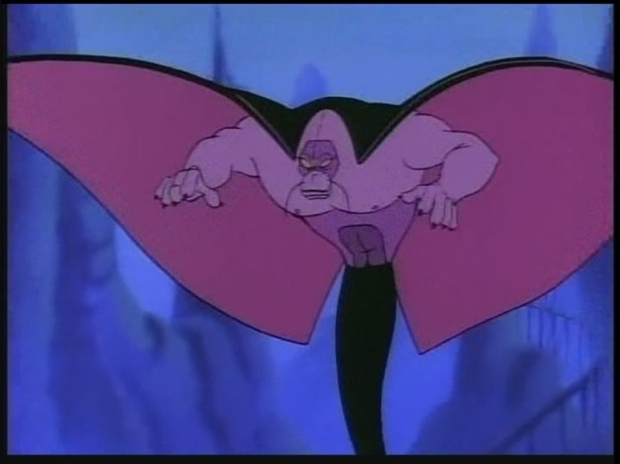
Anyway, remember the Under the Sea sequence from the original movie? Sure ya do. Well, it turns out that’s just how life is in Atlantica all the time, a never-ending calypso-infused bacchanal under the kindly patrician gaze of beloved despot King Triton. So Triton and Sebastien are taking a trip see the “turtle races” and Ariel and Flounder take the opportunity to go exploring. Near a sinister looking volcano they hear a weak, pathetic voice begging them for help and discover an unseen creature trapped in the volcano’s crater. Ariel wants to help but Flounder reminds her of the legend of a terrible monster that was trapped in a volcano (much like this one actually) by the ancient Atlanticans and that would certainly doom their entire civilization if it was ever freed. Ariel, naturally, tells Flounder not to be such a little bitch and frees the creature which turns out to be…the thing, the thing I just said.
I’m not even going to insult you by telling you who they got to voice him. You should be able to tell just by looking at him.
Look, in my time I’ve clapped back at people who disputed bad reviews I gave with the shop-worn riposte “well it wasn’t made for you!” but there does come a point where you have to admit that something just…wasn’t…made for you. Case in point, over the next few posts I’ll be reviewing a cartoon series made for nine year old girls in the early nineties. And it’s one thing to dunk on DarkWing Duck but beating up on a show made for little girls is cheap even for me. Fortunately, Unshaved Mouse inc. has a nine year old girl on staff and she kindly agreed to watch the series with me. And Mini Mouse peaced out after three episodes so I know it’s not just me. Actual transcript:
“Is this a new show?”
“Oh no, it’s almost as old as I am.”
“Oh, that’s why it’s so…”
“So what?”
“Nothin’.”
And look, I wanted to like this series. Hell, I have always wanted to like this series. I’ve mentioned before that The Little Mermaid was the first Disney movie I ever owned on VHS. I loved that film as much as it was safe for a seven year old boy in a rough North Dublin school to love that movie. And I remember being deeply bored by this series. In retrospect, I don’t know what I was thinking. Not because the series is good (oh no) but it is ABSOLUTELY BUCK WILD.
See this? This is from the episode where Ariel defeats a racism powered Ocean Satan with footwear. I made LITERALLY NONE OF THAT UP.
Can we just take a minute to appreciate how deeply weird DuckTalesis? How would you even explain that show to someone who’d never heard of it?
“Richie Rich if he was an old duck?” That’s not even a premise, that’s a meaningless Mad Lib. And yet, DuckTales was a massive, massive deal. It ran for one hundred episodes, kickstarted the modern era of high quality TV animation and spawned a veritable multimedia empire. What gives? How did a show with such a weird, clunky premise achieve that kind of success? I think it comes down to a few different factors:
Carl Barks was given a job drawing funny little Donald Duck cartoons and decided to use that opportunity to write the Great American Novel. His duck universe cartoons were used as the basis of DuckTales and that’s some damn strong source material.
Mark Mueller’stheme song is so insanely catchy that I can just type “Ducktales!” and your brain has already gone “Woo hoo!”
Scrooge McDuck is basically the Doctor.
Here’s what I mean. The reason Doctor Who has lasted so long is that it’s an inexhaustible premise. There is an alien with a box that can go anywhere in time and space. You will never run out of stories to tell with that setup. In the same way, Scrooge McDuck has something almost as powerful as a Tardis: A metric shit-ton of money.
And this is why the show was able to run for 100 episodes. Scrooge is so rich he can basically buy his way in to any genre you can think of. Over the run they did space-opera, western, time travel, romance, pulp adventure, giant mech battles, horror. That’s the beauty of Scrooge McDuck; he’s a strongly defined character who nonetheless can slot into almost any kind of story. Case in point: the time they made him a superhero.
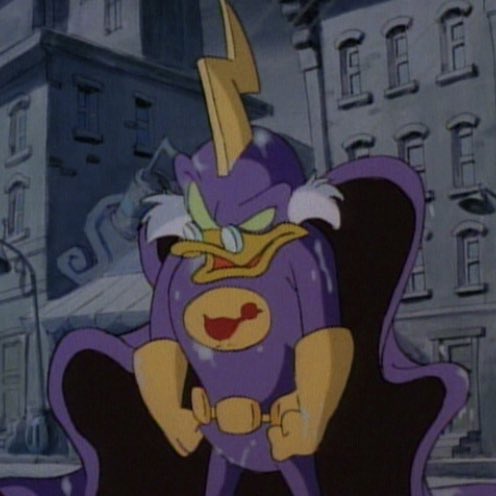
Right, so in Season 3 Scrooge gets so sick of the lying or “fake” news media making people think that the gold-loving billionaire is a bad guy so he decides to become a vigilante and wooooooow this hits different in 2021. Anyway, in order to improve his public image he becomes a superhero called the Masked Mallard.
Stop sniggering in the back, please.
Okay, fast forward a year after DuckTales ended and Disney are prepping a new reboot of The Rocky and Bullwinkle Show only to discover that they don’t actually own the rights to Rocky and Bullwinkle.
“That story makes no sense.”
“Back in the nineties there were still things Disney didn’t own. It was nuts.”
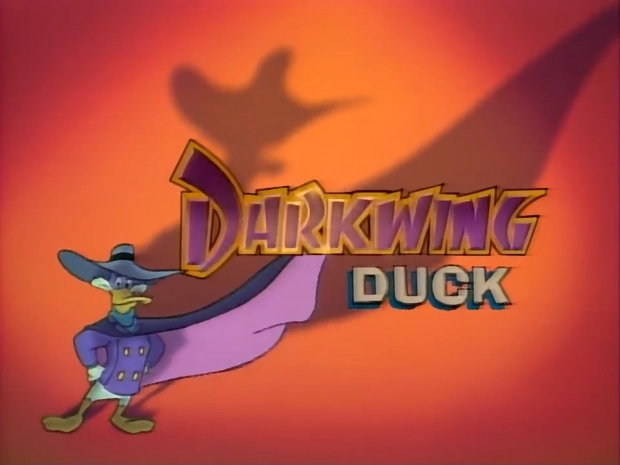
So a hasty, last minute replacement had to be found and they decided on expanding the Masked Mallard concept into its own TV show. The Mallard was re-worked into “Darkwing Duck”, a fedora wearing, cloaked, nocturnal crime-fighter clearly modelled on…
“Don’t say Batman, don’t say Batman, don’t say Batman…”
“The Shadow.”
“Never doubted you.”
And so, as the first stop on our look at Disney cartoon animation for Shortstember, I’ll be doing mini reviews of four episodes of this childhood classic. Let’s get dangerous.
Before we get into the review, I want to address something. Certain commenters (who shall, by virtue of me being the bigger mouse, remain nameless) stated in my last review that I have been “negative” and “harsh” on the Disney canon of late.
Let’s call this out for what it is: VICTIM BLAMING.
It’s a pernicious practice, and I will not tolerate it particularly if I’m the victim. Have I been harsh on Disney recently? Scathing? Even cruel? Yes. But who threw the first punch?
Exactly.
Raya is a historically significant film and definitely represents a demarcation point in the history of the canon. This is, after all, the first canon movie to go straight to streaming (although it did receive a restricted theatrical run). It also, to me, represents the irrevocable “shrinking” of movies. There are no big releases any more, there are no big unifying cultural moments. A few years ago I remember walking home one night and hearing a group of girls on the other side of the road spontaneously bursting into a chorus of “Let it Go” but it kinda feels like that kind of culturally ubiquitous megahit can’t happen any more. There’s too much content. We’re all watching different things. A movie being released in the cinema was kind of an imprimatur of significance, but the cinema might not have survived the decade even without Covid shoving it into a shallow grave. Gloria Swanson was right, she was just off by half a century.
Sorry, this is all frightfully maudlin. I guess for me Raya is less a movie and more a totem of a strange and tragic moment in history.
Also, I don’t really want to talk about it because it sucks and apparently that’s a dangerous opinion. Lindsay Ellis talked shit about this movie and I’m pretty sure she’s dead now or in witness protection or something.
Anyway. Raya and the Last Dragon. Thank you Covid, for sparing me the price of a cinema ticket. I don’t care what they say, ya ain’t all bad.
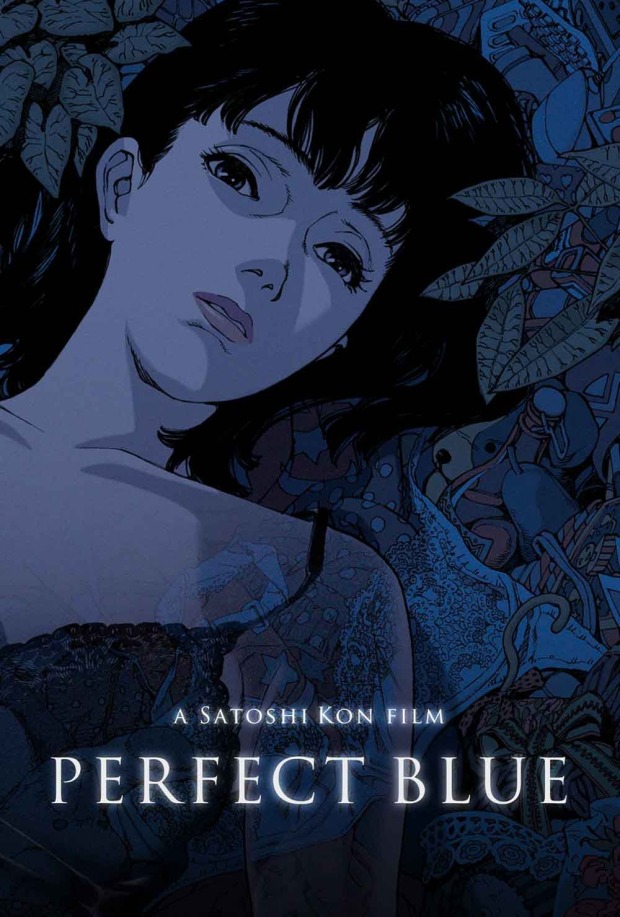
Half a decade ago I reviewed a charming little animé named Tokyo Godfathers from legendary director Satoshi Kon and about as representative of his oeuvre as Interdimensional Cable 2 is of the career of Werner Herzog. True, Kon only directed four films in his tragically short life, but Tokyo Godfathers is definitely the outlier of those four. Perfect Blue, conversely, was Kon’s breakthrough first feature and is probably the film that he is best known for.
In the wake of Akira in 1988, the nineties saw a tsunami of animé arriving in the West. There had been Japanese animation on Western screens long before that of course, but those had been shows that either fit into the Western preconception of animation as being for children (Astro Boy, Speed Racer) or could be made to fit with judicious editing and a wacky robot sidekick (Voltron).
By contrast, in the nineties, animé was out and proud in all its violent, cool, mothers-lock-up-your-daughters-Mr. Octopus-is-single-and-ready-to-mingle weirdness and was starting to bump hard against the deeply ingrained preconceptions of animation in the West. There were a lot of concerned thinkpieces being published, a lot of ominous local news segments beginning with the words “They call it “AH-NEE-MAY”. My first exposure to Perfect Blue was in my local video rental place where they used to publish a weekly magazine advertising the upcoming releases.
“Then, I’d ride the trolley for tuppence.”
In this magazine they had a whole dedicated section for the new animé releases, and I remember Perfect Blue being advertised with the usual breathless ad copy but also a disclaimer at the end saying “please note this movie is not for children”. Back then “animation=harmless fun for my innocent little angels” was still a pretty hard-wired instinct in your typical Western parent and Xtra-vision were obviously trying to head off any complaints from people who’d inadvertantly subjected their kids to the kind of childhood trauma that usually results in a Batman villain. Point is, Perfect Blue was kind of the poster child for why animé was an entirely different beast than Western animation, not simply for its content but also for its sophistication, gritty adult storytelling and reputation as the “scariest animé ever made”.
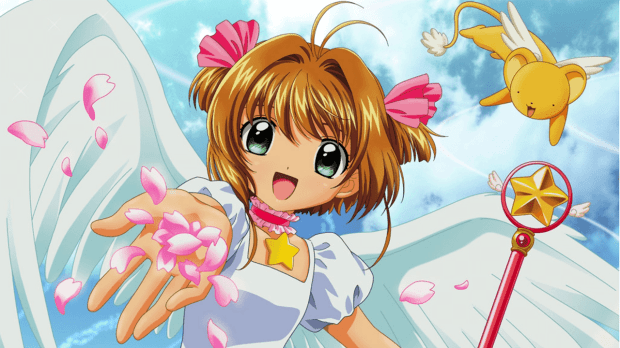
Only if you’ve never seen “Cardcaptor Sakura”.
Now, as any comics fan will tell you, anything from the nineties that claimed to be “gritty and mature” at the time should be sealed in an airlock until all the scans have been completed because there is a damn good chance that it’s held up about as well as the general public’s trust in the polling industry. Plus, “shocking” films tend to look increasingly tame as time goes by. So let’s take a look at Perfect Blue and see if it still deserves either of those descriptions.











 unshavedmouse