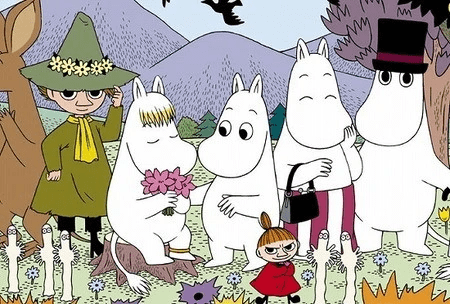
The Moomins are a topic that I feel I understand less the more I try to get my head around them. I tackled another Moomin film, Moomin and Midsummer Madness, around ten years ago so I should have been ready for this. And yet, here I am, looking at this film all…
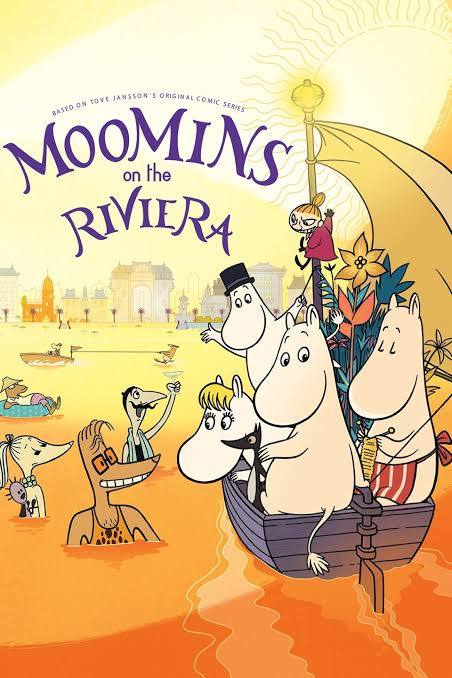
A brief refresher, the Moomins are a multimedia franchise created by Finnish author Tove Jansson that encompasses picture books, novels, short stories, TV shows, movies, theme parks and a comic strip written and illustrated by Jansson herself. The comic strip that inspired today’s film, Moomins on the Riviera, began in 1954 and ran until 1975. This was actually the second Moomins comic strip, the first having appeared in a left wing newspaper but which failed because the readership considered the Moomins to be “too bourgeois”, because even in the late forties there were people who needed to touch some fucking grass.
So what’s it all about?
The series features things called Moomins doing stuff.
I can’t really get more specific than that.
Sometimes they don’t do stuff. Sometimes they just chill.
In 1984, two broke young illustrators named Kevin Eastman and Peter Laird were trying to break into comics. Eastman randomly doodled a turtle in ninja attire and the pair decided that it was a Teenage Mutant Ninja Turtle, essentially a madlib of everything that was popular in comics at the time (except for turtles).
They then wrote a silly little issue parodying Frank Miller’s Daredevil run and that, of course, was that.
This one weird joke concept riffing on an incredibly specific moment in comic book history in a black and white indie vanished without a trace, the very definition of a flash in the pan.
Wait, no. *checks notes*
It went on to conquer the goddamn world. To this day, TMNT is quite possibly the most lucrative Western comic book property not published by either DC or Marvel. Third most successful toyline of all time. Seven TV series, seven films, multiple videogames, hundreds and hundreds of comic issues and a metric shit-ton of merch. Which, on the one hand, is crazy.
How did a concept so ridiculous, and so seemingly instantly dated become one of the most successful and enduring pop culture phenomena of the past half century? Well, success has many fathers. Firstly, I think the franchise’s longevity was sealed with this:
A theme tune that catchy only comes around once in a blue moon. Play it over NINE SEASONS and it’s practically brainwashing.
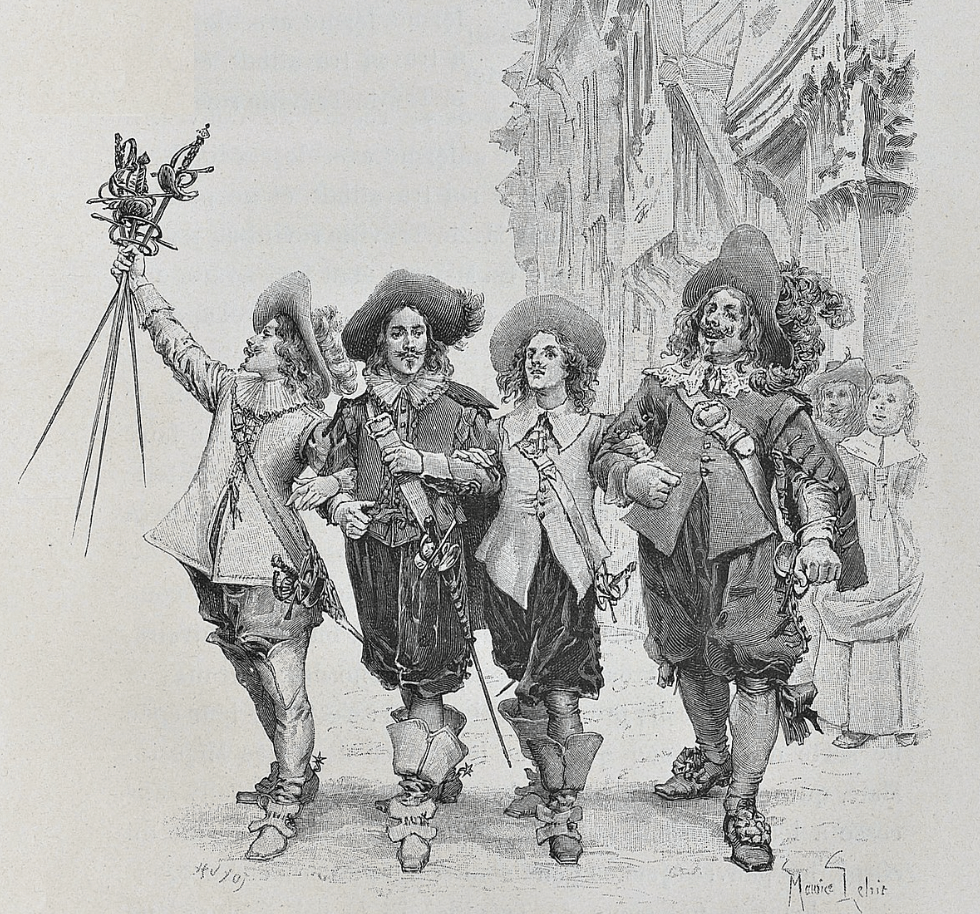
Then there’s the fact that TMNT relies on a template that has proven to be amazingly durable over the last 180 years.
Hothead. Stoic Leader. Smart Guy. Big fun doofus.
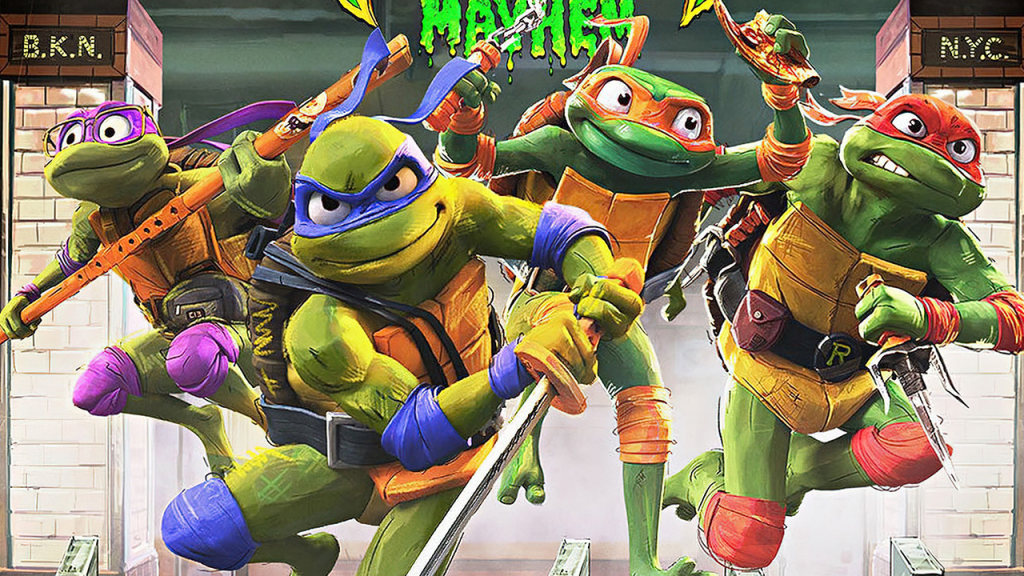
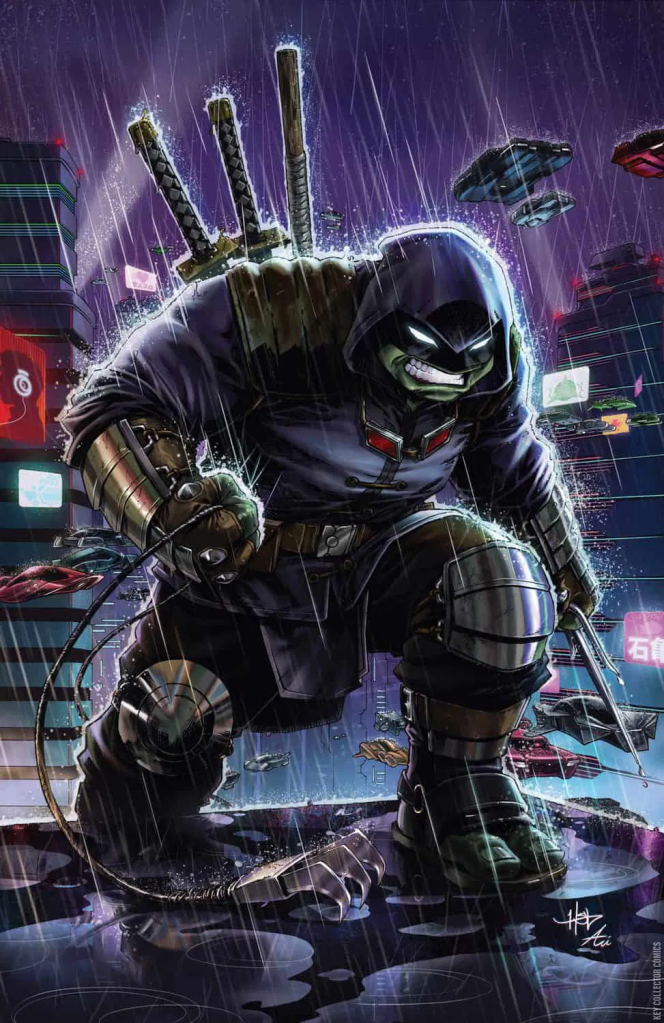
The Musketeer Archetypes are like the Four Chords of character writing. They’re bloody everywhere, but they’re there for a reason. They work, dammit. And these character traits (Leads, Does Machines, Cool but Rude, Party Dude) hold true across virtually all interpretations of the characters which gives continuity across the franchise. But, and this is crucial, with that stability and continuity there also comes incredible plasticity. The Turtles fandom is fantastically diverse in terms of its age range and that’s because TMNT can be this:
Or it can be THIS:
Once you get past the initially (very, very, very) silly premise, the Brothers Turtle can grow with their audience. There’s stuff for kids and there’s also stuff for adults. So, class, where have we heard that before? A character that has a rock solid core that’s also surprisingly adaptable and can tell stories for any and all ages?
So before we go any further, I owe you all an apology. I know I said I’d be reviewing Turtles Forever but you need to know three things:
My DVD of Turtles Forever didn’t arrive in time (that’ll teach me to support physical media).
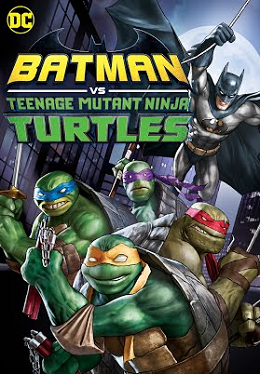
There’s a Turtles movie with Batman in it, how am I NOT going to review that?
So let’s unpack this joke. Here is everything you, the viewer, need to know for this gag to land.
This is Elektra, played by Jennifer Garner.
Garner first played this role over twenty years ago, in the critically reviled Daredevil, and then again in the practically unseen spin-off Elektra.
In Daredevil, she was the love interest of the title character.
Daredevil was played by Ben Affleck.
Garner and Affleck married shortly after making that film.
They subsequently underwent an extremely public and acrimonious divorce.
Hence, Elektra is not particularly cut up about Daredevil dying.
And virtually every joke in this thing is that kind of inside baseball uber-specific nerd bullshit that seems positively tailormade to appeal to me, a 40 something male who had comics instead of friends growing up. And yet…this thing made €1.8 billion dollars. This is as mainstream as movies get now.
Super niche nerd culture is no longer niche. The war is over. Everyone is a massive nerd now.
Total domination.
And I now find myself in a very difficult position as a movie critic.
I thoroughly enjoyed this movie. I laughed my ass off from start to finish.
While I know it isn’t true, I like to imagine there’s one guy in Warner Bros who was put in charge of the Batman films in 1989 despite knowing nothing about comics in general or Batman in particular and who spends every day banging his head against a desk and screaming “what the FUCK do you people even WANT?!”
Because to a casual observer, there really is no rhyme or reason to which Batman movies succeed and which fail. Why was Batman Forever a massive hit and Batman and Robina franchise-killer? Why did audiences love Batmanand largely steer clear of Batman Returns? Why is a grim and gritty Batman great with Christopher Nolan but not with Zach Snyder?
And there’s no one answer, really. Audience expectations. The marketing. The directing. The acting. The writing. The music. There are hundreds of factors that decide whether a Batman movie will succeed, same as any other movie. And added to that there is a very specific problem with adapting this character to screen: nailing the tone.
Getting the tone of a Batman story right is a damnably tricky thing, and it’s something that writers have struggled with ever since the character was introduced 85 years ago. Let’s take a moment, firstly, to acknowledge that Batman has often been campy and fun and played for laughs. And often, as in the sixties Adam West series, or Batman: The Brave and the Bold, it’s been done to great effect. But, fundamentally, this is a character rooted in a mashup of crime fiction and the horror genre. Batman stories, from their very beginning, deal with murder, corruption and violence. A child witnesses his parents’ brutal slaying and devotes his life to waging violent nocturnal war against the criminal element. It ain’t baby-town frolics. And I think what trips up a lot of Batman writers is that they succumb to the temptation to wallow in miserabilism. They lean into the violence and the horror and the awfulness of the setting to a degree that it stops being in any way enjoyable.
The best Batman stories have stakes and drama and darkness, but it’s a certain kind of darkness. A darkness that takes itself seriously, but not too seriously. There is a dusting of pulpy camp that stops the darkness becoming overwhelming. It’s a very, very tricky tone to capture and, if I’m perfectly honest, no single live action director has ever managed to capture it perfectly.
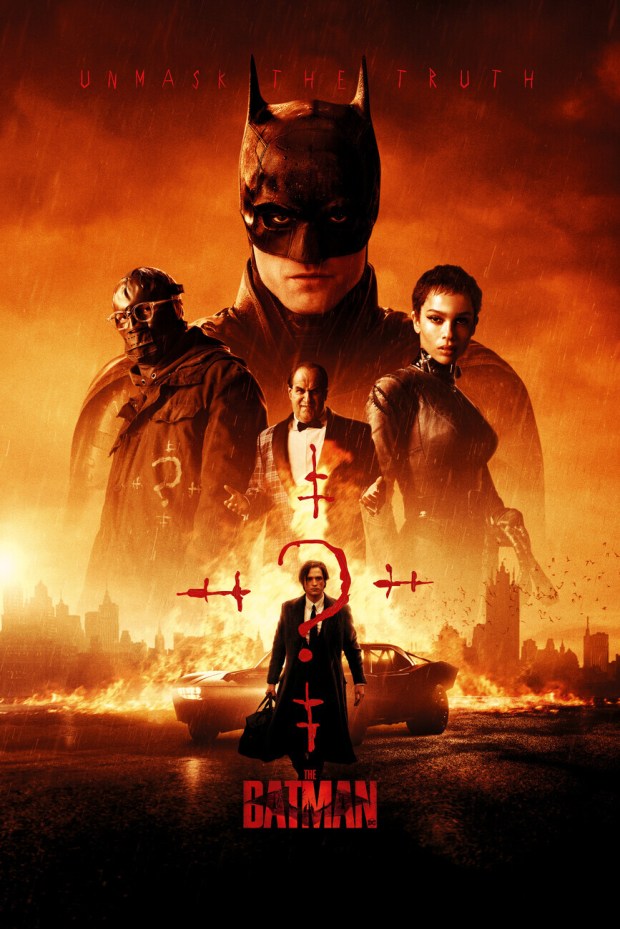
That is, until Matt Reeves knocked it out of the fucking park in 2022.
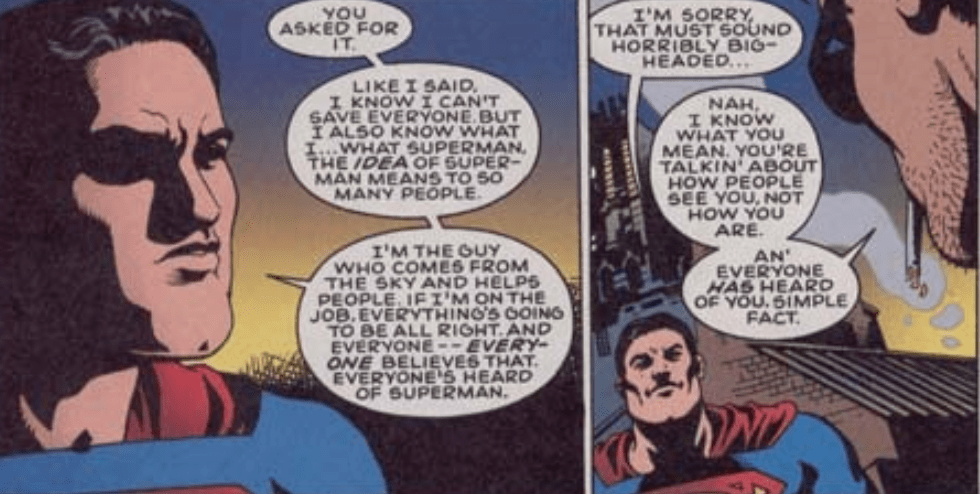
Here’s the big problem with writing a character like Superman: he can’t change the world.
The superhero genre is about taking our world, the recognisable world we live in, and adding a few discreet fantastical elements. That’s the appeal. Ordinary people, trudging to their ordinary jobs look up and see a brightly coloured figure streaking through the air. Is it a bird? Is it a plane? No! It’s Superman!
That’s the magic that the entire genre runs on. Which can create problems when, say, certain real world events have to be incorporated into the fictional reality of the universe.
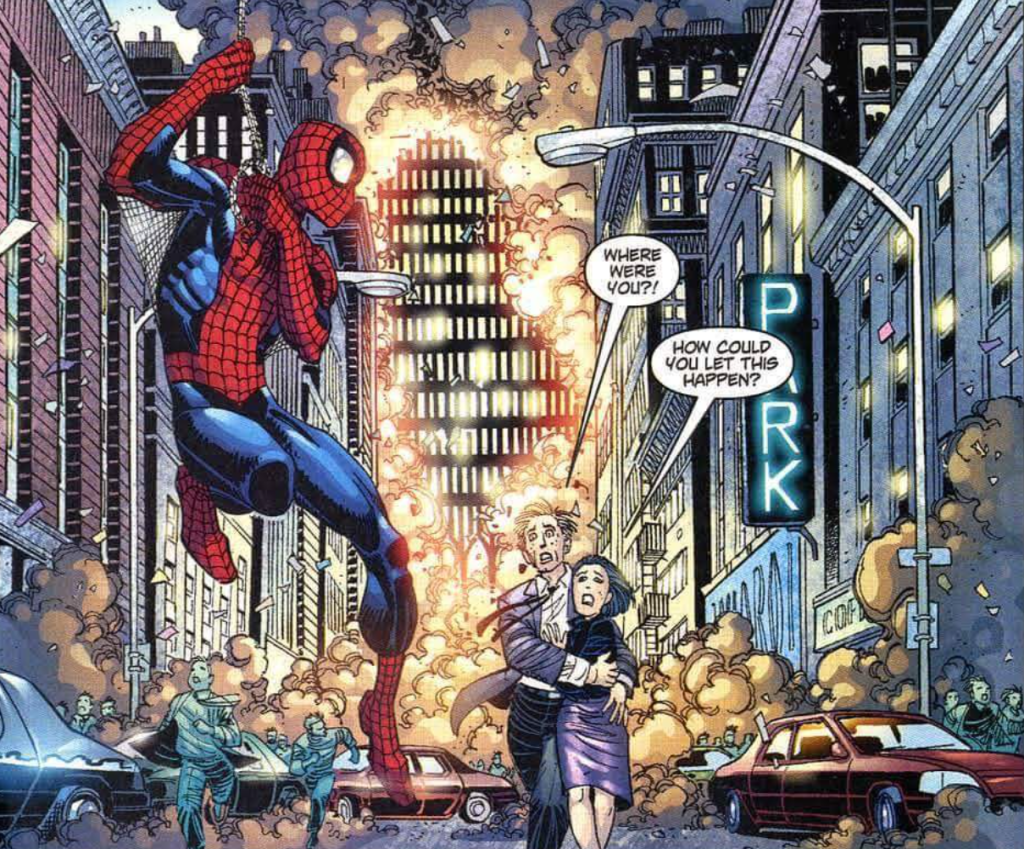
Yeah Spider-man. You should have used your…webs…to stop 9/11.
And that can throw up all kinds of logical head-scratchers. Like (and I’m really, really not trying to be offensive here) ask yourself; would 9/11 even be that big a deal in the Marvel universe? Given that this is the same world where Kang the Conqueror once wiped out the entire population of DC or New York is under constant attack from Galactus, Symbiotes and God knows what else?
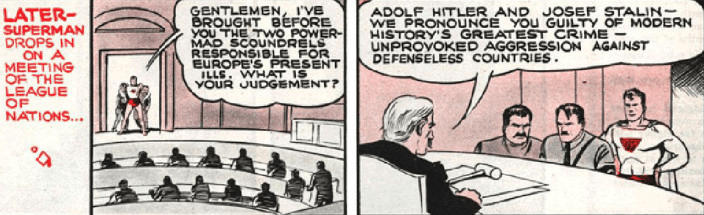
This is not a new problem. In 1940, Siegel and Schuster wrote a non-canon Superman story for Look magazine called “How Superman would End the War”, where Supes abducts Hitler and Stalin and drags them before a tribunal to stand trial.
The League of Nations being useful. There’s some comic book logic for you.
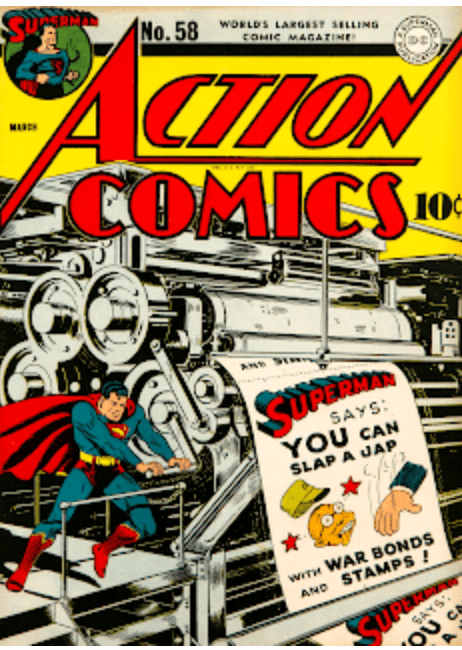
But in the main Action Comics and Superman titles the war went largely unmentioned apart from some now deeply uncomfortable covers schilling war bonds.
Out of universe, the reason for that is obvious. If Superman takes a more active role in world affairs and gets rid of Hitler (or Stalin. Or Saddam Hussein. Or Putin) then his world diverges too far from our own and the story loses that central appeal. It stops being our world and becomes an almost alien alternate reality.
But in-universe, you need to explain why Superman doesn’t just stop every dictator and despot around the world. It’s a problem that a lot of great Superman media has grappled with, and a lot of shitty media too.
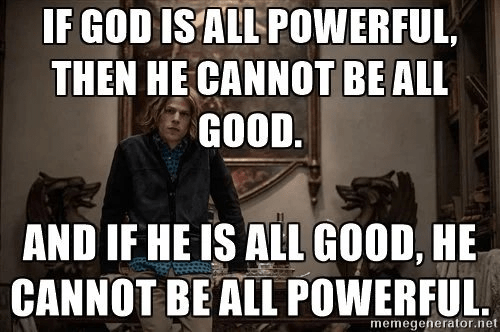
Oh fuck, the Problem of Evil. What a radical new concept.
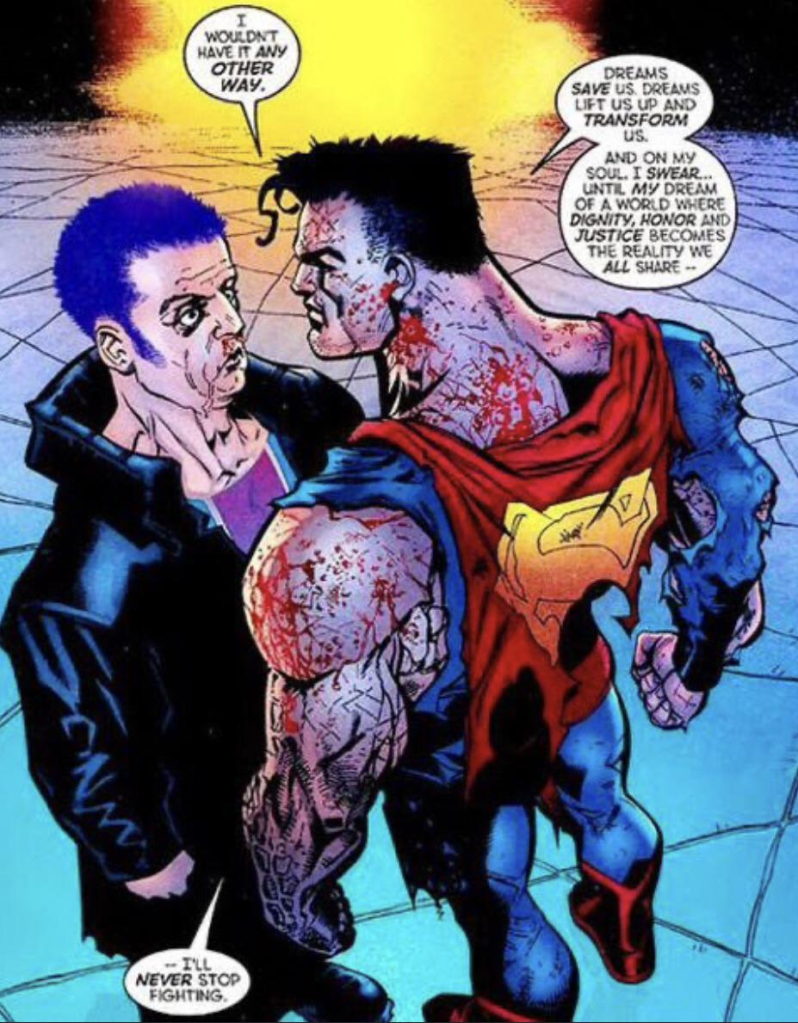
So in 1999, Warren Ellis and Bryan Hitch launched The Authority, a series about a Justice League pastiche that actually does take out dictators and get its hands dirty in global geo-politics. While Ellis intended the Authority to be seen as villain protagonists, when Mark Millar (OF FUCKING COURSE) took over as writer the team’s extreme and violent tactics were portrayed much more positively. The incredible popularity of this run prompted some fans and critics to claim that the nice old status-quo reliant heroes like Superman were strictly squares-ville, daddio, and that political assassinations and low-key fascism were what the cool kids were into. This prompted Superman writer Joe Kelly to pen What’s so Funny about Truth, Justice and the American Way?, where Supes comes face to face with a very thinly veiled pastiche of the Authority and demonstrates that wanting Big Daddy Strongman to come in and fix all our problems and punish our enemies is the cause of, like, 90% of the bad shit in our history as a species.
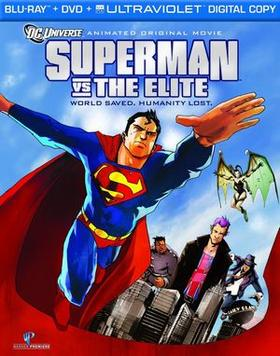
And…here’s where I have to confess to being a fraud and a coward. I haven’t actually read it. Yeah, I know. Even though I self righteously quoted it in the Dawn of Justice review I haven’t actually read the entire story. But, I have seen the 2012 animated adaptation Superman versus The Elite. And I am going to review it. And that is the thing you are reading now. If you’re a long time reader, you probably knew that, but I try to keep things accessible for the newbies.
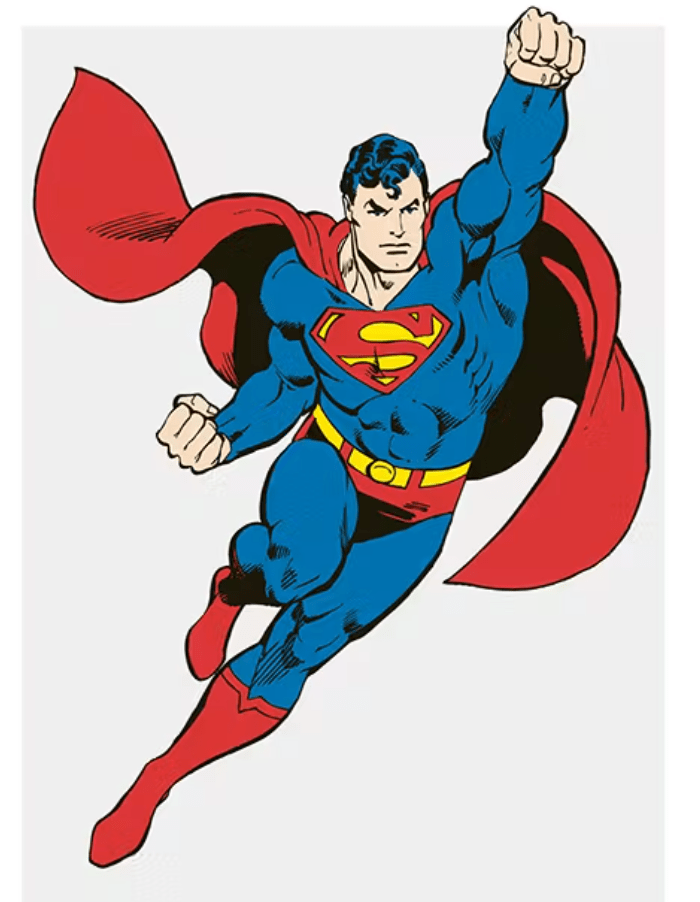
I don’t actually think it’s possible to be a little boy between the ages of 4 and 8 who is aware of Superman and not a fan of Superman. It’s like Star Wars or Transformers. You see this:
And something in your little boy soul just chimes.
So I don’t think there was ever a time where I wasn’t a fan of Superman but as I’ve gotten older I’ve certainly become more of a fan. And I have to say, on behalf of my tribe, it’s a pretty good time to be an enjoyer of Clark Kent. James Gunn is going to be bringing us a new Superman movie next year, both Superman and Action Comics have been enjoying high-quality, well-received runs and My Adventures with Superman is, in my humble opinion, the single best animated depiction of the character since the Fleischer Shortsof the forties. Yes. Better than Superman the Animated Series and Justice League Unlimited. No, I will not take that back.
My point is things are good now. We’ve come along way from…y’know.
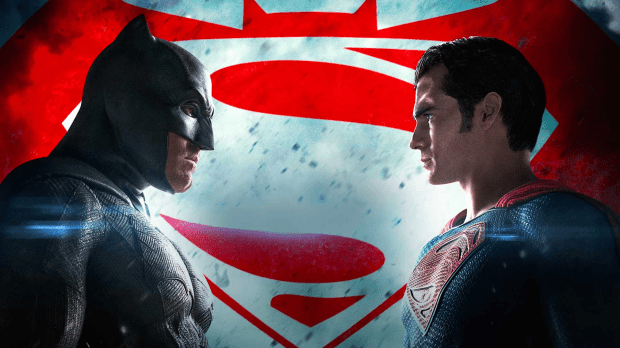
Fuck. There really was a time there when the guy most responsible for shaping Superman’s presentation to the wider world was Zack Snyder.
Future generations won’t believe it. But I was there. It happened.
Alright, let me pull back a little bit. I know you’ve probably clicked on this hoping for some classic, old-school mid-2010s internet rage with all manner of inventive profanity and performative outrage and I won’t lie, I’m not too proud to dance. BUT I want to draw a line in the sand here and make one thing clear.
I don’t hate Zack Snyder either personally or artistically. He is, by all accounts, a lovely guy and the loyalty that he inspires in the actors who have worked with him is genuinely touching. I can’t say I understand the devotion that fans of his movies have to his work but I don’t for a minute doubt its sincerity. People do genuinely, passionately adore his films and respond to them and that can’t be ignored. This is not some studio hack. This is a man who produces works that people respond to strongly, both positively and negatively. This is an artist.
He should not be allowed near Superman. Ever.
He does not understand the character and he does not understand why he matters.
I realise that this is going to come across as just…foam-flecked fanboy ranting but please hear me out. This character is important in a way that very, very few fictional characters are or ever will be. Remember what I said about how every little boy just, instinctively loves Superman?
Okay. Now you may have heard Superman described as a power fantasy for little boys. And to that I say “yes, absolutely he is” and also “why the fuck are you saying that like it’s a bad thing?”
If Superman is a fantasy, what exactly is the fantasy?: “I want to be an all-powerful demi-god so that I can…devote every free moment of my time to protecting and helping those who have less power than me”?
So…you have generations of young boys who will grow up in a world where they will have disproportionate power (of many kinds) over others being influenced by this character and his worldview, modelling behaviours of selflessness, compassion, kindness and justice. You see why that might be, I dunno, a very, very good thing?
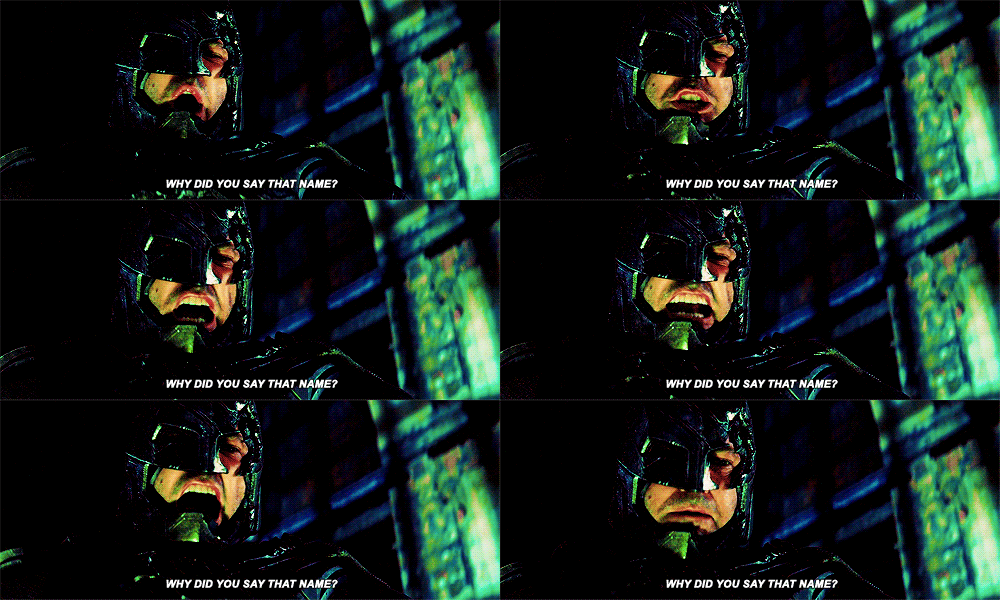
Now here is a quote from Zack Snyder (he’s actually responding to criticism about Batman killing people in his movies but it’s also relevant when discussing his approach to Superman):
“Once you’ve like lost your virginity to this f**king movie and then you come and say to me something about ‘oh, my superhero wouldn’t do that’, I’m like ‘are you serious?’ because I’m down the f**king road on that.
“It’s a cool point of view to be like: ‘My heroes are still innocent. My heroes didn’t f**king lie to America. My heroes didn’t embezzle money. My heroes didn’t commit any atrocities.’
“That’s cool, but you’re living in a f**king dream world, okay?”
And yes, I know juxtaposing that quote with that dialogue from What’s So Funny About Truth, Justice and the American Way has been done so many times it’s cliché at this point but…I wanted to do it and it made me feel good and it’s my blog so there.
Zack Snyder claims that his approach to comics is rooted in Alan Moore’s Watchmen and sure, Moore did deconstruct the tropes of comic books and created superheroes who were deeply, deeply flawed people. But you know what he didn’t do? He didn’t try that shit with Superman.
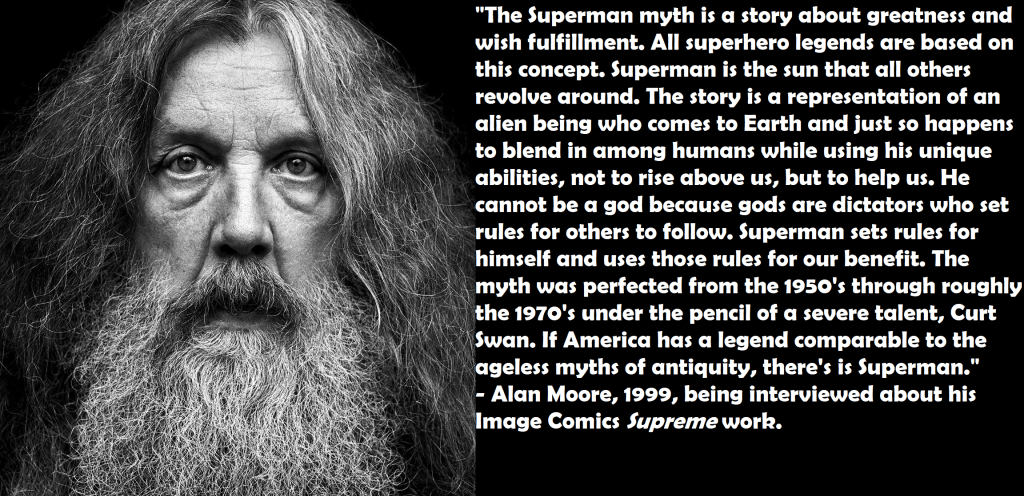
Moore didn’t write a lot of Superman stories but the ones he did featured some of the very noblest, most selfless versions of the character.
Moore gets what makes Superman important, and that it is not something to fuck with.
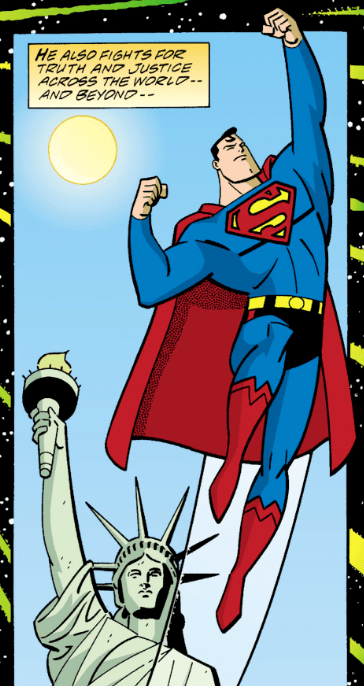
Hell, even Mark Millar and Garth Ennis, the two patron saints of the Shitty Edgelord school of superhero comics. You give them Superman, this is how they write him:
Superman is so fucking good the guy who wrote The Boys can’t hate him.
Anyway.
Hello, welcome to my regular series of movie reviews where I talk about Batman.
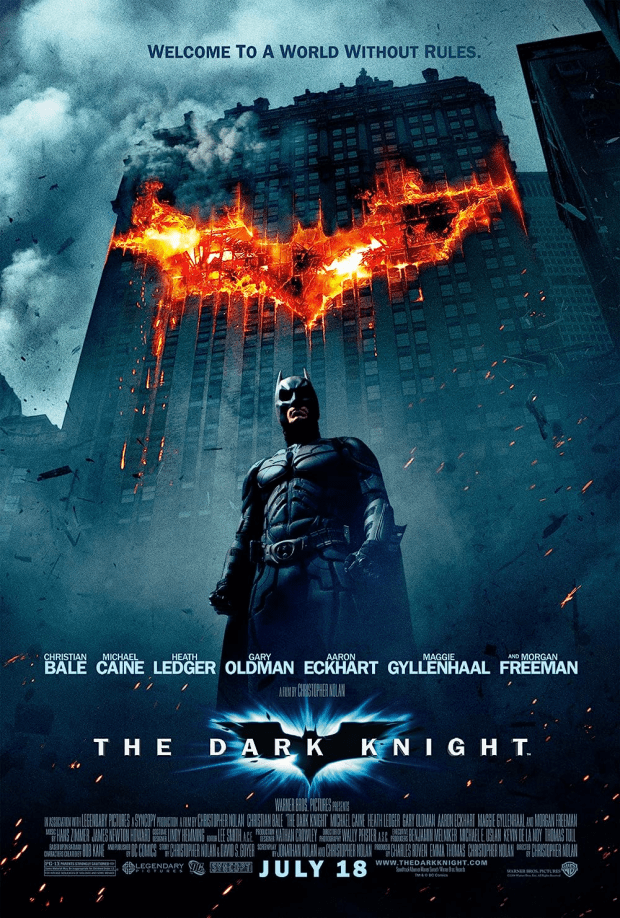
Martin Scorsese supposedly coined the expression: “one for them, one for you”, meaning you do the movies the studio wants you to do in order to do the movies you want to do. The Dark Knight Rises is, famously, one of the most open and avowed “one for them” movies in recent Hollywood history.
Nolan didn’t want to do it (especially after Heath Ledger’s tragic death) and never bothered to hide the fact that this was the hoop he had to jump through to get Warners to pony up for Inception.
But you know what? It’s a myth that great art only comes from passion projects. Plenty of good and even great films have come from people who just showed up to work that day. And look, if the price we had to pay for every Inception was a Dark Knight Rises, I’d take that deal.
But there are problems with this movie. And (bizarrely, given this is the exact same writing team that gave us the fucking GOAT of a script that was The Dark Knight) pretty much all those problems begin and end on the page.
In the past I’ve had plenty of opportunities to extol my favourite film critic, Tim Brayton over at Alternate Ending and now is as good a time as any to re-up. Check him out if you haven’t already. He’s a fantastic critic and an inspiration and so it is with a certain bitter-sweet melancholy that I must report that I have at last surpassed him.
Not in terms of quality of analysis or wit of writing, fuck no, I’m not insane. But you see, Tim actually reviews movies roughly when they come out, like some kind of freak with a work ethic, where as I review movies when I feel like it, maaan.
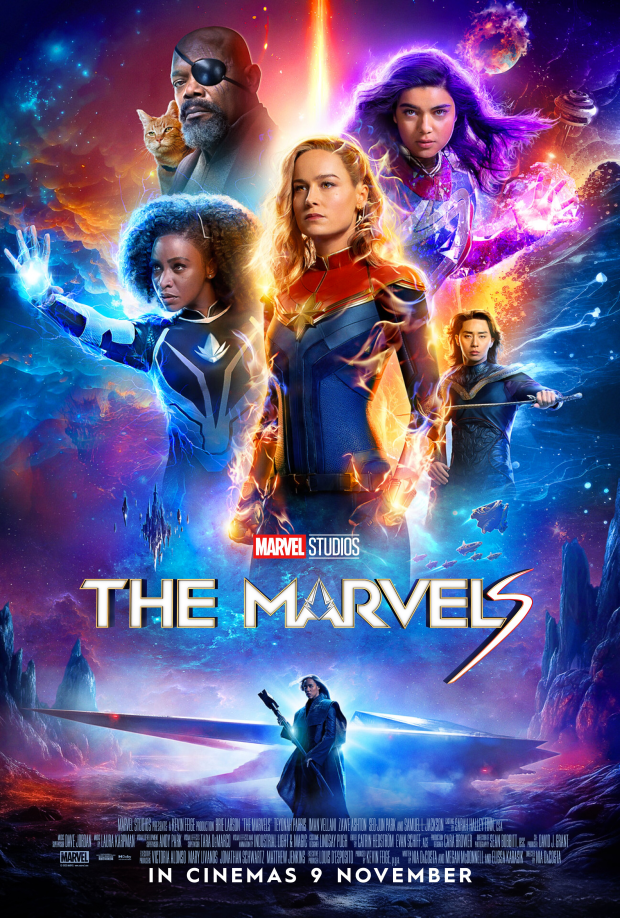
But today represents the first time I’m aware of where I actually beat him to the punch. My The Marvels review has come out before his The Marvels review, a victory whose sweetness is only slightly mitigated by the fact that I’m not entirely sure he intends to actually review this movie, a fact that is both completely understandable and quite damning.
A major critic not reviewing the latest installment of the MCU? How can this be?
It’s like that moment during the trial of Charles the First where the top fell off his cane and no one bent down to pick it up for him. In that moment, he knew he was king no more and also possibly that he was about to get a pretty aggressive haircut.
And look, I wanted to like this one. I want to like every movie I sit down to review. I love a good comeback story as much as anyone. And I had actually heard positive rumblings that this movie was far better than its paltry box-office and mediocre critical reception would suggest. I was even told it was something of an overlooked gem. Who told me that? In retrospect, fools. The movie is (mostly) trash.
Do you want to know how I got these scars into writing about movies?
My college had its own version of “The Onion” where I made my bones writing utterly run-of-the-mill edgy early 2000’s college humour (i.e. the kind of stuff that would get me cancelled today so fast it would break the laws of physics) and my editor asked me if I’d be interested in trying my hand at writing a movie review. And the very first movie I ever reviewed for them (if memory serves) was none other than The Dark Knight. And now you know my gritty origin story. And, if you are old enough to remember my earliest reviews (DON’T GO BACK AND READ THEM DON’T YOU DO IT I SWEAR TO GOD) you’ll remember that this movie was a BIG deal to me and those early reviews are chock full of references to it, even when they weren’t relevant or funny. Which was all the time. I see that now.
So, as you can imagine, I approached this one with a great deal of trepidation. Is it really as good as I remember?
The MCU fell from grace the way Hemingway’s Mike Campbell went bankrupt, slowly and then all at once.
I think we all felt it, didn’t we? At some point this year, probably in the summer when Barbenheimer was in full swing, there was a moment when all of us who had still not disembarked from the hype train took a look at the MCU and said “nah, I’m done”.
And you probably have your own explanation for why that is. Endgame was the peak and it’s all been downhill since then. Superhero fatigue. Bad writing. Too woke. Not woke enough. Too much CGI. Martin Scorsese dropping truth bombs. The pandemic. Whatever.
But ultimately, I think the real reason was just…time. The studio execs currently running around trying to figure out why audiences aren’t flocking to their superhero movies anymore are like surfers wondering why the tidal wave they were riding faded away into the ocean.
Guys. It was a wave. That’s what they do.
Granted, it was a wave like nothing we’ve ever seen before. Depending on when you consider the modern age of superhero movies to have begun (the first X-Men movie maybe?) we’ve been riding this wave for over twenty years with some of the biggest box-office numbers of all time. But, it really was just a bigger version of every other Hollywood trend, be that “make everything like the Matrix” or “make everything like Transformers” or (if you want to go old school) “make everything a Western”. And trends never last. That’s why they’re called “trends”.
And I’ve been burned enough times before to know not to make any big predictions. Maybe these last two years were just a brief blip in an unbroken streak of cinematic dominance that will stretch on to the death of the universe. But, right now, in the waning hours of 2023 it sure feels like the MCU is done. And I’m okay with that. And I don’t regret my time with it as long as I can pretend Thor 4doesn’t exist.
Because, even if we got nothing else of value from this series of films, James Gunn got to make the Guardians trilogy, and I wouldn’t deny him that for the world.