
(1970s)

Bats versus Bolts: Piss on You! I’m working for Mel Brooks!

Comedy is a lot like politics, all careers eventually end in failure. There have been plenty of Bats versus Bolts matchups on this blog that have been, as one commenter put it “Glass Joe versus Mike Tyson” but this really is a foregone conclusion. On the one hand, Mel Brooks’ 1974 masterpiece Young Frankenstein, which would place in the low single digits on any creditable ranking of the greatest American comedies of all time. And on the other hand we have 1995’s Dracula: Dead and Loving It, a movie so critically lambasted on its release that it killed Mel Brooks’ directorial career stone dead, which is a bit like if Frank Sinatra sang a song that was so bad he was never allowed to perform again. I mean it’s Mel Brooks. If he hasn’t earned a mulligan or two, who the hell has?

(more…)

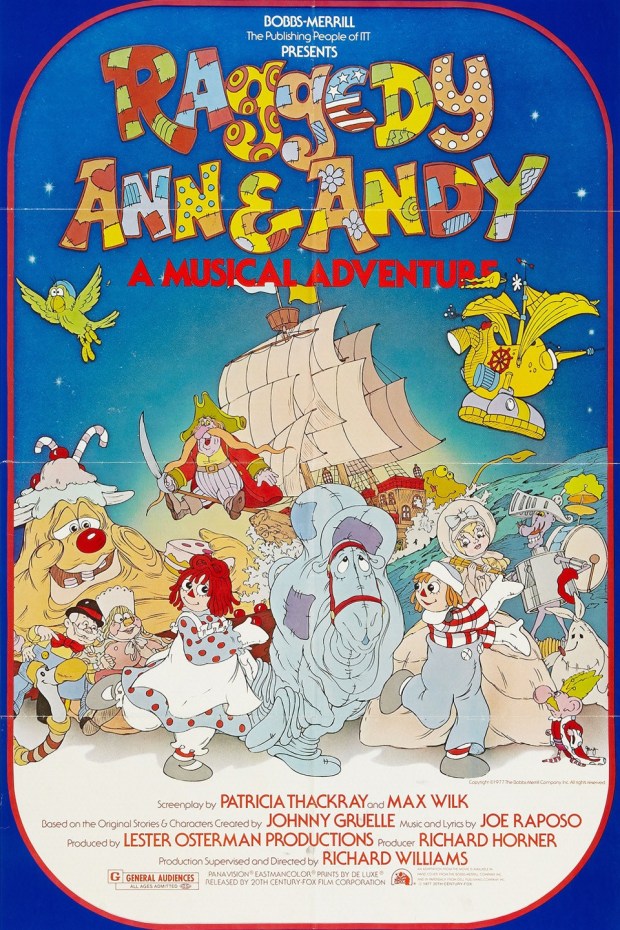
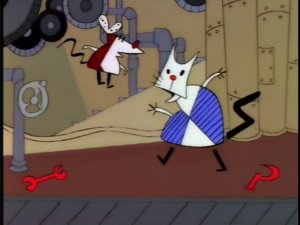
Raggedy Ann & Andy: A Musical Adventure (1977)

What was it about the seventies anyway?

I’ve reviewed a few animated films from this decade by this point and they are all (with the exception of the Disneys) weird as balls.

But I get ahead of myself. I’m going to let you in on a little behind the scenes secret. Ever since this mouse escaped the rat race and started writing full time, I’ve actually had less time to devote to this blog with work starting on most posts a mere few days before they’re scheduled to go live. This can be a problem when I starkly under-estimate just how much there is to research on a given movie and go plummeting down rabbit-holes

And my oh my, Raggedy Ann & Andy: A Musical Adventure is less a field full of rabbit holes than a giant hole with occasional bits of field clinging to the edges. But okay, a little background.

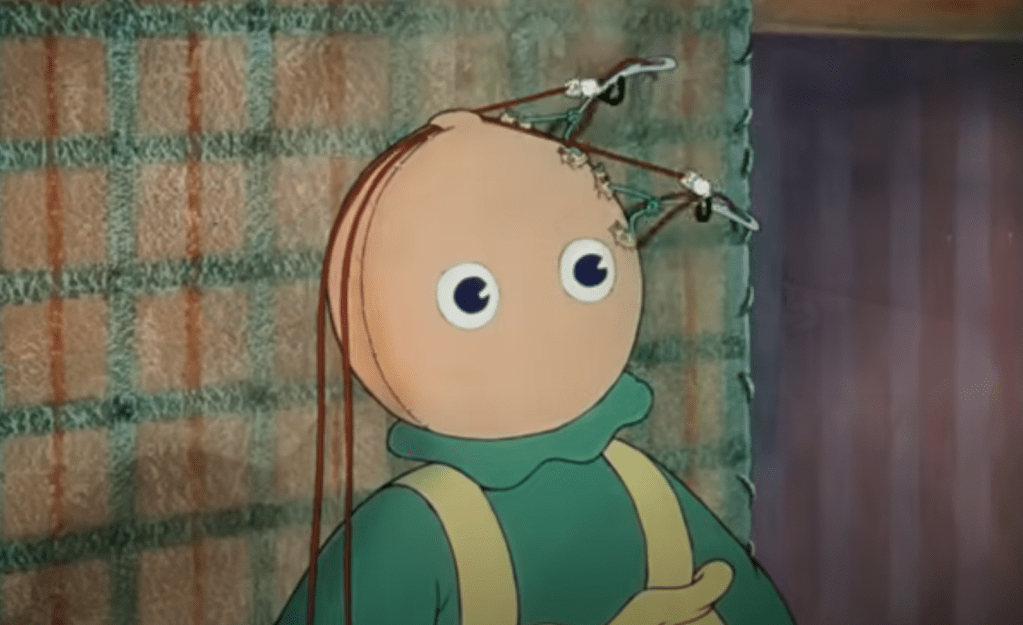
So waaaaay back in the 1910s an American named Johnny Gruelle patented a doll that he named Raggedy Ann and then wrote a series of stories starring her, which were such a success that Raggedy Ann became possibly the first bona-fide modern American toy fad. And, of course, as Jane Austen herself once said “it is a truth universally acknowledged that a toy franchise in possession of a fortune must be in want of an animated tie-in.” And boy howdy, did Raggedy Ann manage to get some impressive talent over the decades. For starters, there was a short series of Fleischer cartoons that were (naturally) as charming and well made as they were horrifying.

No context for you. None.

There were also two television specials produced in the seventies by Chuck Mofawkin Jones. But, without a doubt, Raggedy Ann’s most famous foray into the world of animation was 1977’s Raggedy Ann & Andy: A Musical Adventure which is…well, it’s something.

Here’s what it’s like. Imagine Hasbro want a new Transformers movie. And the director they initially tap dies and so they bring in a replacement; David Lynch. And now Optimus Prime is dancing with a backwards talking midget in the red lodge. That’s kind of what happened here.

Lynch in this instance was Richard Williams, who we’ve had our dealings with in the past. One of the best animators to ever work in the medium, period, Williams was shanghaid into making a glorified toy commerical and decided to use that opportunity to have the time of his life. This film is basically Williams and some of his most talented animator friends (Betty Boop co-creator Grim Natwick, future Genie animator Eric Goldberg and Art “I created Goofy and sued Walt Disney for unfair labour practices, took him all the way to the Supreme Court and lived to tell of it” Babbitt to name a few) having a ball on the dime of the good folks at the Bobbs-Merril publishing company.

But is it a good movie? Well…

(more…)

Bats Versus Bolts: Movies that had virtually nothing to do with Andy Warhol

These movies are terrible. I’m so glad I watched them.

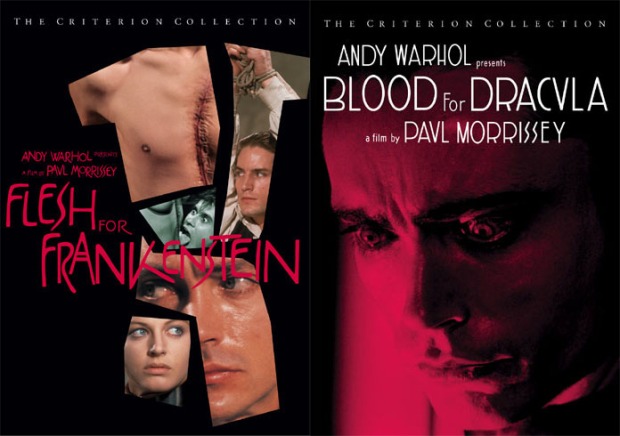
Flesh for Frankenstein and Blood for Dracula are in many ways the best candidate for a Bats versus Bolts  that I’ve done yet. Not only are they by the same director and share many of the same cast, but they were made practically concurrently by the same crew.

Also, when I lie to myself and pretend that there’s some kind of high-minded artistic goal behind this series beyond me getting to talk about vampires and monsters, I like to think that each BvB pair says something about the time they were created in. That is absolutely the case with these two films which are not only seventies movies, but some of the most seventies movies I have ever seen.

These films were directed and written by Paul Morrissey, one of the more fascinating film-makers I’ve come across doing this blog. A member of Andy Warhol’s inner circle (we’ll get to that) he had a front row seat to the drug-soaked bacchanal that was the sixties New York arts scene. Morrissey is fascinating to try to pin down in terms of his politics. A self described right-wing conservative and staunch Catholic…who was also something of a trailblazer in terms of trans representation in film and a body of work that lends itself quite easily to Marxist readings with a consistent portrayal of the aristocracy as a shower of evil degenerate parasites. Like I say: interesting guy. 

Note, I did not say maker of good films.

Anyway, Morrissey claims that the whole idea to make monster movies came about, appropriately enough, from meeting Roman Polanski. Polanski apparently suggested that Morrissey would be the perfect person to make a 3D Frankenstein movie, which honestly I would take as an insult. Morrissey didn’t, however, and arranged a shoot in Italy, filming both Flesh for Frankenstein and Blood for Dracula back to back. Or, as they were known in the U.S.; Andy Warhol’s Dracula and Andy Warhol’s Frankenstein. Why were they called that? Oh, that’s very simple.

Lies.

the-lies-rage

It was just a marketing tactic. Warhol let his friend put his name of the movies to boost the alogorithim. They actually used the same trick for the Italian releases, putting a famous Italian director’s name on them to claim Italian residency which actually got the production in serious legal trouble in Italy.

The resulting movies are Morrissey’s critique of the sticky, shame-filled, bitter and angry come down from the Free Love era that was the early seventies.

That makes them sound a lot more classy and high brow than they actually are.

(more…)

You win. Good day sir.

In 1964 British-Norwegian author Roald Dahl published Charlie and the Chocolate Factory. I wouldn’t call it the greatest Dahl novel (I actually prefer the sequel, believe it or not) but it’s a fun romp nonetheless where you the reader get to enjoy one of the most scabrously funny writers of the twentieth century sit an entire generation of children down and say “Listen up, you little bastards. Here’s why you suck.”

https://static.tvtropes.org/pmwiki/pub/images/Wonka_Book_8934.jpg

However, it has to be said that the ending is objectively terrible. Willy Wonka finishes the tour of his factory, glances over his shoulder and sees that Charlie Bucket has survived his gauntlet of death by dint of having no distinguishing characteristics whatsoever, and essentially says “yes, you, bland cipher child, you shall inherit my chocolate factory!” And that’s it. That’s the ending.

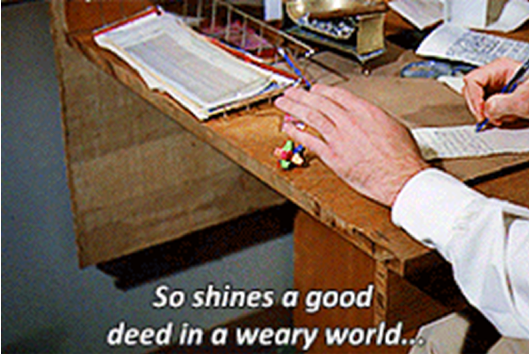
Now, a mere seven years later the book was adapted into Willy Wonka & the Chocolate Factory directed by Mel Stuart and starring the late great Gene Wilder in the title role. The screenplay is solely credited to Roald Dahl but around 30% of it was actually written by David Seltzer, including (I’m pretty certain) the scene I want to discuss. It’s a movie that I love with all my heart and soul and consider one of the very best literary adaptations ever made. I love this film. I love the performances, I love the songs, I love the gags. Those weird, Monty Python-esque skits where the whole world goes nuts looking for the Golden Tickets? I love ’em. And, in my opinion, it improves on the novel in every single change that it makes.

Removing Charlie’s Dad? Makes Charlie more sympathetic and gives Mrs Bucket more of a focus. Having each child only bring in one parent to the factory? Trims the fat. Making the Oompa Loompas little orange dudes instead of Arican pygmies?

But these are all mostly minor, cosmetic changes. There are two scenes added to the story that drastically change the meaning of the story and the character of Willy Wonka. The first interpolation happens between Violet Beauregard being turned into a blueberry and Veruca Salt being sent to the furnace (man, this movie is a fun time). Charlie Bucket and his Grandpa Joe steal Fizzy Lifting Drinks and almost get chopped to pieces by a ceiling fan. They belch their way to freedom and rejoin the tour, with Wonka seemingly none the wiser.

Now, a lot of people hate this addition and I can definitely see why. The whole point of Charlie is that he’s not like the other kids. He’s supposed to be the good one. And, you could argue that by stealing the Fizzy Lifting Drinks Charlie is actually worse than the other kids. I mean, it’s definitely worse than Augustus Gloop drinking from the chocolate river. Wonka just let those kids loose in a chocolate world and told them to go nuts, so why wouldn’t Augustus drink from the river? Why is the river off limits but not anything else? Mike Teevee was definitely out of line but I think the real blame is on the Oompa Loompas for shrinking him. Violet Beauregard may have taken the chewing gum against Wonka’s advice, but at least she was upfront about it and didn’t steal it behind his back! And Veruca…

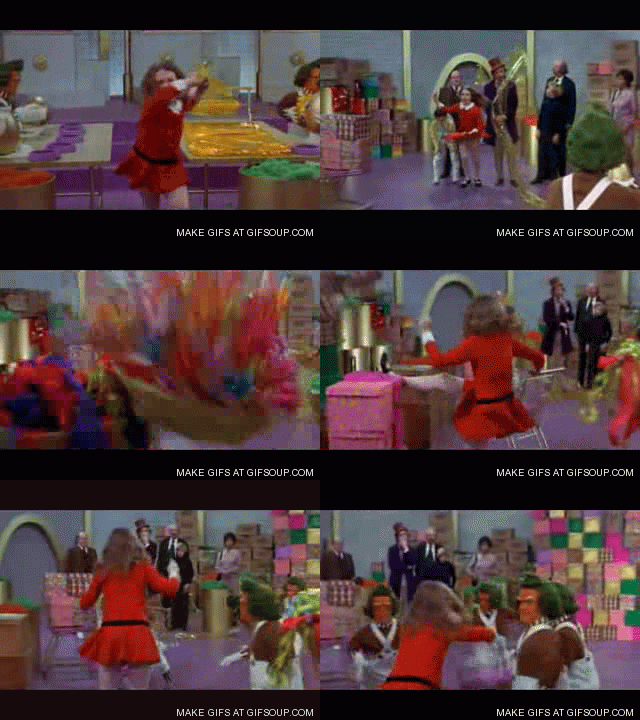
Okay, Veruca just straight up trashed the egg laying room like the Rolling Stones trashing the Miami Hilton.

ROCK AND ROLL!

He’s not worse than Veruca but, other than the upper echelons of the Nazi party, no one is.

(more…)

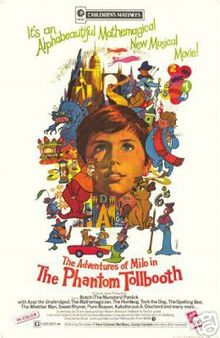
The Phantom Tollbooth (1970)

Like Unshaved Mouse? Please consider supporting my Patreon.

In 1959, scientist CP Snow gave his highly influential lecture; The Two Cultures where he posited that Western civilization had prioritised literature and the humanities to the point that even the most educated members of society were functionally scientifically illiterate. Snow argued that we needed to spend less time on the arts and more time on mathematics and the hard sciences.

Flashforward to 2019 and, as I write this, the most pressing question in contemporary culture is which of a series of interchangeable slabs of orange bacon some wan from Longford is going to put her leg over first so good news, Mr Snow!

“Excellent, so presumably you are all now well versed in the noble sciences?”

“Feller, fer an egg-head you sure do say some dumb shit.”

The influence of The Two Cultures can be seen in The Phantom Tollbooth, Norton Juster’s 1961 children’s novel. Originally released to poor sales, it quickly surged on strong reviews and is now considered one of the classics of 20th century children’s literature something something something segue CHUCK JONES!

Okay, when it comes to the question of who was the greatest Looney Tunes director there are no wrong answers as long as that answer is CHUCK JONES! No disrespect to Tex Avery, Friz Freling, Bob McKimson or Bob Clampett (well, a little disprespect to Bob Clampett the credit-hogging cad). Together, these men created some of the greatest, most timeless cartoon characters of all time and also Foghorn Leghorn and Pepe LePew.

But the cartoons by Chuck Jones are just on another level. They’re not only hilarious (though, my God) they are art. They transcend their medium.

But by the late 1960s Jones had left Warner Bros and was working for MGM, trying to salvage the Tom and Jerry series after the studio had rather disastrously experimented with continuing the series with cheap Czech animation.

Yes, that’s what this was referencing.

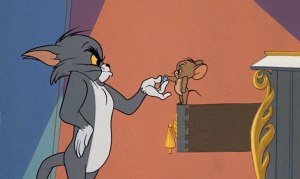
The Chuck Jones Tom and Jerry cartoons were better received but to be perfectly fair Jones’ subtle poised style was always a bad fit for the frenetic Tom and Jerry shorts. I do love his re-designs for the characters though.

But Jones’ last animation for MGM was their adaptation of The Phantom Tollbooth, which is also the only feature length animation he ever directed (not counting various Looney Tunes compilation films). This movie was on heavy rotation in the mouse house when I was growing up, and when the grainy VHS tape that we had used to tape it off BBC 2 was lost there was much wailing and gnashing of incisors which is why my brother requested that I review it.

“Yeah. I did. FIVE YEARS AGO.”

Sorry bro. This one was an absolute bear to track down. I’ve been waiting to do this review for so long that all the Trump jokes were originally going to be Tea Party jokes.

(more…)

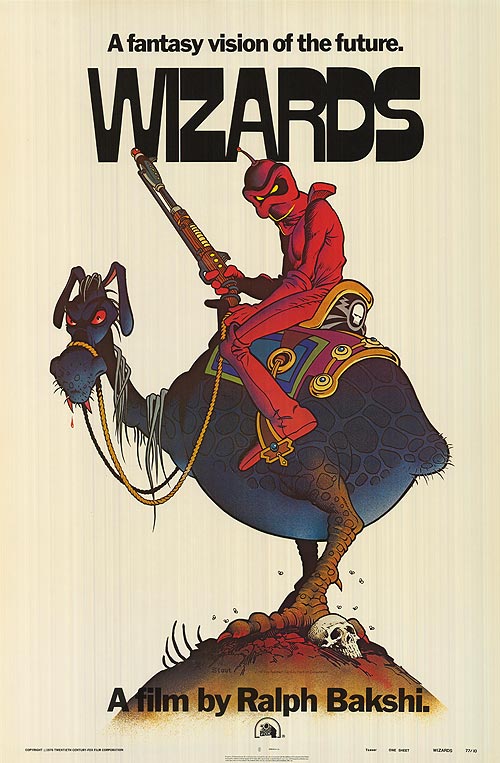
Wizards (1977)

Ah Bakshi, the man they couldn’t tame.

I’ve reviewed two of Ralph Bakshi’s movies now, and even though my feelings on them were, oh let’s just go with “mixed” I have to say I have been looking forward to this one quite a bit. Why? Well, partially it’s because the animation reviews tend to be more fun to write, and also because, even if I don’t think they’re necessarily good films, they’re always a hell of a trip and fascinating to watch and talk about. Look, the guy walked into mainstream animation and just started throwing petrol bombs and I’ve always said I’ll take fascinatingly bad over dully competent any day.

And yet, the more I read up on Wizards (Papa Bear Bakshi’s third feature) the more anxious I got. Wizards is Ralph Bakshi’s most popular movie, and the one that, by Bakshi’s own admission, no one gave him shit over and genuinely seemed to like. This is the movie that even the squares seem to dig.

“You sold out, man.”

“Fuck you, man.”

Could that work? Could Ralph Bakshi actually make a standard, mainstream animated film? Or would his movie lose that inherent grungy Bak-shit insane quality that’s really the only thing that makes his output interesting? What happens when Ralph Bakshi shaves and puts on some damn pants? Let’s take a look.

(more…)

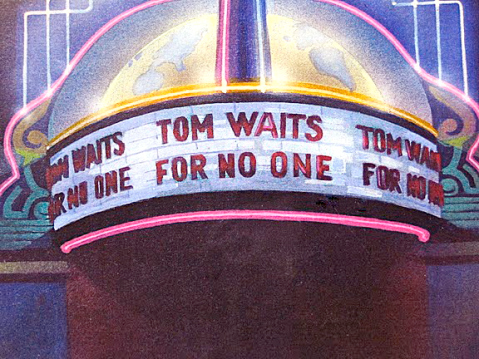
Tom Waits for No One (1979)

So remember when I was going to review ten shorts in one month? Man, I was young then. Anyway, part of the reason Shortstember came to a screeching halt after we covered the sixties was that finding a theatrical animated short released in the seventies is kind of like trying to find a shoe cobbler in 2016. Oh, they still exist. But they’re rare, boy. They are damn rare. By fortunate chance however, today’s short manages to be the absolute apotheosis of everything you think about when you hear the words “seventies animation”. It’s like they squeezed that entire decade of animation history into these six and a half minutes.

Tom Waits for No One was basically a job resume. Directors John Lamb and Bruce Lyon wanted to sell their Lyon Lamb Video Rotoscope technology to Ralph Bakshi, and created the short as a demonstration of what it could do. This probably explains why I can tell you that Ralph Bakshi did not create this short and you still won’t believe me. Hell, I’m not sure I believe me.  It’s the Bakshiest thing I’ve ever seen. It’s also a little NSFW, just so’s you know.

(more…)

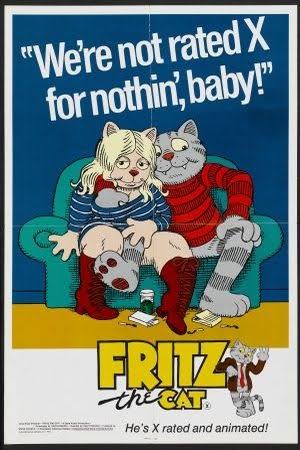
Fritz the Cat (1972)

“Heeey everyone.”

“Heeey everyone.”

“Oh look guys, it’s Spouse of Mouse!”

“Oh look guys, it’s Spouse of Mouse!”

250px-Operation_Upshot-Knothole_-_Badger_001

“Heeey everyone. I was just hoping we could have a little chat before Mouse starts the review. Just us.”

“Heeey everyone. I was just hoping we could have a little chat before Mouse starts the review. Just us.”

“I know you all think it’s really funny that you got Mouse to review Fritz the Cat. I’m sure you’re all having a big laugh. “Ha” you might say, and also “Ha.”

“I know you all think it’s really funny that you got Mouse to review Fritz the Cat. I’m sure you’re all having a big laugh. “Ha” you might say, and also “Ha.”

“But here’s the thing. This movie messed him up so badly that I don’t know if he’ll ever recover. And I’m a simple mouse who lives by a simple rule. You hurt the ones I love?”

“But here’s the thing. This movie messed him up so badly that I don’t know if he’ll ever recover. And I’m a simple mouse who lives by a simple rule: You hurt the ones I love?”

"I WILL FUCK YOUR FUCKING SHIT RIGHT THE FUCK UP."

“I WILL FUCK YOUR FUCKING SHIT RIGHT THE FUCK UP. IF YOU EVER PULL ANYTHING LIKE THAT AGAIN I WILL TRACK YOU DOWN THERE IS NOWHERE YOU CAN HIDE. PAIN? I WILL MAKE YOU LONG FOR SOMETHING AS SWEET AS PAIN.”

“’Kay? Enjoy the review.”

“’Kay? Enjoy the review.”

***

 Do you know what it’s like to review Fritz the Cat? To sit in the dark watching that cat fuck everything that moves, to feel your brain slowly coming apart from the constant assault of surreal, messed up, toked out, crazy shit? No. You don’t. Because you’ve never been out there, man. Out in the real deep shit. This movie man. You don’t know, man. It’s like, you think you have a handle on things, man, like life and art and truth and beauty man like they’re all just packaged and sold in these neat little Styrofoam boxes, man, and then this movie comes along and it’s like, you know man? Like, what does it all mean, man? I…I…I shouldn’t be doing this man, I should be a pair of ragged claws scuttling across floors of silent seas, man…

“Mouse, relax. You’re going crazy over there, man.”
“Mouse, relax. You’re going crazy over there, man.”

"YOU WERENT THERE MAN!"

“YOU WEREN’T THERE, MAN!”

 Sorry. Sorry. I’m alright. Okay. Let’s do this.
For as long as there have been comics there have been “underground” comics, the kind of comics that aren’t read in a newspaper at the breakfast table on a lazy Sunday morning but are more usually read at night. Under the covers. With a flashlight.
Jerkin’ it.
Pornographic comic books or “Tijuana Bibles” were especially popular in the Great Depression and usually featured well known comic book characters or public figures engaging in what scripture calls “the hard fuckin’”. No one was safe. Popeye, Betty Boop, Superman you name it, someone drew them doin’ it.
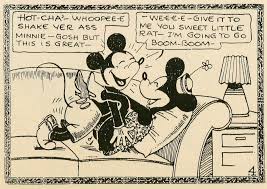
Trust me, just be glad it’s Minnie and not Pluto.

Trust me, just be glad it’s Minnie and not Pluto.

By the 1960s the underground comics (or “comix”) scene had merged with the broader counter culture movement. In contrast to mainstream comics which had to abide by the Comics Code Authority, comix were uncensored and didn’t abide by jack shit. These books were absolutely steeped in sixties drug and music culture, often politically radical and transgressive and extreme in their depictions of sex and violence. They also, it must be said, frequently had a streak of misogyny a mile wide. But at its best, the comix scene produced some of the finest American sequential art of the twentieth century (Art Spiegelman, for example, honed his craft in indie magazines in the seventies).
The one creator who is probably more associated with the comix scene than any other is Robert Crumb and his most famous creation is almost certainly Fritz the Cat, an anthropomorphised cat who’s kinda like Felix crossed with Roosh V. The Fritz strips first appeared in the magazine Help! where the editors famously responded to his submission with a letter saying; “Dear R. Crumb, we think the little pussycat drawings you sent us were just great. Question is, how do we print them without going to jail?” The comic became a genuine breakout hit and was read by many a long-haired hippie degenerate, one of whom was our old friend Ralph Bakshi.
Bakshi had set up his own animation studio and was looking to create animation for adults. He came across one of Crumb’s books and bought the rights to the strip. Warner Bros originally were going to fund it but then they saw Bakshi’s early shoots.
Vapors
Instead, the movie ended up being funded by Cinemation Industries, purveyor of such highbrow classics as The Black Godfather, Sweet Sweetback’s Badasssss Song and The Eighteen Year Old Cheerleaders.
It’s important to remember that there was a weird period from the late sixties to around the mid-eighties where porn was pretty much mainstream, and you could just go to the cinema and watch a big budget porno made and financed by a large studio as opposed to some dude with a camera and a couch. Fritz the Cat is very much a part of that. It’s not solely a porno but it’s got relatives who are pornos if you catch me. So before we get into this review please take note that this is a movie with sex and nudity, pretty grotesque ethnic caricatures, frequent homophobic and racial slurs and some generally fucked up shit.
What I’m trying to say is…

“This review ain’t NSFW for nothin’ baby.”

“This review ain’t NSFW for nothin’ baby.”

(more…)
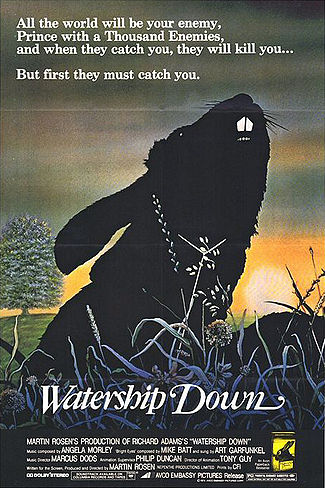
Watership Down (1978)

In the 1970s Richard Adams, a British civil servant and WW2 veteran wrote down a story about rabbits he had told to his daughters. He sent it to a few publishers who rejected it before it was finally printed by a small London based publisher, became an instant international bestseller, won the Carnegie medal and allowed Adams to quit his job and work full time as a writer.
This, and I cannot stress this enough, does not usually happen.
The book’s success was so stunning that it immediately gave birth to a sub-genre of animal fantasy stories. Colin Dann’s  The Animals of Farthing Wood was published a few years later and it feels like half the books I read growing up were about a group of some species of animal trying to get from point A to point B without getting run over by Toyotas. Seriously, there were Watership Down-esque books about hares, owls, squirrels, foxes, otters, even fish.

Yes. This was a real goddamn thing.

Yes. This was a real goddamn thing.

Some were good. Some were terrible. Some were about fish. But none were ever able to match the popularity of the original. Because there is only one Watership Down. Well, until Adams published the sequel in the nineties. Then there were two. Anyway, my point is; other books have fans. Watership Down has cultists. And I’m one of them. I fell in love with this book in primary school and checked it out of the school library so many times that the librarian finally said “You know what? Just keep it.”

Yeah, pretty much.

Yeah, pretty much.

So what makes it so good? Well at the most fundamental level Adams is just a phenomenally good writer with a lovely, clear, elegant prose style that can switch between bucolic descriptions of the English countryside to a muscular blow by blow account of two rabbits kicking the hraka out of each other. Coupled with that, the personalities of the various rabbits are simple but distinct and vivid. Adams based the personalities of the main rabbits on his squad from the war back when he was a smouldering, sensitive young officer with dark unfathomable eyes and a soft voice that could win the heart of any army nurse who crossed his path.

"Jerry's an alright sort. He's just being lead by a bad egg."

“Jerry’s an alright sort. He’s just being lead by a bad egg.”

But the most important trick of any fantasy novel is to bring you into its world. It’s why Lord of the Rings and Game of Thrones are so beloved, because the amount of detail and thought that has gone into crafting Westeros and Middle Earth makes reading the books almost like taking a holiday in a foreign country, albeit one filled with rampaging orcs (so, like Lanzarote).
This is the real genius of Watership Down. Adams gives his rabbits a language and a mythology and threads details of it throughout the larger narrative. And while they have been anthropomorphized to an extent, they’re still very much rabbits. They behave and react like wild animals, and they have difficulty understanding sophisticated concepts like art or, say, numbers higher than four.
Today’s movie was released in 1978, a mere six years after the book was published. And given the length of time it takes to get an independently financed feature length animation off the ground we can probably take it that the movie was in the works almost as soon as the ink was dry on the first print run. The film is now regarded as a classic of British animation and Total Film named it as one of their greatest British films of all time. But it’s also been at the centre of controversy ever since the British censorship board rated it “U” or suitable for all ages, a decision that they are still getting complaints about almost forty years later. And loathe as I am to side with the Helen Lovejoys of the world, yeah. No way in Inlé should this have gotten a U rating.

Yes. "Mild" violence. If youre a fucking DROOG!

Yes. “Mild” violence. If you’re a fucking DROOG.


  But is the movie really as good as all that? Let’s take a look. Spoiler warnings for both the movie and book ahead.
AD

(more…)

Disney Reviews with the Unshaved Mouse #23: The Rescuers

DISCLAIMER: This blog is not for profit. All images used below are property of their respective companies unless stated otherwise. I do not claim ownership of this material.


***

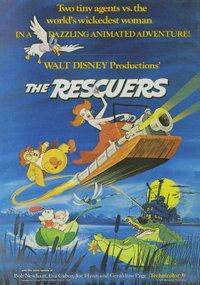
So. The Rescuers. Most successful animated film ever made at the time. Did you know that? I sure as hell didn’t. The Disney studio’s first big animated hit since The Jungle Book ten years previously, and the last until The Little Mermaid twelve years later. Oscar-nominated for Best Song and nominated for the American Film Institute’s list of the Top Ten Animated films of all time (NOTE: This post originally stated that it made that list. Apologies for the error.). People were saying it was the best Disney film since Mary freaking Poppins. And to that all I can say is…

Really?

No, I don’t hate it but…

Really?

Of all time?  Because I can think of ten animated movies from Disney alone that I would put ahead of this. And as for being better than Mary Poppins?! I mean, Jesus!

"Say that again. I dare you. I double dare you motherfucker."

“Say that again. I dare you. I double dare you, motherfucker.”

And yet a lot of people have been telling me how much they’re looking forward to me reviewing this movie. How to account for the love this movie seems to engender in people?

I have a theory. Y’all just love mice.

Not that I blame you. I mean, look at me.

Not that I blame you. I mean, look at me.

Do you know what finally broke the Rescuers’ box office record? Hint; it wasn’t Ariel and it wasn’t Disney.

Durrrr...

Durrrr…

Yeah. From the late seventies to the late eighties everyone was just, really, really into cartoon mice.

Well, anyway let’s take a look at the film.

(more…)