(DISCLAIMER: This blog is not for profit. All images and footage used below are property of their respective companies unless stated otherwise. I do not claim ownership of this material. New to the blog? Start at the start with Snow White.)
The story of the most beloved characters in the history of British animation begins with the invasion of the Falkland Islands in 1982 by the Military Junta of Argentina. Corporal Nick “Rottweiler” Park of Her Majesty’s Northumberland Fusiliers returned home from the war as a hero with over nine hundred certified enemy kills and was lauded in the press and both houses of parliament as the man who had almost single-handedly won the conflict for Great Britain. However, Park found it almost impossible to adjust to civilian life and, after an argument with a local grocer over the price of a packet of Cheese and Onion crisps, ended up taking the entire rural village of Dutchington-on-Fenth hostage. Incarcerated in Dartmoor prison, Park’s life was changed forever when a relative gave him the gift of a camera and some plasticine. Park later said that he was able to channel his uncontrollable urges to kill into plasticine figures, which he would use to stage horrendously violent scenes with the camera, teaching himself the basics of stop-motion animation in the process. “Once I got all that out of my system” Park would later say “I started experimenting with films where the characters didn’t kill everyone who ever crossed me, and Wallace and Gromit kind of came from that stepping outside of my comfort zone.” Upon being released from prison…
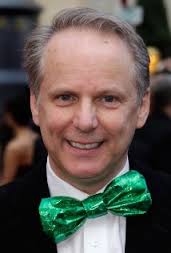
Oh, hello Nick Park. To what do I owe the pleasure?
Yes? What of it?

“Well, I think you may have gotten some bad information. I never served in the Falklands. I’ve certainly never been in prison. And that business with the Cheese and Onion crisps has just been blown out of all proportion.”
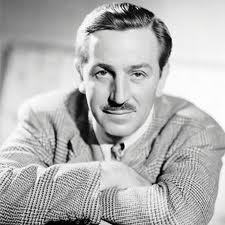
Ah. See, I don’t know how to tell you this Nick but…you’re too nice. The animators I cover on this blog tend to be half mad geniuses tormented by demons the likes of which normal men can scarcely conceive of. I mean, have you even met Walt Disney?
Oh. Oh, you sweet summer child. But anyway, you’ll understand if I had to jazz up your life story a little for the intro. Sorry. Anyway, Wallace and Gromit.
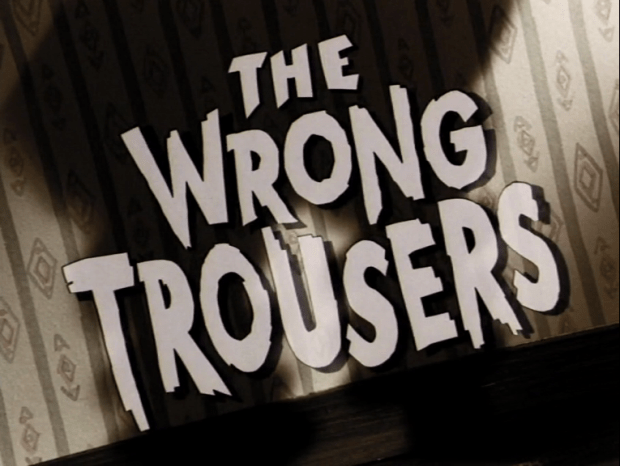
It feels almost gauche to refer to Wallace and Gromit as a “franchise”. And yet, these characters are a pretty massive enterprise. Four short films, one feature, numerous spin-offs, comics, computer games, all manner of merchandise and huge global brand recognition. And yet, Wallace and Gromit have never felt “big”. The series has always had a kind of cosy, intimate charm that is thoroughly English while somehow appealing to a worldwide audience. The premise of the series is simplicity itself: Wallace (Peter Sallis) is a cheese-loving inventor with more technical skill than common sense. Gromit, his dog, is his loyal, long-suffering straight man. The first movie, A Grand Day Out, was begun by Park in 1982 when he was still in film school and finally finished eight years later with help from Aardman Animation who had hired Park to work for them. Today’s movie, The Wrong Trousers, is the second Wallace and Gromit short and is pretty unanimously considered to be the best of the series.
Why is it so good? Let’s take a look.
(DISCLAIMER: This blog is not for profit. All images and footage used below are property of their respective companies unless stated otherwise. I do not claim ownership of this material. New to the blog? Start at the start with Snow White.)
Oh boy.
Where do I start I don’t even?
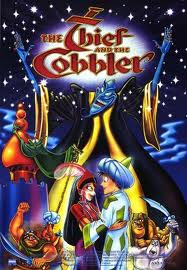
Movies, as a general rule, do not happen overnight. Making a film is a long, laborious, expensive process and can take years. Even so, some movies just take this to ridiculous extremes. The longest production time on record for a live action film is the twenty years it took Leni Riefenstahl to finish Tiefland. That record is surpassed by only one other film, our subject for today, Richard Williams’ legendary, famous, infamous, infamfamous unfinished crapasterpiece The Thief and the Cobbler. Thirty one years. In the same length of time it took this movie to see theatres, I went from a sperm to a person writing these words. Thirty one years. And, keep in mind, at least Riefenstahl had the excuse of the SECOND WORLD WAR happening in mid-production.
So what’s Williams’ excuse?
Alright, so time for backstory.
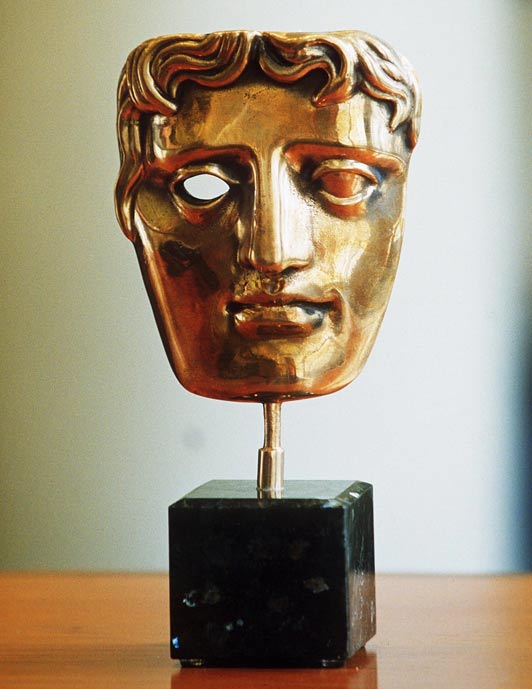
While he doesn’t have anything like the name recognition of animators like Don Bluth or Ralph Bakshi, Richard Williams is serious business in the world of animation. He emigrated from his native Canada to Britain in the fifties and helped himself to a Bafta for his animated short The Little Island. He was twenty five. That launched a long and often highly acclaimed career in animation with Williams’ picking up an Emmy and a couple of Oscars.
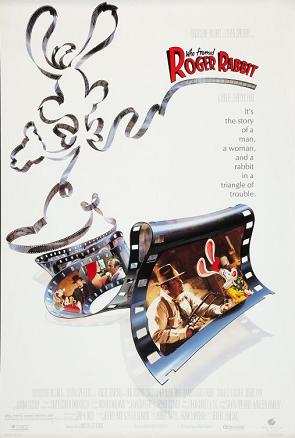
In 1964, Williams began work on Nasruddin! the movie that would eventually become The Thief and the Cobbler. Williams was not humble in his goals. This film was going to be his masterpiece, and raise the bar for animation as an artform. Instead it turned into a logistical nightmare that dragged on for decades, with story and characters being dropped and re-written and backers pulling out. Williams had a vision for the film; animation for adults with very little dialogue. But the various investors he found over the decades also had a vision; they wanted to make money. Williams refused to commercialize the work and for long periods of the production had to fund it himself with the proceeds from various animation gigs. A breakthrough finally came when Williams showed some footage to his friend and mentor, Disney animator Milt Kahl. Kahl, realising that his apprentice had indeed become strong in the ways of the force, showed the footage to Stephen Spielberg and Robert Zemeckis and before long they were sidling up to Williams and asking questions like “Sooooooo…how do you feel about rabbits?”
Williams’ agreed to do the animation chores for Roger Rabbit in exchange for help distributing Thief. After Roger made enough money to buy one of the nicer continents and got so much critical adoration that everyone just started feeling a little embarrassed, Warner Bros agreed to bankroll the project and Williams got to work. He recruited some of the hottest young talent from the animation schools of Europe to replace the original animators, most of whom were now gone. And I don’t mean gone as in “moved on to other projects” I mean “they were taken by the icy hand of death which comes for us all in the end.” Which is what happens when your movie takes longer to complete than, I dunno, a pyramid. But at last Williams was ready to finally finish the film. He had the money. He had the talent. What could possibly go wrong?
Yeah, so as well as being a phenomenal animator Williams was kind of an insane crazy person. He was a fanatical perfectionist and any animator who wasn’t able to meet his insanely high standards was kicked to the curb. According to one source, literally hundreds of animators were pink-slipped. Making matters worse, Williams…
I’m sorry, this is hard for me to even say.
Williams…Williams didn’t believe in using storyboards. Because he felt they were “too limiting”.
Alright, so imagine you have two architects, okay? One sits down, draws a blueprint for a building, decides it’s crap and then throws it away. The other just starts building. And by the time he’s built twenty stories he realises that the building is crap and has to be torn down. Both architects failed to create a building. But one of them has a rolled up ball of paper, and the other has several million quids worth of wasted time and building material. Williams is the second guy.
Because he didn’t use storyboards and basically allowed his animators to improvise scenes on the fly, the only way to figure out that a particular scene wasn’t working was when it was already at least partially animated. Fail to plan, plan to fail etc.
So by 1991 the movie’s still not finished and is massively overbudget (please, no shrieks of astonishment) and Disney are prepping Aladdin for release, a movie that some might say is rather suspiciously like Thief and the Cobbler. Some might say that. I wouldn’t. I say, yeah, you take thirty one years to make a movie someone somewhere will make a movie like it. Law of averages, baby. Warner Brothers finally threw up their hands and said “Screw this, we got superheroes to ruin” and pulled out. And then The Completion Bond Company stepped in which is never a good day.
Animation producer Fred Calvert was appointed by the bond company to hack the movie into something marketable. Calvert renamed the movie The Princess and the Cobbler and tried to make it as close to Aladdin as possible. Miramax bought the rights on behalf of Disney and then did their own hatchet job on it, casting celebrity voices and releasing it under the title Arabian Knight before finally letting it limp to video under its original title of The Thief and the Cobbler. Part of the problem with reviewing this movie is that there are so many different versions of it, the first Calvert cut, the Miramax edit and the (at time of writing) four Recobbled cuts, which are filmmaker Garret Gilchrist’s attempts to restore the film to William’s original vision or as close as possible. For clarity, I’ll be reviewing the Miramax version because that’s the one I have on DVD and it features Matthew Broderick who I haven’t made fun of recently. Come my friends, let us gaze upon the beauty and the carnage.
(DISCLAIMER: This blog is not for profit. All images and footage used below are property of their respective companies unless stated otherwise. I do not claim ownership of this material. New to the blog? Start at the start with Snow White.)

“Right. Then it’s not an ending. You don’t need a big climax. And besides, if you just try to cram in as many cameos and running jokes as you can it’s just going to turn into a massive circle jerk. Your readers just want to see you review a movie they love. Trust your instincts, do the best job you can and that’ll be enough.”
(DISCLAIMER: This blog is not for profit. All images and footage used below are property of their respective companies unless stated otherwise. I do not claim ownership of this material. New to the blog? Start at the start with Snow White.)


In hindsight, Disney dodged a bullet by not green-lighting POGS: The Movie.

Make-a-pact-with-the-forces-of-pure-evil-for-a-chance-of-making-some-bank Disney
Oh-God-what-were-they-thinking? Disney.

I should be a casting director. I should live in Hollywood and have a big house and a fancy car.

Brando used to pull shit like that all the time.

“It’s the EIGHTIES for Gods sake! Do some coke! Live a little!”

You’re nuttier than squirrel poop, what’s to get?
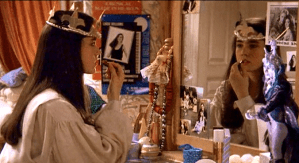
Sarah tells the kid a story about a beautiful young girl whose horrible baby brother was carried away by the Goblin King. Somewhere, in some dark nether-realm, an army of filthy goblins springs awake.

Kinda like what happens whenever someone mentions misogyny on the internet.
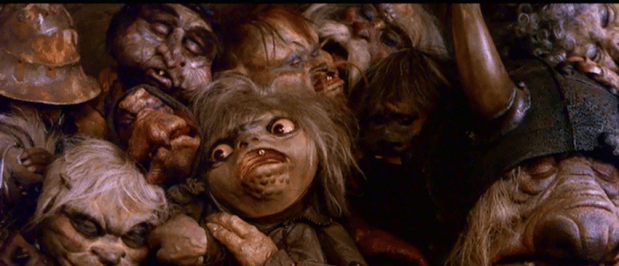
The Goblins listen intently as Sarah says “I wish! I wish! I can bear it no longer! Goblin King! Goblin King! Wherever you may be take this child of mine far away from me!”
The goblins complain that “it didn’t even begin with “I wish”” and I gotta say, I think the Goblins are being overly generous to Sarah here. I mean sure, it’s not a complete sentence but I think any reasonable judge would rule in their favour if they just snatched the kid there and then.
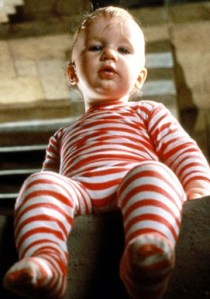
Anyway, Sarah finally does make the wish and leaves the room and as soon as she closes the door the baby stops crying, and I’ll admit it’s an extremely creepy moment.
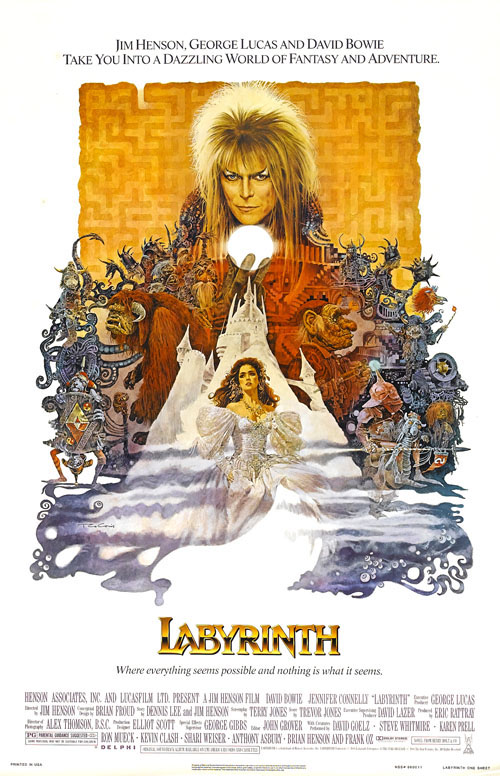
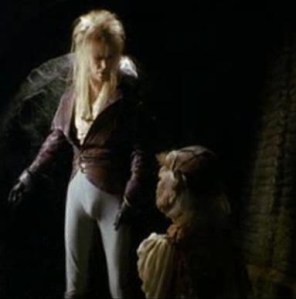
Sarah goes back into the darkened room to find Toby gone and finds herself face to face with the Goblin King (David Bowie, at his very Bowiest). I’ll admit, I love Bowie’s performance here, even though I’m not sure you could exactly call it great acting. It’s kind of like the performance a lot of actors give in Muppet movies, not exactly mugging for the camera but very clearly in on the joke. There’ s no denying that the guy has incredible charisma though, and it doesn’t hurt that he’s sporting a package that would be the pride of a male pornstar or indeed an internet critic.

The Fremen call it “Shai-Hulud”. The Old Man of the Desert.
Sarah begs him to let her brother go, saying that she was actually just joking and Jareth reveals that as well as being king of the land of the Goblins he is also Emperor of the Confederated Realm of No Backsies. Jareth tells her that if she wants Toby back she’ll have to make her way through the labyrinth to his castle in thirteen hours.

“Wow. Shes craaaaaazy.”

“You said it buddy!”

Now step on ’em! Crush their little heads!

Gorgeous.

“What babe?”

“The babe with the power.”

“What power?”

“What power you ask? How about the power of flight? That doing anything for ya? That’s LEVITATION homes.”

“What are you talking about?”

“I…I…think he’s talking about Power Girl.”

The babe with the power.
Bowie is awesome in this song. His goblin backing vocalists are not however, and they really drag the song down. Other than that this song is only really memorable for the scene with Bowie throwing the baby high into the air.

Yeah. I could definitely see Michael Jackson playing this part.
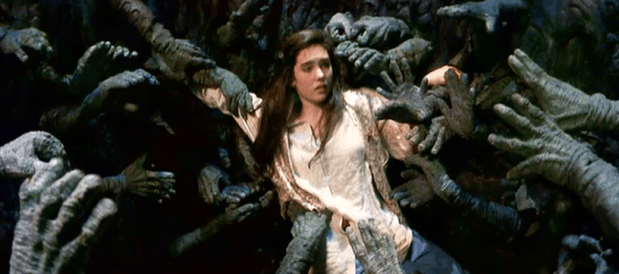
Meanwhile, Sarah comes to two doors that are guarded by Scottish accented moustachioed camels (one of my favourite Saturday morning cartoons from the eighties incidentally) and has to solve a version of the Liar’s Riddle. This scene I actually really like, Connolly seems more engaged in her performance and it actually shows Sarah using intelligence to solve a problem rather than trusting to blind luck. If the movie had done more of this (I say “more” because it does do some) and actually showed how Sarah’s character learns and becomes a better person through her struggles in the Labyrinth I think it could have been a much better movie. The potential is definitely there, and shines through a lot of the time, but the script really needed more work to make the story more about Sarah’s journey rather than a random series of shit that happens to her. Anyway, she chooses correctly (I think?) and falls through an endless tunnel of grabbing hands.

Poor girl. Like travelling on an Italian subway.

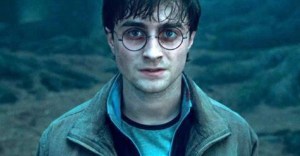
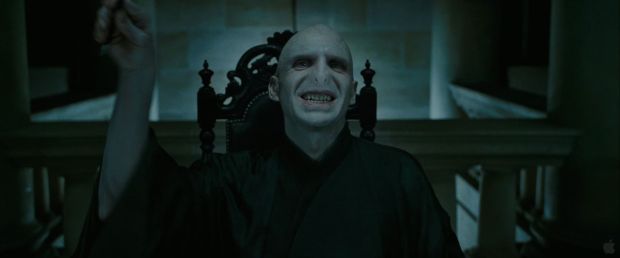
You’re a killer, Harry.
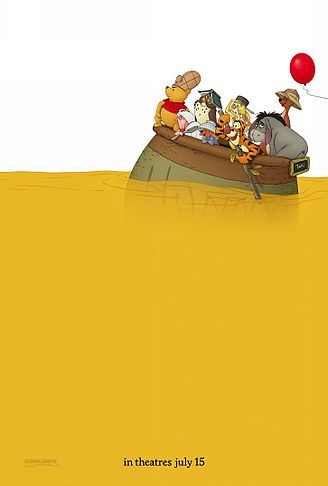
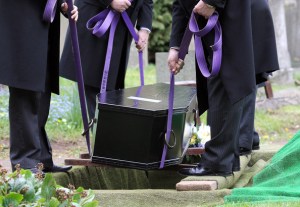
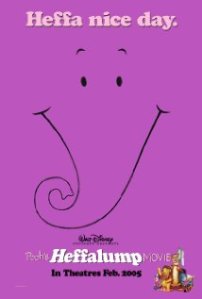
What were you thinking Disney? Sending Winnie the Pooh out, alone and unarmed, against Harry Potter and the Deathly Hallows? In summer?!

“He knew the risks.”
Well, there’s nothing left now. Traditional Disney Animation is dead. Lower him in.

Oh! Hold off the earth till I have held him in my arms once more!

“Mouse. C’mon buddy. You gotta be strong for Latin America.”

“There is nothing inside me. I am hollow now.”
You’re right. You’re right, I’m sorry.
Gotta get a grip.
A grip…
On Daniel Radcliffe’s lily white pencil neck…NO! BAD MOUSE!
As absolutely crazy as it seems it retrospect, putting Winnie-the-Pooh up against Harry Potter probably wasn’t that outlandish an idea on paper. The two properties are aimed at quite different age demographics, and Disney was probably banking on their movie hoovering up all the younger cinema-goers who’s parents wouldn’t be willing to take them to a movie that is essentially Schindler’s List with wizards.

Oh Disney. Your naive belief that parents have any real control over what their children watch is what makes you so loveable.
And while Pooh was undoubtedly the underdog in this fight, let’s not forget that the Bear of Very Little Brain is also the Bear of Massive Merchandising Revenue. Pooh may in fact be the single most valuable character in the whole Disney stable. So why was this movie absolutely crushed at the box office?
Okay fine, because it went up against fucking Harry Potter, but indulge me, please.
Bad reviews? Oh hell, no. Critics ate this up.
The fact that it was released in summer instead of in winter like most Disney movies? Nah, see I never bought the “People won’t go to see movies that are on at different times than movies like that movie are usually on” concept.
I have a theory.
If you want a bloodbath polite and well reasoned debate, ask a bunch of Disney fans how many sequels there are in the Disney canon. Rescuers Down Under certainly. And Winnie the Pooh. But after that? Is Fantasia 2000 really a sequel considering it has no plot? Is Three Caballeros a sequel to Saludos Amigos? And if it is, does Melody Time make it a trilogy since José Carioca and Donald Duck appear in it too? Hell, you could argue that Fun and Fancy Free is a sequel to Pinnochio because they both feature Jiminy Cricket and are both pant-shittingly terrifying.
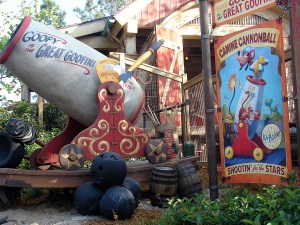
But…if you were to ask just a normal person on the street how many sequels are in the Disney canon they’d look at you funny and ask “What’s a Disney cannon?”

Pictured: A Disney cannon.
Y’see, to ordinary movie-goers the concept of a Disney “canon”, the idea that some movies are more Disney than others is meaningless. Disney made it, it’s a Disney movie. QED. Why should they care which part of the company created it? I mean, let’s be honest here, the whole notion of the canon is just a marketing gimmick that allows Disney to put a seal of quality on some of their movies while allowing them to pretend that their less exceptional output somehow doesn’t matter and OH JESUS CHRIST I’VE WASTED TWO YEARS OF MY LIFE.
Now, Joe Sixpack may not really get what the canon is, but he has slowly, and through painstaking trial and error, learnt one very important lesson:
Avoid Disney sequels like the fucking plague.
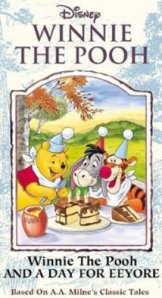
Rediscovering the original Many Adventures of Winnie the Pooh was one of my most pleasant surprises doing this blog. It really is a lovely little film. But it wasn’t the last Winnie the Pooh movie to be released by Disney.
Not by a long…

…long…

…long…

…long…

…long…

…long…

…long…

…long…

…long…

Alright, screw this, I gotta review to write, you get the idea.
And it’s not like these were all straight to video either, quite a few of those movies actually had theatrical releases. So is it any wonder that the public weren’t queuing down the street for this one? They didn’t know that all those sequels were done by DisneyToons and that the grownups were actually in charge of this one. All they knew was that Disney had released a long string of pretty shitty Winnie the Pooh cartoons (no pun intended, I honestly swear to God). It’s Disney’s fault. They didn’t protect their characters.

You release a movie called “Frankenpooh” you deserve every damn thing that happens to you.
So here we are. This is how it ends. But how does it end? With inspiring last words, or a damp fart as the muscles relax with the onset of death?
Let’s take a look.