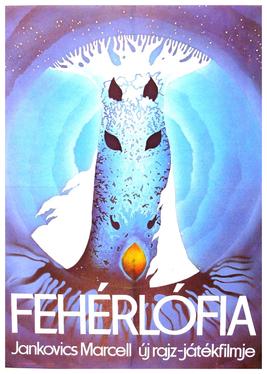
I will probably never watch this movie again.
Not because it is bad.
Because the experience of watching Son of the White Mare again could never top the experience of watching it for the first time.
And you know what’s crazy? This is…drumroll please…my final reader’s request. And the reason I left this one to last was because the requester simply asked me to review “something Eastern European” and I just chose this because it looked interesting. I picked this one almost at random.
And it ended up being…well, we’ll get to that.
Son of the White Mare, (or Fehérlófia in its native Hungarian) is a 1981 film by filmmaker Marcell Jankovics, who created the first feature length Hungarian animated film, Johnny Corncob. He also, apparently, worked with Disney on Kingdom of the Sun, the abortive first attempt at creating The Emperor’s New Groove. And damn, while I wouldn’t give up Groove for anything, I do really want to see what Jankovics would have cooked up.
Anyway, White Mare is an adaptation of a narrative poem published in 1862 by László Arany, itself based on ancient Eurasian folktales. When it was initially released, it flopped hard and even to this day it’s something of a polarising film in its homeland. Outside of Hungary, however, it’s almost universally acclaimed, particularly within the indie animation space. I’d bet good money that this movie is shown to every animation student at CalArts because I kept seeing images I recognised from Gravity Falls, Steven Universe and Adventure Time.
It’s a hugely influential film, but not necessarily an easy watch. That’s not to say that it’s disturbing in its subject matter, or that it’s a complicated film to follow. In fact, the story is incredibly simple, just about the simplest type of story you can tell: a prince goes on a quest to rescue princesses and slay dragons.
The movie begins with a white mare running through a dark forest being chased by mysterious, shadowy beings.
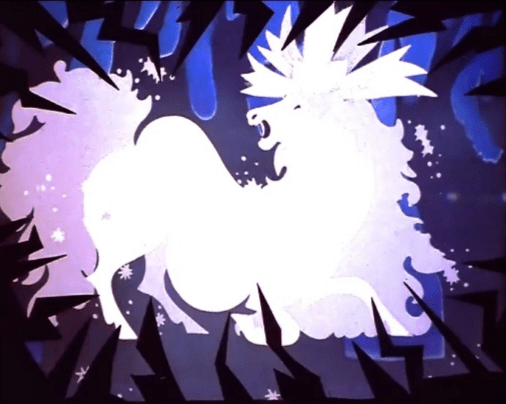
She escapes and gives birth to a boy that she names Treeshaker and tells him a story of the Forefather and the Queen of Heaven who had three sons.
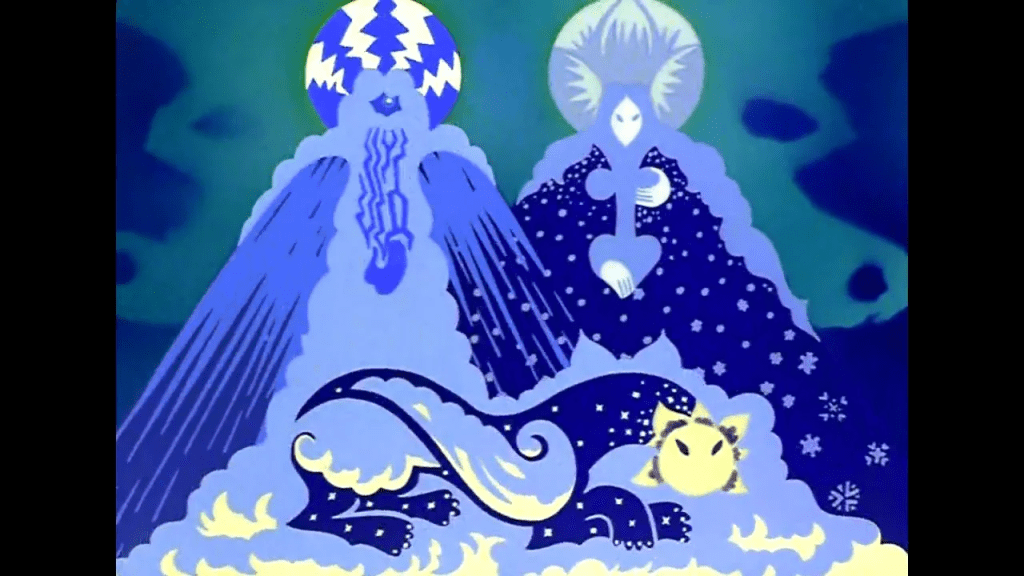
The sons were lonely and so the Forefather created three princesses to be their brides. But the princesses were too curious and freed the dragons that were chained in the dungeon beneath the world. The dragons broke free, took over the world and took the three princesses for their own. So, when he comes of age, Treeshaker goes on a quest, meets his two brothers, teams up with them, and eventually rescues the three princesses and defeats the three dragons.
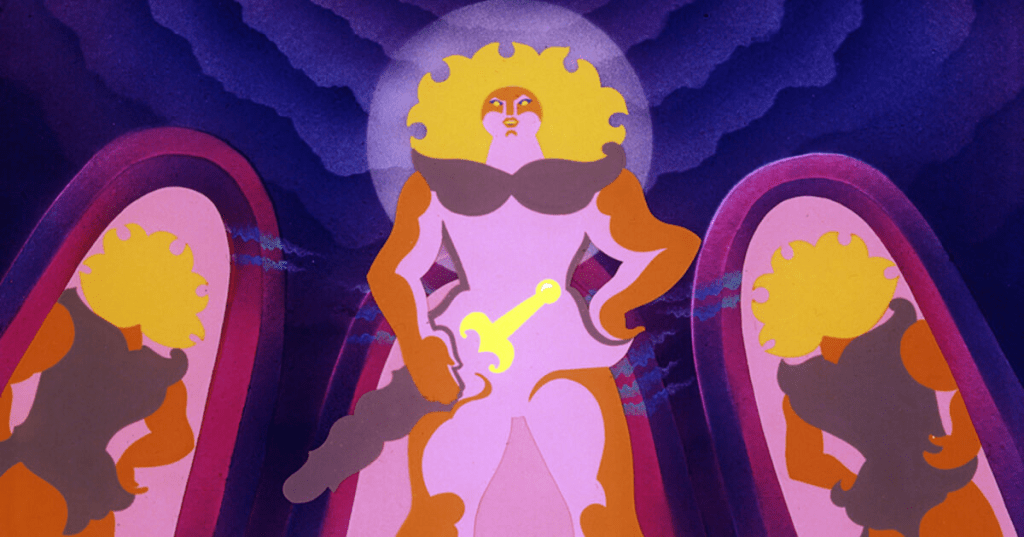
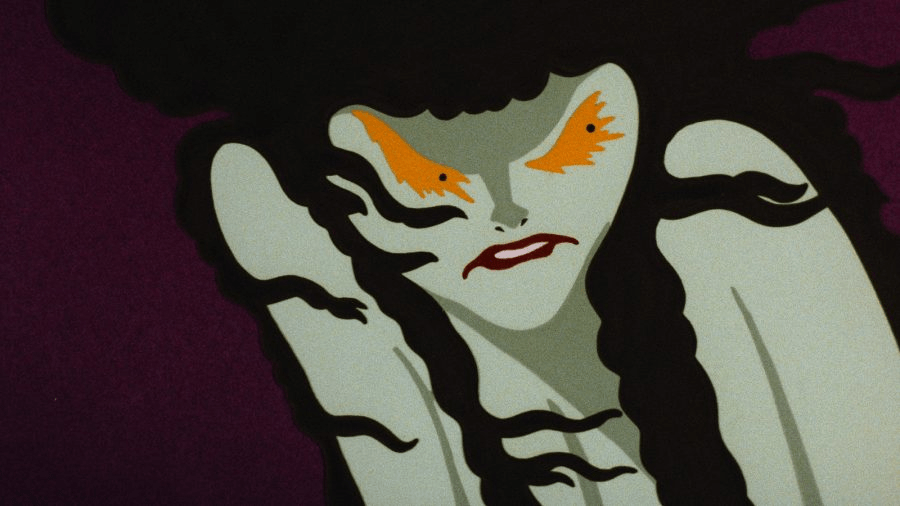
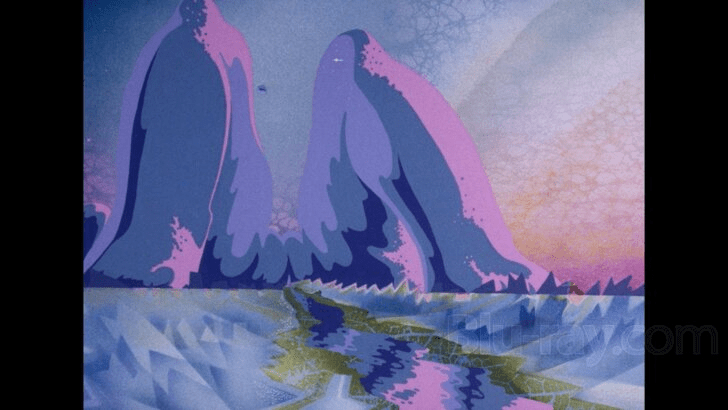
See what I mean? Very simple story. However its imagery is so surreal, so visually dense and so laden with symbolism that you have to focus to avoid just drowning in it.
Most traditional animation uses static backgrounds, with the characters animated over them. Jankovics instead treats the backgrounds and characters as one and the same, animating them both, with both planes running into each other. It creates an incredible, surreal, dreamlike effect that is like nothing I’ve ever seen in either Western or Asian animation. It’s why, even with a plot simple enough that it could be memorised and told around a campfire, you sometimes lose track of what’s going on if you’re not paying attention.
This was, at least partially, by necessity. Hungary in the eighties was controlled by a despotic government intent on silencing and controlling all possible dissent.
Therefore, if Jankovics did intend this as a critique of the communist regime, he would have to hide it under a thick layer of symbolism for his own personal and professional safety.

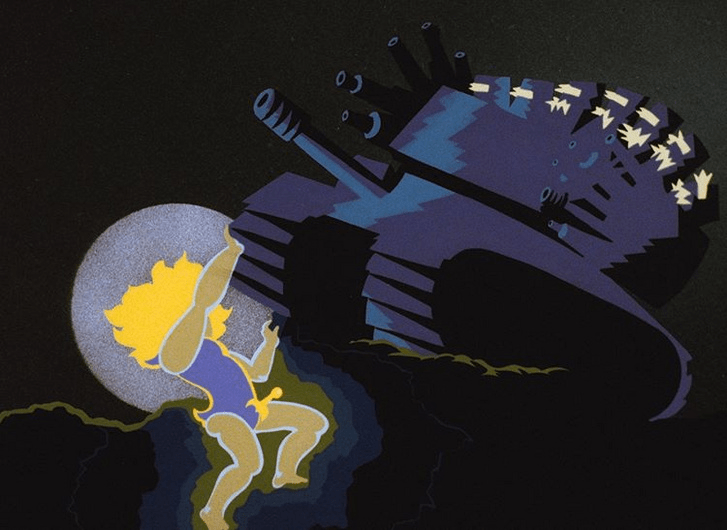
This ambiguity has lead to criticism that the movie is ultimately just a visual showcase with no deeper thematic weight beyond its visuals.
To which I say, even if that was true, have you SEEN the visuals?
I feel like I’m burying the lede here, somewhat.
This is my new favourite animated film.
It is like nothing I have ever seen.
I watched this with my eyes like saucers and my jaw on the floor.
If you’ve never seen it, I urge you to see it with every fibre of my being.
***
Let’s just say that my appreciation for Hungarian animation has increased by around infinity percent from my last encounter. This is a movie that is unique, so visually beautiful, so utterly without peer in what it is trying to do with the medium of animation that finding fault with it seems pointless. To find fault, you’d have to compare it to something equivalent, and there is nothing equivalent.
It stands alone, in every sense.
Which is, why, after thirteen and a half years of doing this blog, I’m breaking a cardinal rule.
FINAL SCORE: 100%
NEXT UPDATE: As per usual, I’ll be taking December off to focus on writing. I’ll have the usual Christmas wrap up and then see you all 08 January 2026 for the next review.
NEXT TIME: God, fifties movie posters went so hard.
 unshavedmouse
Yeah you know what, I’m gonna give this a watch soon, it seems like a genuinely mind-blowing achievement by any standard, but obviously way moreso considering when and where it was made.
You owe it to yourself
I’ve never heard of this movie.
However, I have heard of this myth.
Hungarian folklore is fascinating because it has so many similarities to other world cultures, some thousands of miles away. Like the Norse they have their own World Tree (divided into forests of metal ruled by three brothers). And like so many other cultures based on the steppes, so much of their iconography is based around horses.
One thing I’ve noticed about the screenshots you posted is that this film is rather striking with color. A lot of animation of that era tended to be in a darker pallete so veritable aura of the hero, the gods and the mare is truly quite unique.
Once again you cover some truly out-there films and I think we’re enriched by those choices.
I was noticing similarities with Irish folktales too
Funnily enough, “the story is simple, but the animation is so great it more than makes up for it” is exactly my opinion on the Recobbled Cut of The Thief and the Cobbler.
Cool.
Rare Hungary W
I saw this a long time ago, I think I must have been a teenager (I am Hungarian). I was looking forward to a more detailed breakdown to jog my memory, but this is good too – I’ll take your word for it and just rewatch it
I was going to say that the animation reminds me of some of the other Hungarian animation from that era, such as the Hungarian Folk Tales animated series… but it turns out that’s because Jankovics created that series, too. None of it is as heavy with symbolism as this, and they are for children, but I have fond memories of them. (I don’t think the English dub does them justice – compare the subtitled https://www.youtube.com/watch?v=qFAteUOFzOY to the dubbed https://www.youtube.com/watch?v=NAYe1mYVN6w)
Looking at Jankovics’s filmography, he worked a lot with myths, folk tales, and legends. Kingdom of the Sun with his style would have been insane
This one’s been on my watchlist for years. Probably ought to pull the trigger on that, it looks amazing.
Oh boy! This one was my request. I’d come across mentions of Czechoslovak and Hungarian animation in the 1970s and 1980s but couldn’t find much detail, so someone with more experience and knowledge of animation history might be able to find out more.
I’m so glad this is what it resulted in.
A little note about Hungarian censorship in the 1980s: so rather infamously, Hungary might’ve been the only country where artists and writers got together to actually demand censorship…because officially, Hungary didn’t have censorship! Oh no, expression was totally free, you just risked a visit from the security services and having your career ruined if you wrote the wrong thing.
Which changed constantly. Not for any consistent reason, it’s just that as certain topics or people became officially lauded or denounced due to the political struggles at the top, the official stances changed. Thus something that might be anodyne and even officially approved one day might be denounced the next, and as you could imagine, the effect this had on the Hungarian cultural sphere was generally catastrophic. At the least, went the demand from the Hungarian intellectuals, lay down consistent guidelines for everyone to follow, rather than having to navigate the minefield of what the apparatchiks felt like approving or not based on the often unexpressed desires of the men at the top.
That reminds a lot of Chinese movie censorship. Randomly banning ghosts or time travel for lolz.
Sounds good; maybe I’ll see if I can find it.
this is one of those ‘formidable’ movies that I always dread watching. I fear my expectations might be too high.
Where did you watch this? I’ve been searching for months.
I found a DVD because I needed English subtitles. If you speak Hungarian I think it’s on Daily Motion.
About every half decade or so I write a comment…
I just watched it. I don’t LOVE it like you do, but I really do like it. (Watching it, I was reminded of Fantastic Planet. Inner monologue: “I’m not sure I get it, but I respect the hell out of whoever put this together.”) And I’d never heard of it before your review. Thank you. My world is a slightly brighter place for having experienced this movie.
A few questions (for you or anyone else)…
You mentioned that it’s referenced in Gravity Falls. Where? I believe you, I just didn’t catch it and am disappointed not yo have done so.
You mentioned that it’s NOT well regarded in Hungary (or that opinion is divided). Why? My knowledge of Hungary begins and ends with my knowing how to pronounce Puskas — why are they not proud of this film? (This isn’t like America/France in regards to Jerry Lewis movies, is it?)
Other random thought…
As I watched, I thought once again how much of a sucker I am for “fairy tale” stories. (Don’t get me started on Kubo and the Two Strings or Night of the Hunter!) I’m not sure why. Maybe it’s the promise of a hard road, possibly with sacrifice, that ends more or less happily (though it can be bittersweet too). I don’t know. I just watched a stage show of The Fantasticks recently. Same sort of feeling. I wish I could identify what it is about the stories that resonates, and what it is that makes me feel I’m watching one. I know you’ve thought about Fairy Tales more than me — maybe you have thoughts on this?
Oh damn, new Nobbery comment dropped. This is conjecture but I think one of Bill’s hench creatures is based on the second dragon, the gothic baby looking one. I read that in Hungary it is (or was) regarded as all flash no substance. Just a very very pretty film thst ultimately doesn’t mean much.
Stories and narrative are literally how our minds are trained to simplify and make sense of the world. Folk tales are the simplest and oldest and most universal version of that.