Humour

The Little Mermaid The Series: Introduction

Look, in my time I’ve clapped back at people who disputed bad reviews I gave with the shop-worn riposte “well it wasn’t made for you!” but there does come a point where you have to admit that something just…wasn’t…made for you. Case in point, over the next few posts I’ll be reviewing a cartoon series made for nine year old girls in the early nineties. And it’s one thing to dunk on DarkWing Duck but beating up on a show made for little girls is cheap even for me. Fortunately, Unshaved Mouse inc. has a nine year old girl on staff and she kindly agreed to watch the series with me. And Mini Mouse peaced out after three episodes so I know it’s not just me. Actual transcript:

“Is this a new show?”
“Oh no, it’s almost as old as I am.”
“Oh, that’s why it’s so…”
“So what?”
“Nothin’.”

And look, I wanted to like this series. Hell, I have always wanted to like this series. I’ve mentioned before that The Little Mermaid was the first Disney movie I ever owned on VHS. I loved that film as much as it was safe for a seven year old boy in a rough North Dublin school to love that movie. And I remember being deeply bored by this series. In retrospect, I don’t know what I was thinking. Not because the series is good (oh no) but it is ABSOLUTELY BUCK WILD.

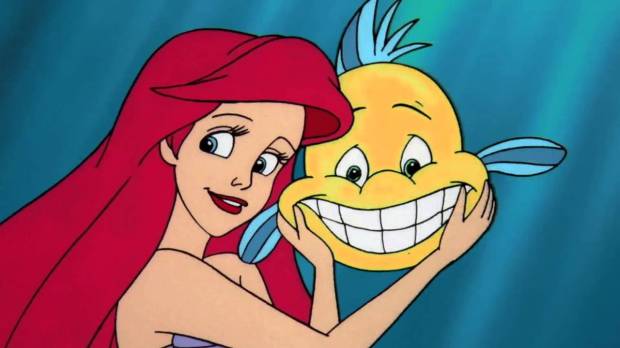
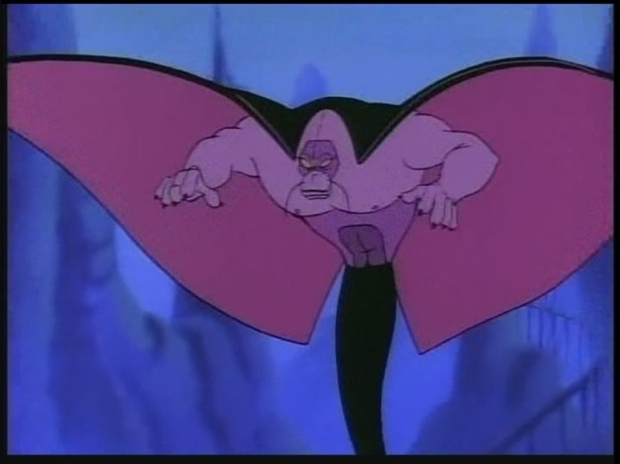
See this? This is from the episode where Ariel defeats a racism powered Ocean Satan with footwear. I made LITERALLY NONE OF THAT UP.

Buckle up, Mother-Guppies. We’re gettin’ weird.

You win. Good day sir.

In 1964 British-Norwegian author Roald Dahl published Charlie and the Chocolate Factory. I wouldn’t call it the greatest Dahl novel (I actually prefer the sequel, believe it or not) but it’s a fun romp nonetheless where you the reader get to enjoy one of the most scabrously funny writers of the twentieth century sit an entire generation of children down and say “Listen up, you little bastards. Here’s why you suck.”

https://static.tvtropes.org/pmwiki/pub/images/Wonka_Book_8934.jpg

However, it has to be said that the ending is objectively terrible. Willy Wonka finishes the tour of his factory, glances over his shoulder and sees that Charlie Bucket has survived his gauntlet of death by dint of having no distinguishing characteristics whatsoever, and essentially says “yes, you, bland cipher child, you shall inherit my chocolate factory!” And that’s it. That’s the ending.

Now, a mere seven years later the book was adapted into Willy Wonka & the Chocolate Factory directed by Mel Stuart and starring the late great Gene Wilder in the title role. The screenplay is solely credited to Roald Dahl but around 30% of it was actually written by David Seltzer, including (I’m pretty certain) the scene I want to discuss. It’s a movie that I love with all my heart and soul and consider one of the very best literary adaptations ever made. I love this film. I love the performances, I love the songs, I love the gags. Those weird, Monty Python-esque skits where the whole world goes nuts looking for the Golden Tickets? I love ’em. And, in my opinion, it improves on the novel in every single change that it makes.

Removing Charlie’s Dad? Makes Charlie more sympathetic and gives Mrs Bucket more of a focus. Having each child only bring in one parent to the factory? Trims the fat. Making the Oompa Loompas little orange dudes instead of Arican pygmies?

But these are all mostly minor, cosmetic changes. There are two scenes added to the story that drastically change the meaning of the story and the character of Willy Wonka. The first interpolation happens between Violet Beauregard being turned into a blueberry and Veruca Salt being sent to the furnace (man, this movie is a fun time). Charlie Bucket and his Grandpa Joe steal Fizzy Lifting Drinks and almost get chopped to pieces by a ceiling fan. They belch their way to freedom and rejoin the tour, with Wonka seemingly none the wiser.

Now, a lot of people hate this addition and I can definitely see why. The whole point of Charlie is that he’s not like the other kids. He’s supposed to be the good one. And, you could argue that by stealing the Fizzy Lifting Drinks Charlie is actually worse than the other kids. I mean, it’s definitely worse than Augustus Gloop drinking from the chocolate river. Wonka just let those kids loose in a chocolate world and told them to go nuts, so why wouldn’t Augustus drink from the river? Why is the river off limits but not anything else? Mike Teevee was definitely out of line but I think the real blame is on the Oompa Loompas for shrinking him. Violet Beauregard may have taken the chewing gum against Wonka’s advice, but at least she was upfront about it and didn’t steal it behind his back! And Veruca…

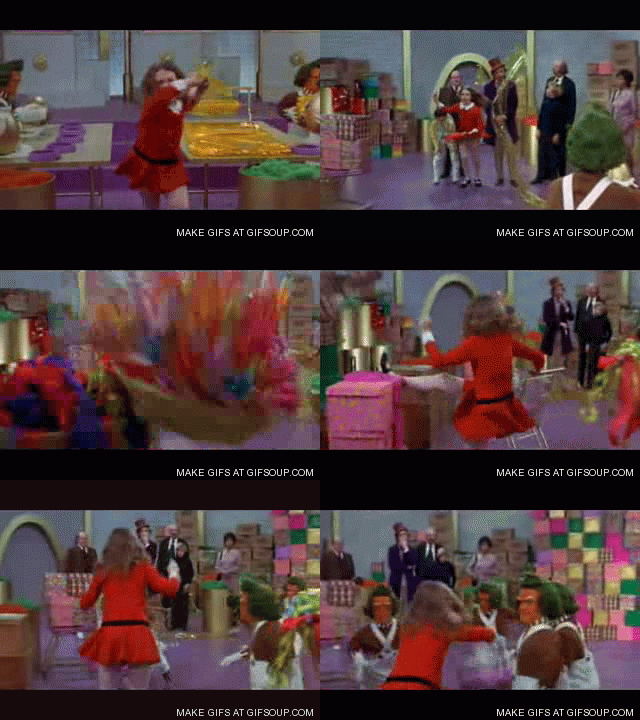
Okay, Veruca just straight up trashed the egg laying room like the Rolling Stones trashing the Miami Hilton.

ROCK AND ROLL!

He’s not worse than Veruca but, other than the upper echelons of the Nazi party, no one is.

(more…)

Disney Reviews with the Unshaved Mouse #59: Raya and the Last Dragon

Before we get into the review, I want to address something. Certain commenters (who shall, by virtue of me being the bigger mouse, remain nameless) stated in my last review that I have been “negative” and “harsh” on the Disney canon of late.

Let’s call this out for what it is: VICTIM BLAMING.

It’s a pernicious practice, and I will not tolerate it particularly if I’m the victim. Have I been harsh on Disney recently? Scathing? Even cruel? Yes. But who threw the first punch?

Exactly.

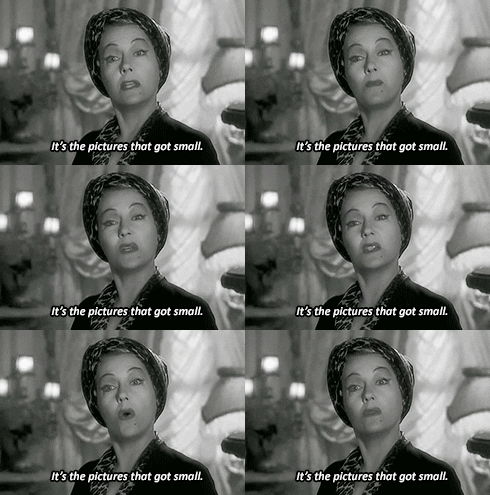
Raya is a historically significant film and definitely represents a demarcation point in the history of the canon. This is, after all, the first canon movie to go straight to streaming (although it did receive a restricted theatrical run). It also, to me, represents the irrevocable “shrinking” of movies. There are no big releases any more, there are no big unifying cultural moments. A few years ago I remember walking home one night and hearing a group of girls on the other side of the road spontaneously bursting into a chorus of “Let it Go” but it kinda feels like that kind of culturally ubiquitous megahit can’t happen any more. There’s too much content. We’re all watching different things. A movie being released in the cinema was kind of an imprimatur of significance, but the cinema might not have survived the decade even without Covid shoving it into a shallow grave. Gloria Swanson was right, she was just off by half a century.

Sorry, this is all frightfully maudlin. I guess for me Raya is less a movie and more a totem of a strange and tragic moment in history.

Also, I don’t really want to talk about it because it sucks and apparently that’s a dangerous opinion. Lindsay Ellis talked shit about this movie and I’m pretty sure she’s dead now or in witness protection or something.

Anyway. Raya and the Last Dragon. Thank you Covid, for sparing me the price of a cinema ticket. I don’t care what they say, ya ain’t all bad.

(more…)

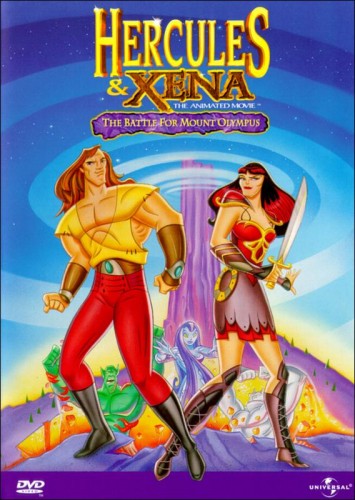
Hercules and Xena: The Animated Movie-The Battle for Mount Olympus (1998)

Firstly, I have to thank regular commenter Lupin the 8th for sending me the media file that allowed me to finally (finally) cross this review off the old list.

Hercules: The Legendary Journeys starring Kevin Sorbo was a TV series that ran from 1995 to 1999 that dared to ask the question: what if Greek mythology was Baywatch?

It was an occasionally entertaining, perenially stupid mid-nineties hunk of cheese now best remembered it’s much more influential spin-off show. Lucy Lawless appeared as a villain in Hercules before audiences said “More hot lady in the leather who kicks ass please” and Xena the Warrior Princess was born. Basically think “Distaff Hercules with more nineties ‘tude and the blatant homoeroticism delivered with a saucy wink instead of a slack-jawed stare”.

It was, simultaneously, a hugely important and influential chapter in the history of women in television and a queer cultural touchstone and dumb as all hell. This was the show that depicted Abraham and Julius Caesar as contemporaries despite the fact that Abraham was more ancient to Julius Caesar than Julius Caesar is to us.

Together, these two shows formed a kind of mini-television universe…

“Three shows.”
“Whazzat?”
“There was also a prequel series called Young Hercules.”
“What?”
“What?!”
“Whaaaaaaaaaaaaa…”
“Uh, Mouse, the review?”
“What? I’m just supposed to CARRY ON?!”

Okay, focus. Focus.

The final, second-least weird part of this mini multimedia franchise is today’s movie is the animated feature Hercules and Xena: The Animated Movie-The Battle for Mount Olympus or HXTAMTBMO for short. This movie came out in 1998, which I find significant because the previous year saw the release of a certain other, beloved, animated depiction of Hercules. Oh yeah, you know the one I’m talking about.

Oh Golden Entertainment, you utter whores.

Seriously though, while you might be tempted to view HXTAMTBMO as a cheap cash in on Disney’s Hercules there was actually some talent behind this one. It was directed by Lynne Naylor who was one of the co-founders of Spümcø animation (the Ren and Stimpy lads) and who worked on Batman: The Animated Series. It was produced by Sam Raimi, had the main cast of the show on hand to voice their roles and scripting duties were handled by John Loy who wrote for Pinky and the Brain. Okay! Not a bad bench of talent. This could be good? Right? Right?

Sigh.

Guys, let me level with you. I’ve spent four years trying to track this movie down. And if there’s one thing I’ve learned about animated movies it’s this; cartoons are like a politician’s tax returns. If someone’s trying to hide them, it’s not because they’re just so damned good.

(more…)

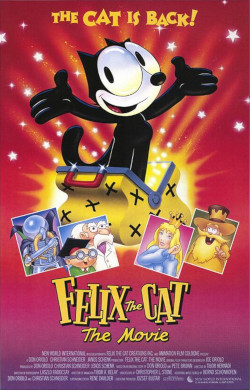
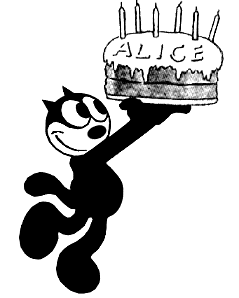
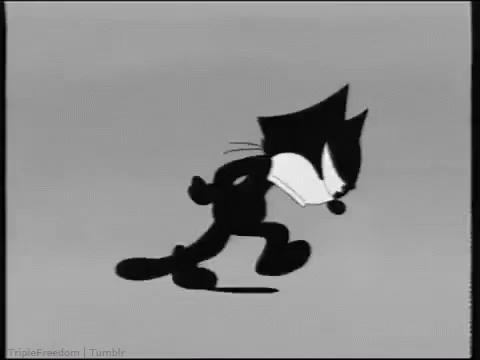
Felix the Cat (1988)

Here we go again. Every so often I’ll have a moment where I’ll go “Have I really been blogging about animation for X number of years without covering Y?” and this one’s a doozy.

So, ahem.

Have I really been blogging about animation for nine years without covering Felix the Cat? Because Felix the Cat is a pretty damn big deal in the history of animation.

Not the first cartoon character, but the first cartoon star, the first cartoon character able to draw a crowd on name recognition alone. The character was created in 1919 by Australian animator Pat Sullivan.

Or, as is now accepted by a majority of animation historians, by one of Sullivan’s animators Otto Messmer.

Honestly, researching this post taught me that Pat Sullivan was what people think Walt Disney was; a talentless credit-stealer and a nasty racist to boot. Anyway. Sullivan’s studio produced a rake of silent Felix shorts in the late teens and throughout the twenties and Felix was, for a time, a full on pop culture phenomenon. And you know what? With good cause. While simple, these shorts have a real charm and wit and I honestly think they hold up a lot better than a lot of later cartoons by Disney and Warner Bros from the early talkie era.

These shorts were also hugely influential on the field of animation in general, with the basic precepts of Felix’s design going on to influence American and Japanese animation right up to the present day, setting the template for characters as diverse as Mickey Mouse and Sonic the Hedgehog. And some people didn’t even bother with being “influenced” and just straight up fucking stole it.

Pictured: Julius the Cat, Walt Disney and Ub Iwerks’ TOTALLY ORIGINAL CHARACTER.

But, by the end of the twenties a sinister new threat had emerged to challenge Felix’s place as the world’s preminent cartoon character: SYNCHRONISED SOUND.

Hear my dark melody, Cat. I whistle your doom.

Sullivan resisted the switch to sound for as long as he could, but eventually caved and started producing sound Felix cartoons. Unfortunately, these cartoons did not use synchronised sound and instead were pre-animated with music, dialogue and sound effects being added in post-production, which results in what animation aficionados call “really crap cartoons”. The new series of sound Felix cartoons were cancelled, the studio shuttered and Pat Sullivan spiralled into an alcoholic depression brought on by the death of his wife and died in his forties Jesus Christ that got so bad so fast.

A brief, utterly Disnified run of cartoons by Van Beuren studios in the thirties notwithstanding, Felix was seemingly a defunct property. Having failed to transition to the sound era, Felix disappeared from public view, presumably to a rambling mansion on Sunset Boulevard where he could brood and slip into obsession and madness.

“I know you! You’re Felix the Cat! You used to be big!”
“I am big. It’s the cartoons that got small.”

Fast forward to the 1950s and Joe Oriolo, an animator and artist who’d worked with Otto Messmer on the Felix the Cat comic strip, created the Felix the Cat TV Show. This show was arguably the most influential and famous iteration of the character, introducing a host of concepts and characters that are now inextricably linked to Felix like the magic bag, the Professor and Poindexter. And if you love this cartoon…you do you. Personally I can’t stand it but then I’m pretty non-plussed by mid-century American TV animation as a general rule. But yeah, this series gave Felix his second bite of the super-stardom pie and also launched him to Spinal Tap levels of popularity in Japan.

So why did it take so long for Felix to make the leap to feature length animation? Well Pat Sullivan’s death had left Felix in legal limbo but Joe Oriolo was finally able to get full ownership of the character in 1970, probably because Joe Oriolo was an absolute snack.

“Hey doll, how about you give me the rights to YOUR pussycat?”

Oriolo pére passed away in 1985 but his son Don carried on the Felix legacy, finally bringing a full length Felix the Cat animated feature to movie screen in 1988.

Sorry, sorry, my mistake. The movie was completed in 1988 (using Hungarian animation) but only released in the United States in 1991. Very briefly. Before going straight to video.

Oh, and, fun bit of trivia. Researching for this post I first came across the phrase “abandoned movie”. Felix the Cat has been “abandoned” in the United States. What this means is that Felix the Cat DVDs are no longer sold in America. If you’re in America and you want a DVD of this movie you either have to buy it from overseas or get one of the original run of discs from the nineties which will cost you an arm and a leg.

And I know what you’re thinking!: “Mouse, this film that was animated in a second world totalitarian Communist state whose release was delayed by two years before getting a blink-and-you’ll-miss-it theatrical run and then being consigned to home video hell before being full on abandoned at the side of the road in the new millenium sounds like a really good movie!”

Which is what I love about you, reader. Your unflagging optimism. But I’m afraid I have to crush your hopes with the greatest violence possible. How bad is this movie?

(more…)

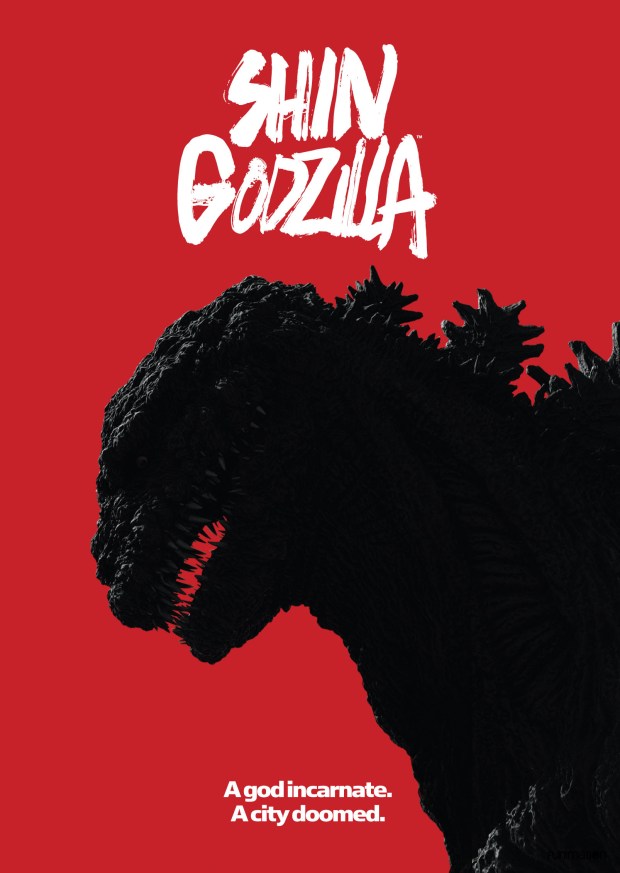
Shin Godzilla (2016)

I suppose I should just make this confession upfront; I’m not a Kaijiu fan. Never have been.

Not writing off an entire genre, obviously but it appears to me to be a genre chiefly relying on empty spectacle as a consequence of focusing on a main character incapable of speech, higher level reasoning or emotional growth.

That said, I have been watching the Kong versus Godzilla trailer on repeat and the sight of the two titular monsters duking it out on top of an aircraft carrier is the fucking coolest thing I have ever seen.
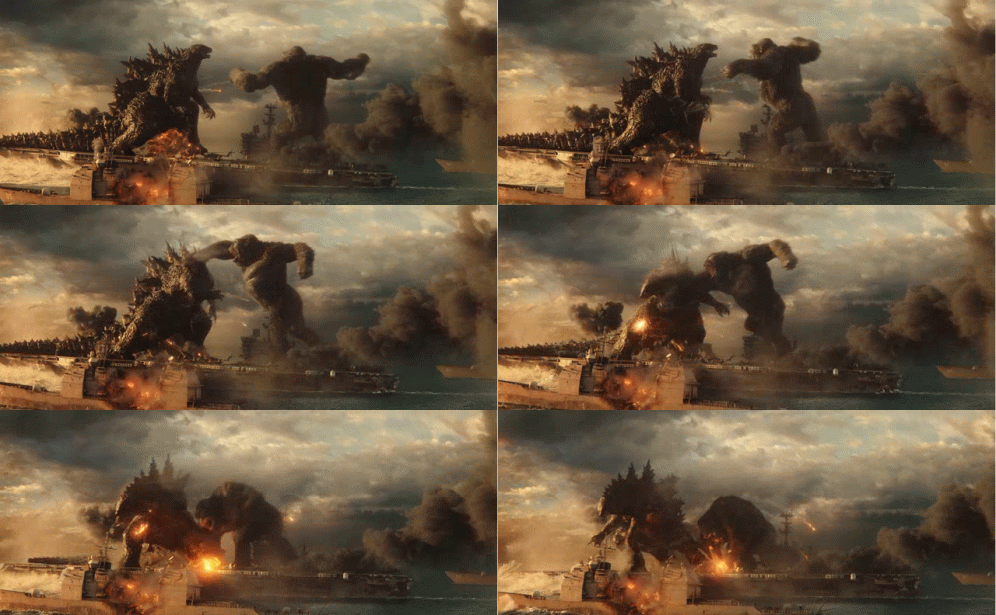
Godzilla King Kong GIF - Godzilla KingKong Kong - Discover & Share GIFs

I am not made of stone.

So…Godzilla. My experience with this character is as follows:

Godzilla 1954

What can I say? Classic of world cinema.

Godzilla 1998

I have a lot of fond memories of this one for purely personal reasons. Yeah, it’s dumb as all hell but it’s not as terrible as people say.

Godzilla 2014

Honestly, I’d fallen asleep before Watanabe said “Let them fight” though I’m told that makes it all worth it. Must have been a hell of a delivery, I wouldn’t know.

Aaaaand that’s it. So yeah, three Godzilla movies and only one of them was Japanese.

“Okay, so you have no cred whatsoever.”

“None!”

Oh wait, I tell a lie, I religiously watched the Saturday morning Godzilla cartoon  in the nineties.

Godzilla: The Series - Wikipedia

SUPER under-rated show.

Man, Adelaide Productions, whatever happened to them? They also did the Men in Black cartoon which was another movie tie-in animation that was so much better than it had to be...
“Hey, hey, back on topic you!”

“Sorry, sorry. You can take the mouse out of the animation…”

“Sigh. Okay fine, this Godzilla movie was directed by Hideaki Anno.”

“Oooh, I can work with that.”

Hideaki Anno is a celebrated Japanese animator and filmmaker who has worked on dozens of films over a long celebrated career and none of that means jack shit because he created Neon Genesis Evangelion and he will never not be the “the guy who created Neon Genesis Evangelion“. Dude could cure cancer and it would still be the second line of his obituary after “the creator of Neon Genesis Evangelion died today”. That show, which ran from 1995 to 1996 started out as a pretty typical (if far more stylish than usual) “teens in mechs battling monsters” show before transitioning into an emotionally fraught exploration of adolescent psychology, mental health and abuse served with a heavy dose of surrealist imagery and Christian symbolism.

Diemay Angel | Evangelion | Fandom

Plus, the robot battles were sick, brah.

Godzilla’s home studio, Toho, had put the franchise on hiatus with 2004’s Godzilla: Final Wars, but after the positive reception of Ken Watanabe saying “Let Them Fight”, Toho decided to bring back Godzilla to kickstart a new continuity for the character.

Now understand, if you’re a fan of the Godzilla series what I’m about to say isn’t meant as a criticism, more an observation. There are two basic types of Godzilla movie: Godzilla versus Humans and Godzilla versus Other Monsters. It’s a pretty limited schema, but credit where credit’s due, the creators of this series have managed to ring a fair bit of variety out of these two scenarios, particularly in terms of Godzilla’s character, which is doubly impressive when you remember we’re talking about a large non-verbal animal. Godzilla is something of a renaissance lizard, a Kaijiu for all seasons. In the original he was a very deliberate representation of Japan’s lingering trauma over the nuclear bombings of Hiroshima and Nagasaki as well as a response to the more recent deaths of the crew of Daigo Fukuryū Maru as a result of US nuclear testing in the Pacific. He’s also served as a metaphor for Japanese war guilt, a gentle Friend to All Children, a reluctant guardian of humanity, a vindictive destroyer and even just a big dumb lizard. After 30 films, you’d be forgiven for thinking there wasn’t really much else to do with the big lug. That’s probably why Anno got the nod to direct Shin Godzilla, given his success in putting a new spin on the seemingly tired giant mech genre.

How did it go? Shin Godzilla was a massive, and I do mean MASSIVE success in its home country, opening at number one and out-grossing the 2014 American Godzilla by almost a quarter and tripling the box office take of Godzilla: Final Wars, the previous Japanese installment. It also won Picture of the Year at the Japan Academy Awards, which is kinda like a new James Bond movie winning Best Picture.

This thing was huge in Japan, appropriately enough. In the West, though, the reaction has been a bit more mixed. Not bad, by any means, but there’s definitely a sense that this movie is not remotely interested in catering to Western sensibilities as to what this kind of movie should be. And that’s fair, this is most assuredly not your typical Godzilla movie, which is probably why the Western DVD release thought it necessary to put one of the most underwhelming review pulls I have ever seen on the cover:

“Of all the movies to feature Godzilla, this is certainly one of them.”

(more…)
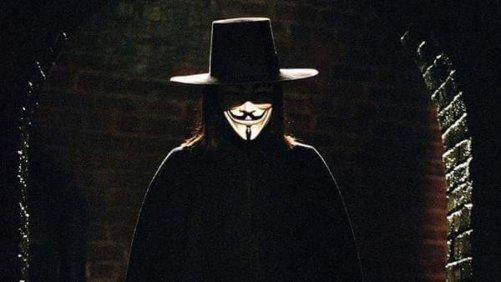
“Beneath this mask there is an idea, Mr. Creedy. And ideas are bulletproof.”

Alan Moore. I honestly doubt whether there is a single writer for whom the gap is wider between the strength of their work and the quality of the adaptations based on that work. If I read you off Moore’s bibliography it forms a perfectly acceptable list of greatest comics of all time:

Watchmen, From Hell, The Killing Joke, League of Extraordinary Gentleman.

I read you the list of the corresponding adaptations (for movies at least):

Watchmen, From Hell, The Killing Joke, LXG

and you start looking for the fire extinguisher to put out this garbage fire. There is a reason why Alan Moore refuses to even be credited on works based on his comics and it’s not because he is now just a beard suspended in mid-air by a floating energy field of old man cussedness. He has been done dirty by Hollywood like few writers before him. But, amid all the terrible adaptations there is of course one exception. Or is there?

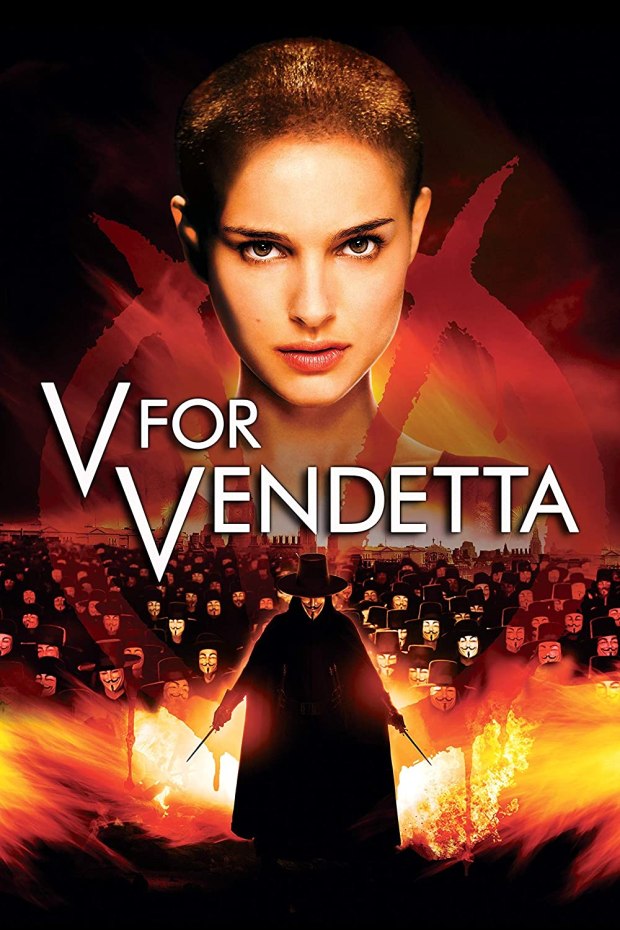
Uncovering V, The Revolutionary Leader in V for Vendetta

“Verily”.

Or maybe not. Sorry, I’m vascillating. Here’s what I find fascinating about V for Vendetta. It is, was, and probably will remain an incredibly divisive film and that is so much rarer than it used to be. In the pre-internet days, film criticism was the domain of a relative handful of newspaper and TV film critics. The masses would vote with their wallets, but their actual opinion on any given movie was largely silent. No one was taking big polls of thousands or millions of ordinary movie-goers to gauge their opinions on a given film. That was left to the critics who would often disagree wildly with each other on the merits of any one work.

Nowadays, of course, everyone is a film critic. Everyone writes about film, whether it’s on Twitter or Rotten Tomatoes or Facebook or or any of the million and one new social media platforms that are just sprouting up everywhere like little markers on my path to the grave.

Analysis: Why TikTok is open for business

“Hi there.”

“Fuck off.”

You would think that this would mean an even greater diversity of opinions on every single film but on the contrary, the opposite tends to happen. Consensus usually builds around a film very rapidly. Either it’s universally acclaimed, universally pilloried or (if it’s anything remotely political) it gets stripped for parts in the never-ending culture war with two camps forming who will defend it to the death regardless of its merits or flaws as long as it triggers the libs/smashes the whitecispatriarchy.

This, you will probably not be surprised to learn, is not a conducive enviroment for insightful, nuanced film critique. So what I really appreciate about V for Vendetta is that it’s a rare film in that it does actually provoke a very diverse range of responses from people. Opinions on it run the full gamut from Travesty to “Capital G” Great Film.

I’m pretty sure most people would agree that it is the best Alan Moore cinematic adaptation, but after that consensus ends. I’m going to keep my opinion on the film to myself until the end (largely because at the time of writing I’m still trying to figure out that very thing). But regardless of its quality it is an absolutely fascinating film to discuss and I’m looking forward to it tremendously.

(more…)

“Well, at least we can all agree the third one’s always the worst.”

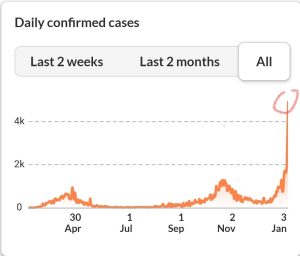
“2021! We made it, people! We beat the hell year!”

“Everything’s going to be great now, and we don’t have to worry about that awful coronavirus anymore because it just magically vanished at the stroke of midnight like a Fairy Godmother’s pumpkin coach!”

“Uh, Mouse?”

“Who dares interrupt my hubris?”

“Sorry, but it looks like the virus heard we’d created a vaccine and took it…kinda…personally…”

“YAAAAAAAAAAARGGHHHH!!”

“Oh please. So this “mutant strain” is a touch more virulent, how bad can it really be?”

“Oh crap.”

***

Hi. Welcome to the blog. Make yourselves at home. WASH YOUR GODDAMN HANDS AND DON’T TOUCH ANYTHING IT MAY BE TRANSMITTABLE THROUGH THE INTERNET BY THIS POINT WHO KNOWS YOU DON’T KNOW WHAT IT CAN DO.

Ahem. So, here in Ireland we’re back in full lockdown as the virus runs rampant through the streets, overturning cars and making lewd comments at our gentle lady folk. As a result, we’re keeping Mini and Micro Mouse at home which means I’ve been full time Dadding it for the last few weeks. Which is my weasely way of saying that this review is going to be very short as I’ve been spending every waking hour minding my awful time sucking monsters sweet, darling little angels.

“Can I watch five solid hours of Avatar the Last Airbender again?”

“Does Daddy have the strength or will to stop you?”

“No.”

“Then. Why. Ask?”

Oh and it’s a shame too, such a gosh darned shame that I won’t be able to spend much time on X-Men Apocalypse. Such a layered work. So brimming with craft and ideas and actors clearly giving it their all and happy to be there. So obviously not directed by a man giving instructions from his trailer as the chickens of his past behaviour come home to roost. So…I can’t maintain this level of sarcasm, I’m not as young as I used to be, I HATE THIS MOVIE.

Not fun hatred either. Not the kind of hate that gets you pumped and excited to tear this thing a new critic hole. Just weary, dispassionate disgust at the whole bloated mess.

But I was going to give it a full length review, honest. Just couldn’t because of the mutant corona virus. Which, shockingly, is only the second worst thing involving mutation I’ve had to contend with recently.

(more…)

“You’ll see Peter. People need to believe. And nowadays, they’ll believe anything.”

Christmas is almost upon us and so, in the spirit of the season, I will challenge the existing status quo and speak truth to power.

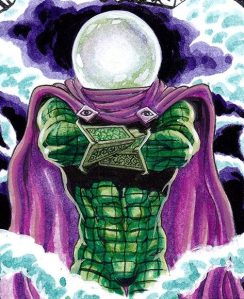
Mysterio sucks. Always has. Always will.

And I think I’m somewhat in the minority on this, since fans have been clamouring to see him in a Spider-Man movie since pretty early on in the Raimi films. Some people even seem to genuinely believe that Mysterio is a good villain, which in my opinion is akin to Climate Change denial or saying “Kingdom Hearts has a good story”. Not simply incorrect, but morally reprehensible. Hell, IGN even named him the 85th Greatest Comic Book Villain of all time, proof if proof were needed that the once noble art of ranking things on the internet has become a sorry, corrupt burlesque.

And, yes, he is a creation of Stan Lee and Steve Ditko and therefore is deserving of respect if you believe that pampered scions of privilege deserve a free ride just because of who their daddies are.

Fine, the visual design is so ridiculous that it shoots the moon and becomes kind of magnificent.

True, the cape. Is. FABULOUS.

But the whole concept of Mysterio is just a one-way train ticket to disappointment. His schtick is that he’s a special effects wizard who uses tricks and illusions to seem like he’s an actual wizard. In other words, he’s a villain who’s no real threat and uses smoke and mirrors to make you think he actually is a threat. But he’s not. He’s not a threat at all. Hit him with a crowbar, you’ll probably kill him. Doesn’t know karate or anything. Completely normal dude.  His first appearence in the Amazing Spider-Man #15 was one long game of “Got Yer Nose” and once Spider-Man realised that he did not, in truth, have his nose, I don’t really think we needed to see the character again. Once Spidey has seen through his bullshit, the only way you can bring him back is to have him secretly messing with Spider-Man from the shadows. And, once Spider-Man has figured out who’s really behind these shenanigans, it will always be anticlimactic:

  1. Oh no! The Daily Bugle is being menaced by a gigantic red snake!
  2. Huh?! The snake was just a red sock on a stick and the use of forced perspective.
  3. Oh, Mysterio was behind it all. Everyone relax, he can’t actually do anything, his powers are just lies and bullshit.

And that’s Mysterio. Disappointment in a cape and a fishbowl.

All that said, he’s not the worst choice as a villain for Far From Home. After the sturm and drang of Avengers Endgame this movie was intended to close out Phase 3 with a light little comedic palette cleanser and Mysterio is probably a better fit for that than…say, Carnage. Which, I suppose, is as good a point as any to bring up the fact that we have for the moment reached the end of our journey. This is, at the time of writing, the last released MCU film what with Black Widow‘s release having been pushed back and Shang Chi and the Legend of the Ten Rings being delayed due to the world going viral in the bad way. This also means that I have to make some tricky decisions. Like; do I actually need to review Wandavision and The Falcon and Winter Soldier? I haven’t reviewed any of the TV shows thus far but all indications are that the Disney Plus shows are going to be FAR more impactful on the overall narrative than, say, Cloak and Dagger or Runaways.

Marvel's Runaways Talk Cloak & Dagger Crossover | Den of Geek

“We exist!”

 Or maybe I should just accept that the film and television production and consumption landscape is almost unrecognisable from what it was when I started reviewing these movies way back in 2015 and that by this point the MCU is just too damn large for one blogger to cover and get on with it.

(more…)

Perfect Blue (1997)

Half a decade ago I reviewed a charming little animé named Tokyo Godfathers from legendary director Satoshi Kon and about as representative of his oeuvre as Interdimensional Cable 2 is of the career of Werner Herzog.  True, Kon only directed four films in his tragically short life, but Tokyo Godfathers is definitely the outlier of those four. Perfect Blue, conversely, was Kon’s breakthrough first feature and is probably the film that he is best known for.
In the wake of Akira  in 1988, the nineties saw a tsunami of animé arriving in the West. There had been Japanese animation on Western screens long before that of course, but those had been shows that either fit into the Western preconception of animation as being for children (Astro Boy, Speed Racer) or could be made to fit with judicious editing and a wacky robot sidekick (Voltron).
By contrast, in the nineties, animé was out and proud in all its violent, cool, mothers-lock-up-your-daughters-Mr. Octopus-is-single-and-ready-to-mingle weirdness and was starting to bump hard against the deeply ingrained preconceptions of animation in the West. There were a lot of concerned thinkpieces being published, a lot of ominous local news segments beginning with the words “They call it “AH-NEE-MAY”. My first exposure to Perfect Blue was in my local video rental place where they used to publish a weekly magazine advertising the upcoming releases.

“Then, I’d ride the trolley for tuppence.”

In this magazine they had a whole dedicated section for the new animé releases, and I remember Perfect Blue being advertised with the usual breathless ad copy but also a disclaimer at the end saying “please note this movie is not for children”. Back then “animation=harmless fun for my innocent little angels” was still a pretty hard-wired instinct in your typical Western parent and Xtra-vision were obviously trying to head off any complaints from people who’d inadvertantly subjected their kids to the kind of childhood trauma that usually results in a Batman villain.  Point is, Perfect Blue was kind of the poster child for why animé was an entirely different beast than Western animation, not simply for its content but also for its sophistication, gritty adult storytelling and reputation as the “scariest animé ever made”.

Only if you’ve never seen “Cardcaptor Sakura”.

Now, as any comics fan will tell you, anything from the nineties that claimed to be “gritty and mature” at the time should be sealed in an airlock until all the scans have been completed because there is a damn good chance that it’s held up about as well as the general public’s trust in the polling industry. Plus, “shocking” films tend to look increasingly tame as time goes by. So let’s take a look at Perfect Blue and see if it still deserves either of those descriptions.

(more…)