Before you ask, no, this wasn’t planned. It’s just a coincidence that I’m doing this review so soon after Megamind: The Doom Syndicate defiled everyone’s childhood memories like a randy Gungan. Not my childhood memories, obviously. I was engaged when this thing came out. But apparently there are people out there who were children when the original movie released and now are, like, allowed to vote and stuff? It’s a mad world.
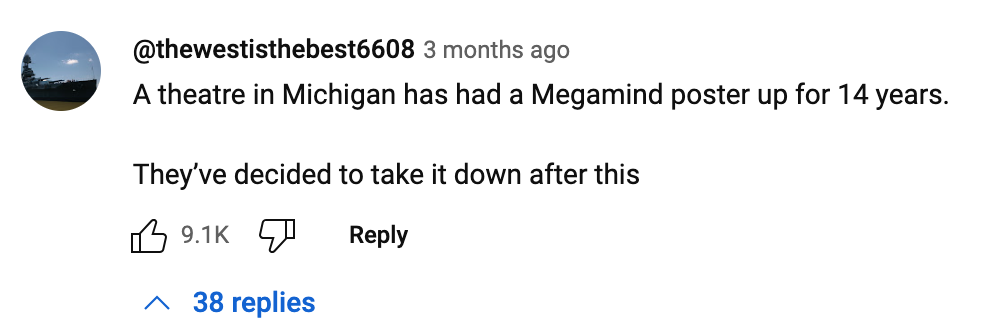
I haven’t seen the sequel but I did watch the trailer on YouTube. This was the most upvoted comment and the sense of historical tragedy and pathos was just too great for me not to share with you all.
My God. It’s like the fall of Paris.
I’ll be upfront, upfront. I like Megamind just fine but I don’t know how much I have to say about it. It doesn’t have a special place in my heart but neither is there a lot of stuff to make fun off. Plus it’s a comedy that is actually unironically funny on its own merits and you know how much I love writing about those!
But that doesn’t mean it’s not an interesting movie. It actually belongs in the category of film that I would argue are among the most interesting; movies that were re-appraised after their initial release. When it dropped in 2010 Megamind was mostly dismissed as an inoffensive but unremarkable bit of fluff chasing the trend started by The Incredibles and Despicable Me. Since then it’s been re-evaluated as one of the best Dreamworks movies with a devoted cult following. And that’s interesting (to me, at least) because when that happens it’s usually less to do with the movie itself and more to do with society changing and seeing the movie in a new light.
So, what’s next on the old docket? Why what’s this? A canon Disney movie? One of the films that this very blog was established to review?
Why, this is something of an occasion! Maybe we’ll have lots of cameos from long running characters like The Horned King or Walt Disney himself? Maybe a long and overly complicated kidnapping arc? Might Otto Von Bismarck appear? He bloody might!
“Mouse, quit stalling, I’ve got fifty bucks on you giving this shitpile a good review just to be contrarian.”
“Then you, sir, just lost fifty bucks and my respect.”
But before surgery commences, I want to talk about conspiracy theories.
Conspiracy Theories, counter-intuitively, are a way to make the world seem less scary, to make sense of an otherwise terrifyingly random existence.
To many Americans, the idea that a shadowy cabal within the US government would kill a sitting president of the United States was actually a less unsettling prospect than the idea that some random nutjob could decide to kill the most powerful man on Earth and just…do it.
Or that a lunatic fundamentalist in a cave with a few followers and some bolt cutters could have handed the US its most devastating attack on home soil since Pearl Harbour. Or that…a majority of Americans just didn’t think that Donald Trump should get another term.
Which is why, if you’re about to get angry at me for bringing up the extremely well known conspiracy theory that Wish was either wholly or partly the creation of generative AI, I think you’re missing the point. To understand a conspiracy theory’s appeal, you have to look not at the theory itself but the reality that it would replace if it were true. People want to believe that Wish is AI generated because it’s less scary than believing that this is just the kind of film that Disney’s creative process produces now.
Recently I gave an interview for a podcast where we discussed how the publishing industry is becoming totally, crushingly data driven and where books are increasingly commissioned, marketed and read for and by micro-targeted audiences. Books are becoming products rather than pieces of art, not something the artist wrote because they cared about it but because the algorithim says that Becky in Minnesota is jonsing for an enemies-to-lovers mafia werewolf story. And this isn’t just limited to publishing, the whole entertainment industry is sick with it.
So I know why so many people believe this theory is true*, because the reality is actually scarier. The same market and technological forces that make AI art so…off are now infecting even human created art. The machines aren’t just getting more human-like. We’re meeting them in the middle.
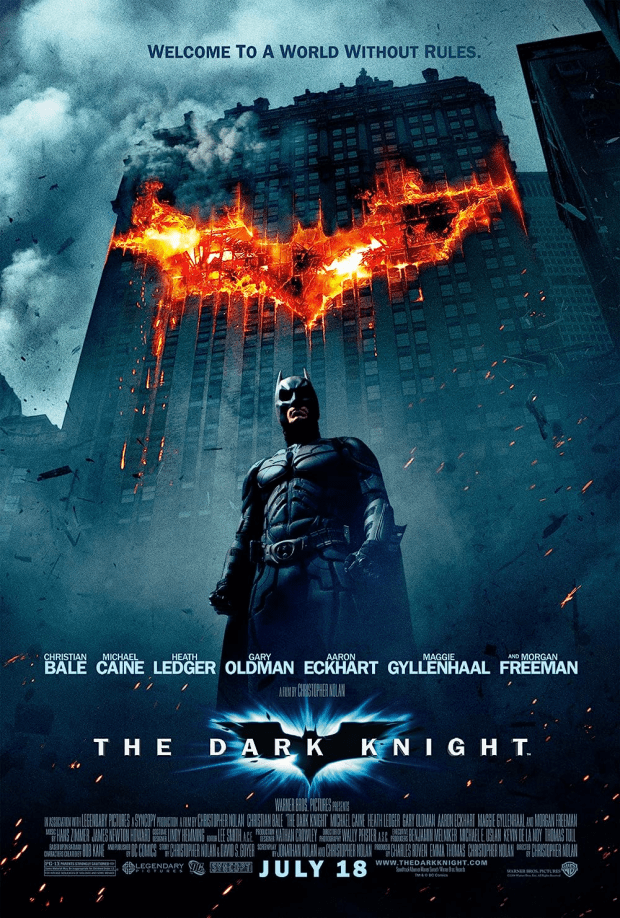
Martin Scorsese supposedly coined the expression: “one for them, one for you”, meaning you do the movies the studio wants you to do in order to do the movies you want to do. The Dark Knight Rises is, famously, one of the most open and avowed “one for them” movies in recent Hollywood history.
Nolan didn’t want to do it (especially after Heath Ledger’s tragic death) and never bothered to hide the fact that this was the hoop he had to jump through to get Warners to pony up for Inception.
But you know what? It’s a myth that great art only comes from passion projects. Plenty of good and even great films have come from people who just showed up to work that day. And look, if the price we had to pay for every Inception was a Dark Knight Rises, I’d take that deal.
But there are problems with this movie. And (bizarrely, given this is the exact same writing team that gave us the fucking GOAT of a script that was The Dark Knight) pretty much all those problems begin and end on the page.
In the past I’ve had plenty of opportunities to extol my favourite film critic, Tim Brayton over at Alternate Ending and now is as good a time as any to re-up. Check him out if you haven’t already. He’s a fantastic critic and an inspiration and so it is with a certain bitter-sweet melancholy that I must report that I have at last surpassed him.
Not in terms of quality of analysis or wit of writing, fuck no, I’m not insane. But you see, Tim actually reviews movies roughly when they come out, like some kind of freak with a work ethic, where as I review movies when I feel like it, maaan.
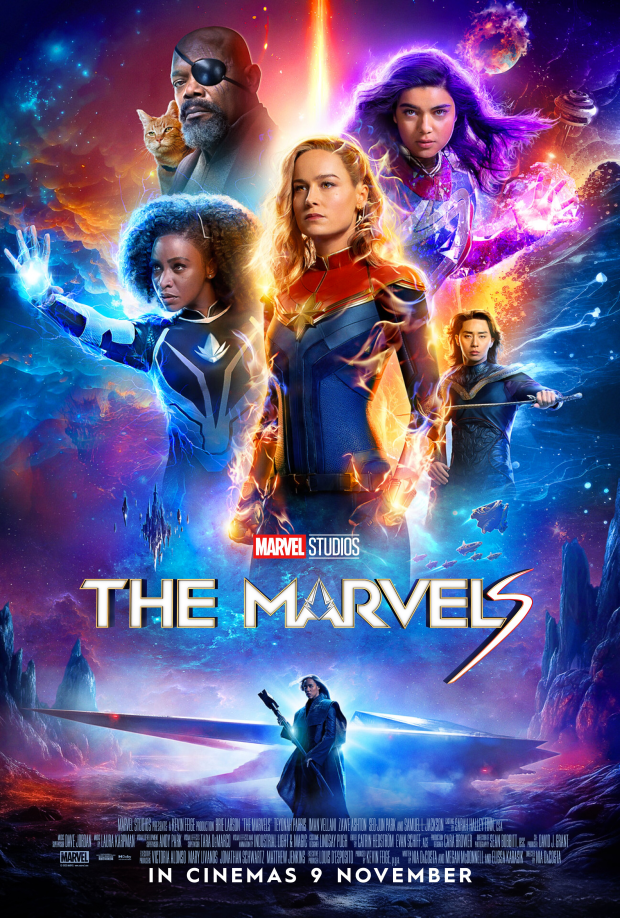
But today represents the first time I’m aware of where I actually beat him to the punch. My The Marvels review has come out before his The Marvels review, a victory whose sweetness is only slightly mitigated by the fact that I’m not entirely sure he intends to actually review this movie, a fact that is both completely understandable and quite damning.
A major critic not reviewing the latest installment of the MCU? How can this be?
It’s like that moment during the trial of Charles the First where the top fell off his cane and no one bent down to pick it up for him. In that moment, he knew he was king no more and also possibly that he was about to get a pretty aggressive haircut.
And look, I wanted to like this one. I want to like every movie I sit down to review. I love a good comeback story as much as anyone. And I had actually heard positive rumblings that this movie was far better than its paltry box-office and mediocre critical reception would suggest. I was even told it was something of an overlooked gem. Who told me that? In retrospect, fools. The movie is (mostly) trash.
Two days out to the post going up and that’s where I’m at.
This movie made me feel clean because it just washed right over me.
I saw Zone of Interest recently. That shit shook me to my core. I could write about that? Something something banality of evil something something evil of banality?
Look, we all like to make fun of Disney and their utterly shameless milking of their beloved animated classics with cheap and tawdry cash ins. But give them this; even during the height of the direct-to-video boom after Return of Jafar had proved that cheap sequels to big-name animated features were basically a licence to print money, they never went to the same well more than twice. Okay, twice and a tv series. That was it. Three movies and a TV series, MAX. No more. They had standards. Allegedly.
I love how it says “An All New Movie”. Isn’t every movie an all new movie?
Of course, Disney had a very large stable of properties to exploit. But what if you had a studio that
a) Really wanted to get in on that cheap direct-to-video cartoon action.
b) Had a very, very small pool of household name animation to sequelise and
c) Had absolutely zero shame?
Well…you’d get the cinematic donkey-show that was Universal’s Land Before Time franchise. Now, Land Before Time was a pretty damn good film and it did, y’know…decent at the box office. It opened at No 1. But it also lost to Oliver and Companyin terms of overall ticket sales. So…fine, but nothing to crow about either.
Certainly, it did not do the kind of numbers that would justify 13 GODDAMN SEQUELS. THIRTEEN.
ONE. THREE.
AND A MOTHERFUCKING TV SHOW.
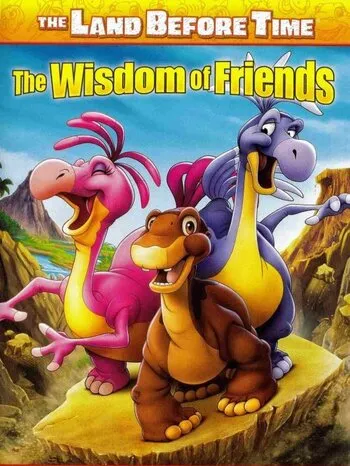
Now, I am not going to review every single one of them, that’s why God made Jenny Nicholson. I’m just here to review The Land Before Time XIII: The Wisdom of Friends, the second last entry in the series and, by all accounts, the worst of the bunch (because my readers think I’m a bad person and wish me harm).
However!
We can’t just dive in after an eleven movie gap without being hopelessly lost so I have set my team of extremely well-paid maps to work on a breakdown of everything that happens in this series between the first and thirteenth installements.
The Land Before Time II: The Great Valley Adventure
The gang must fight to protect their new home when Sharpteeth find a way into the Great Valley.
The Land Before Time III: The Time of Great Giving
When a sudden shortage of water threatens all life in the Great Valley, the gang of young dinosaurs must cooperate with a group of bullies to make a risky journey outside the valley and find the cause.
The Land Before Time IV: The Quest for Peace
The gang decide to rid the valley of nuclear weapons.
The Land Before Time V: The Final Frontier
Littlefoot’s previously unknown half-brother appears in the Great Valley, and he’s on a mission from God.
The Land Before Time VI:
In an attempt to save their failing marriage, Littlefoot and Cera open a bistro in Milan.
The Land Before Time VII: Long Hard Neck
The series’ one brave, but ultimately misjudged, entry into the genre of hardcore pornography.
The Land Before Time VIII: Littlefoot versus Godzilla
The no-brainer crossover that couldn’t fail. Actually failed quite a bit.
The Land Before Time IX: Please No More
Clip show.
The Land Before Time X: Tokyo Drift
In order to avoid a prison sentence, Littlefoot becomes a drag racer.
The Land Before Time XI: Ultimate Betrayal
The gang are shocked to learn that Spike was working for Internal Affairs the whole time.
The Land Before Time XII: Time Arrives
The gang have to adjust to living in a land that has time now where they can actually age and die. Directed by Werner Herzog. Harrowingly bleak.
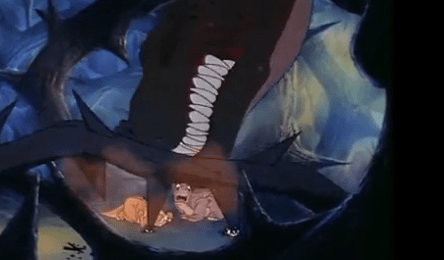
You know the thing about the dinosaurs? It’s really, really sad when you think about it.
These beautiful animals lived for millions of years and then one day, literally one day, their world turned into a flaming hell and they died horribly. And they never understood why.
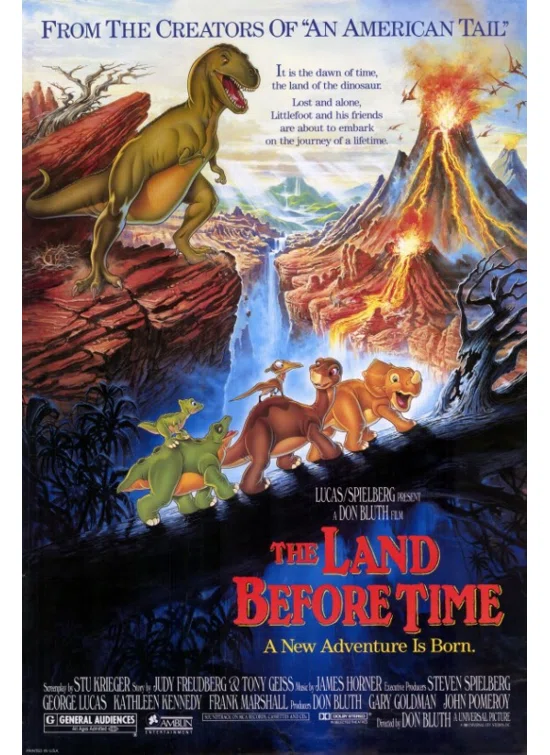
I was thinking about that a lot as I sat down to re-watch Don Bluth’s third film, The Land Before Time, and the last one he made before parting company with Stephen Spielberg. On one level, this is the least personal of Bluth’s early, pre-sellout films and the one that he had the least real affection for. Whereas Secret of Nimhand An American Tailwere true collaborations, The Land Before Time seems to have been the point where Spielberg (and new producer George Lucas) really took the reigns and Bluth was more just the guy who animated what the execs wanted. Story-wise at least. Whatever you think about him as a film-maker, Bluth had a tendency to stamp his work very strongly and it does still very much feel like one of his films in terms of atmosphere, if not necessarily subject matter.
This feels like it came from Spielberg. Is that just me?
Bluth’s films are famously dark and melancholy and I think that’s why this one works.
More than any other movie, this one captures the essential truth that any story about dinosaurs is a tragedy.
Do you want to know how I got these scars into writing about movies?
My college had its own version of “The Onion” where I made my bones writing utterly run-of-the-mill edgy early 2000’s college humour (i.e. the kind of stuff that would get me cancelled today so fast it would break the laws of physics) and my editor asked me if I’d be interested in trying my hand at writing a movie review. And the very first movie I ever reviewed for them (if memory serves) was none other than The Dark Knight. And now you know my gritty origin story. And, if you are old enough to remember my earliest reviews (DON’T GO BACK AND READ THEM DON’T YOU DO IT I SWEAR TO GOD) you’ll remember that this movie was a BIG deal to me and those early reviews are chock full of references to it, even when they weren’t relevant or funny. Which was all the time. I see that now.
So, as you can imagine, I approached this one with a great deal of trepidation. Is it really as good as I remember?
The MCU fell from grace the way Hemingway’s Mike Campbell went bankrupt, slowly and then all at once.
I think we all felt it, didn’t we? At some point this year, probably in the summer when Barbenheimer was in full swing, there was a moment when all of us who had still not disembarked from the hype train took a look at the MCU and said “nah, I’m done”.
And you probably have your own explanation for why that is. Endgame was the peak and it’s all been downhill since then. Superhero fatigue. Bad writing. Too woke. Not woke enough. Too much CGI. Martin Scorsese dropping truth bombs. The pandemic. Whatever.
But ultimately, I think the real reason was just…time. The studio execs currently running around trying to figure out why audiences aren’t flocking to their superhero movies anymore are like surfers wondering why the tidal wave they were riding faded away into the ocean.
Guys. It was a wave. That’s what they do.
Granted, it was a wave like nothing we’ve ever seen before. Depending on when you consider the modern age of superhero movies to have begun (the first X-Men movie maybe?) we’ve been riding this wave for over twenty years with some of the biggest box-office numbers of all time. But, it really was just a bigger version of every other Hollywood trend, be that “make everything like the Matrix” or “make everything like Transformers” or (if you want to go old school) “make everything a Western”. And trends never last. That’s why they’re called “trends”.
And I’ve been burned enough times before to know not to make any big predictions. Maybe these last two years were just a brief blip in an unbroken streak of cinematic dominance that will stretch on to the death of the universe. But, right now, in the waning hours of 2023 it sure feels like the MCU is done. And I’m okay with that. And I don’t regret my time with it as long as I can pretend Thor 4doesn’t exist.
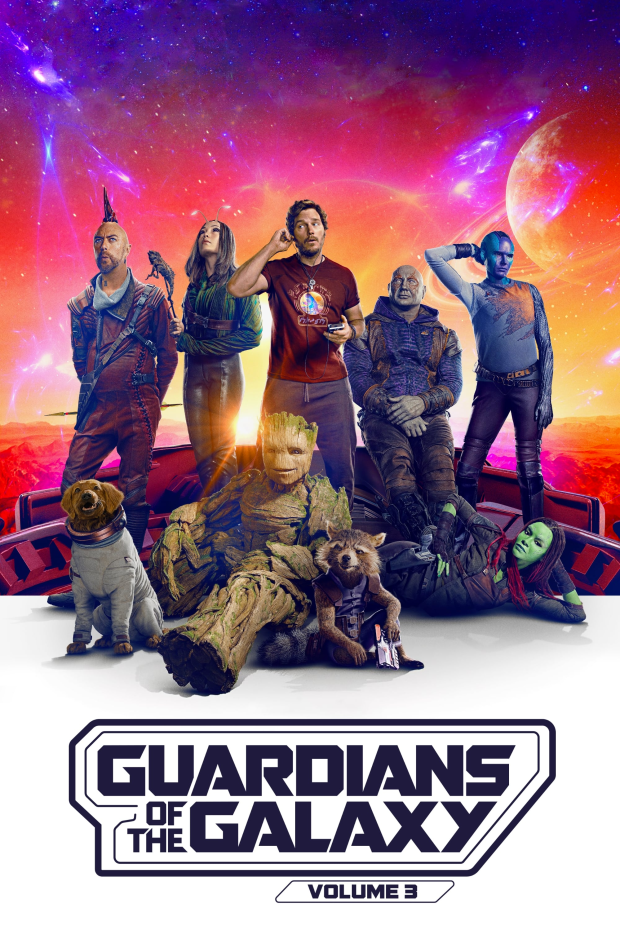
Because, even if we got nothing else of value from this series of films, James Gunn got to make the Guardians trilogy, and I wouldn’t deny him that for the world.
I’ve reviewed a few animated films from this decade by this point and they are all (with the exception of the Disneys) weird as balls.
But I get ahead of myself. I’m going to let you in on a little behind the scenes secret. Ever since this mouse escaped the rat race and started writing full time, I’ve actually had less time to devote to this blog with work starting on most posts a mere few days before they’re scheduled to go live. This can be a problem when I starkly under-estimate just how much there is to research on a given movie and go plummeting down rabbit-holes
And my oh my, Raggedy Ann & Andy: A Musical Adventure is less a field full of rabbit holes than a giant hole with occasional bits of field clinging to the edges. But okay, a little background.
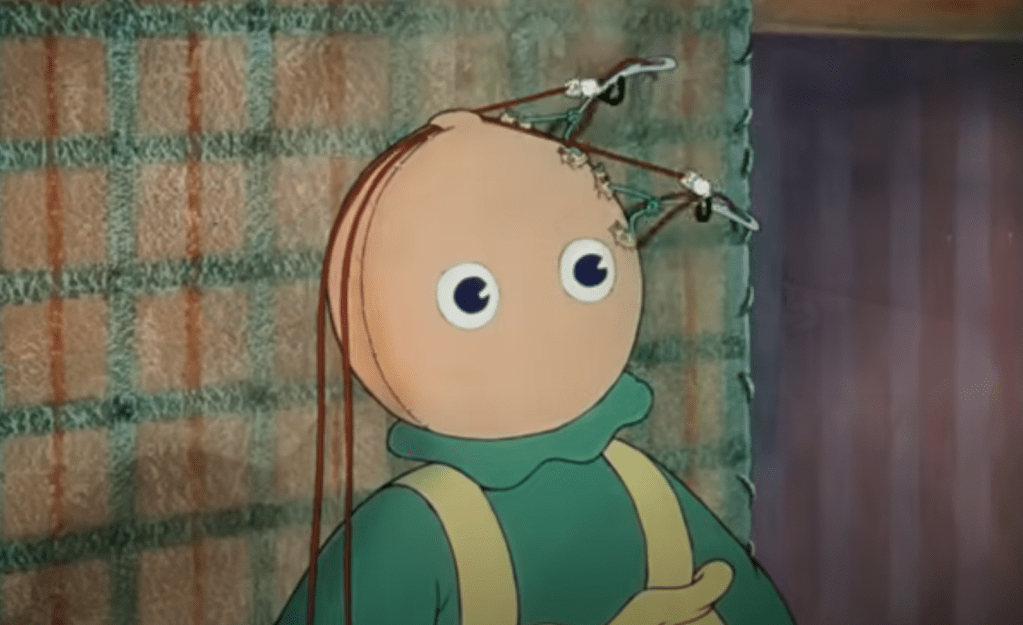
So waaaaay back in the 1910s an American named Johnny Gruelle patented a doll that he named Raggedy Ann and then wrote a series of stories starring her, which were such a success that Raggedy Ann became possibly the first bona-fide modern American toy fad. And, of course, as Jane Austen herself once said “it is a truth universally acknowledged that a toy franchise in possession of a fortune must be in want of an animated tie-in.” And boy howdy, did Raggedy Ann manage to get some impressive talent over the decades. For starters, there was a short series of Fleischer cartoons that were (naturally) as charming and well made as they were horrifying.
No context for you. None.
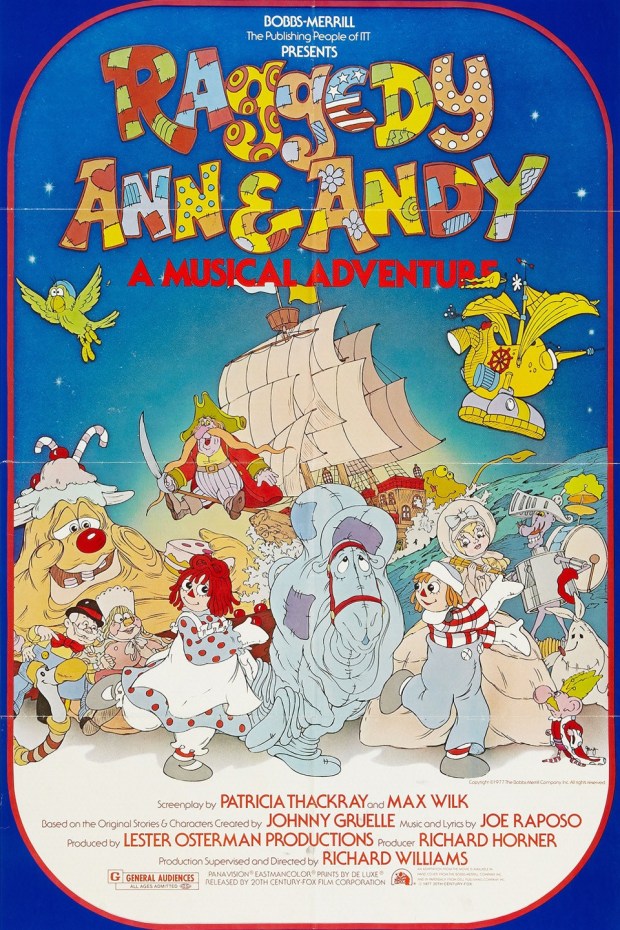
There were also two television specials produced in the seventies by Chuck Mofawkin Jones. But, without a doubt, Raggedy Ann’s most famous foray into the world of animation was 1977’s Raggedy Ann & Andy: A Musical Adventure which is…well, it’s something.
Here’s what it’s like. Imagine Hasbro want a new Transformersmovie. And the director they initially tap dies and so they bring in a replacement; David Lynch. And now Optimus Prime is dancing with a backwards talking midget in the red lodge. That’s kind of what happened here.
Lynch in this instance was Richard Williams, who we’ve had our dealings with in the past. One of the best animators to ever work in the medium, period, Williams was shanghaid into making a glorified toy commerical and decided to use that opportunity to have the time of his life. This film is basically Williams and some of his most talented animator friends (Betty Boop co-creator Grim Natwick, future Genie animator Eric Goldberg and Art “I created Goofy and sued Walt Disney for unfair labour practices, took him all the way to the Supreme Court and lived to tell of it” Babbitt to name a few) having a ball on the dime of the good folks at the Bobbs-Merril publishing company.








 unshavedmouse