Steven Universe

So here’s something hilarious; I actually thought this was going to be an easy review. “Three episodes of Steven Universe?” I thought “That’s only half an hour’s worth of animation! I can do that in my sleep! I can wrap this review up in one night and take the rest of the week off to maybe work on some other things and actually be a writer for once!”
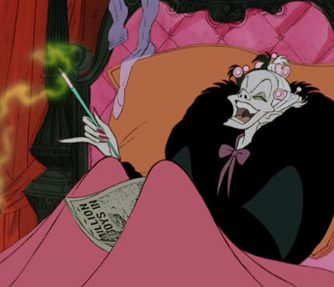
“Oh Mouse! You are a FOOL!”

“Oh Mouse! You are a FOOL!”

Of course not. Because before I can get into reviewing Steven Universe I actually have to explain what Steven Universe is and the backstory of the show to people who have never seen it. And with a backstory this epic, I have been forced to employ special tools. Please click this link.
(NOTE this link may not work on all devices, I’m working on getting a video to embed in the post but that may take some time. In the meantime, the Mary Sue gives a good run down of the backstory)
So yeah, that is the incredibly dense and rich mythology that the series has built up over one hundred episodes and is IN ABSOLUTELY NO HURRY TO LET YOU IN ON. Seriously, this show is such a goddamn tease, I’d say it drip feeds its backstory but these aren’t even drips, these are molecules of plot moisture.
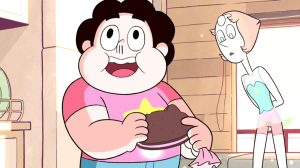
Oh goodie. Another episode where Steven eats ice-cream.

Oh goodie. Another episode where Steven eats ice-cream.

I kid, I kid (mostly). One of the show’s charms is actually how it carefully builds up its world and devotes time to the various characters that make up Steven’s social circle, whether it’s the gems, or the various residents of Beach city, or his father Greg. And all these characters are so wonderfully layered and charming that even episodes where nothing substantial happens to move the main plot forward feel worthwhile.
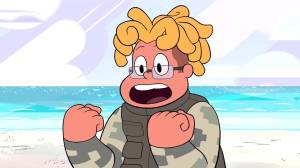
Except Ronaldo because oh my giddy Aunt, FUCK RONALDO.

Except Ronaldo because, oh my giddy Aunt, FUCK RONALDO.

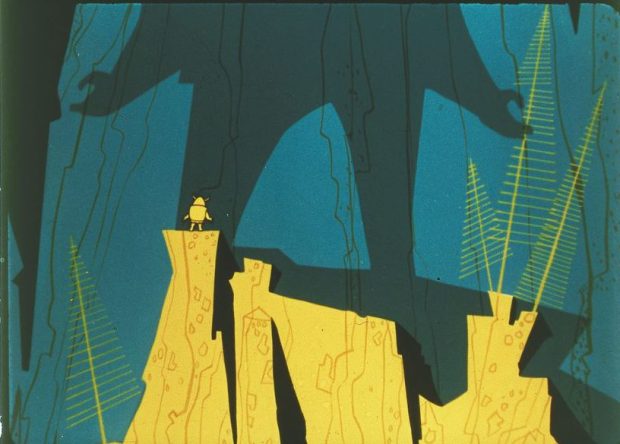
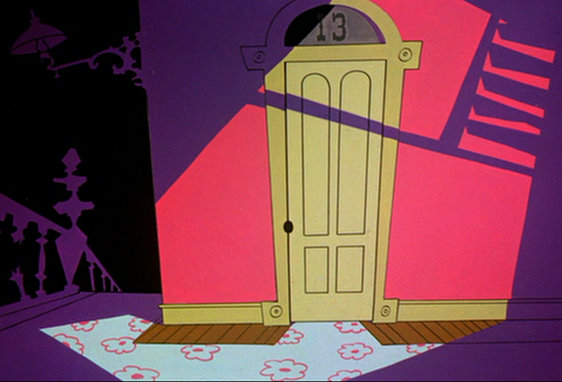
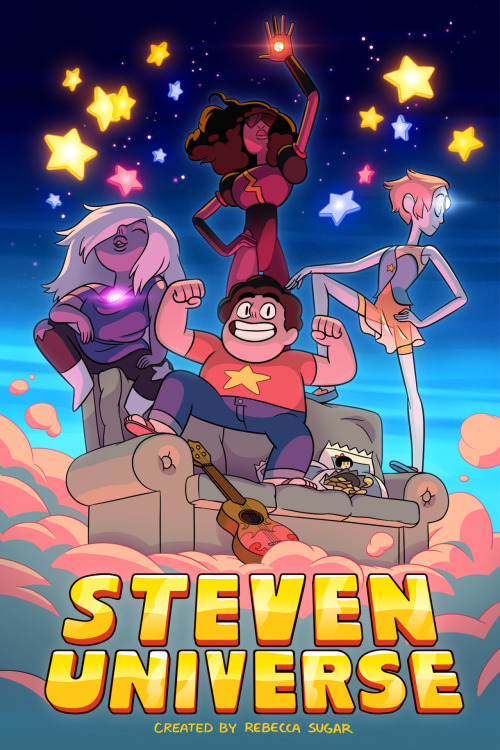
So this show first aired in 2013 on Cartoon Network and is the creation of Rebecca Sugar, a former writer and storyboard artist on Adventure Time. At the top of this post there’s some concept art from the original pilot which was much more “Adventure Timey” in its animation and style but the actual series looks quite different. The show has a simple but very elegant art style favouring beautiful painted backdrops and clean, uncomplicated character designs. The music is also really inventive with original songs featuring in many episodes (it helps that the main and supporting cast are crammed with professional singers). But all that would just add up to a very good looking and sounding children’s cartoon. To understand what makes Steven Universe so special we have to talk about fusion.
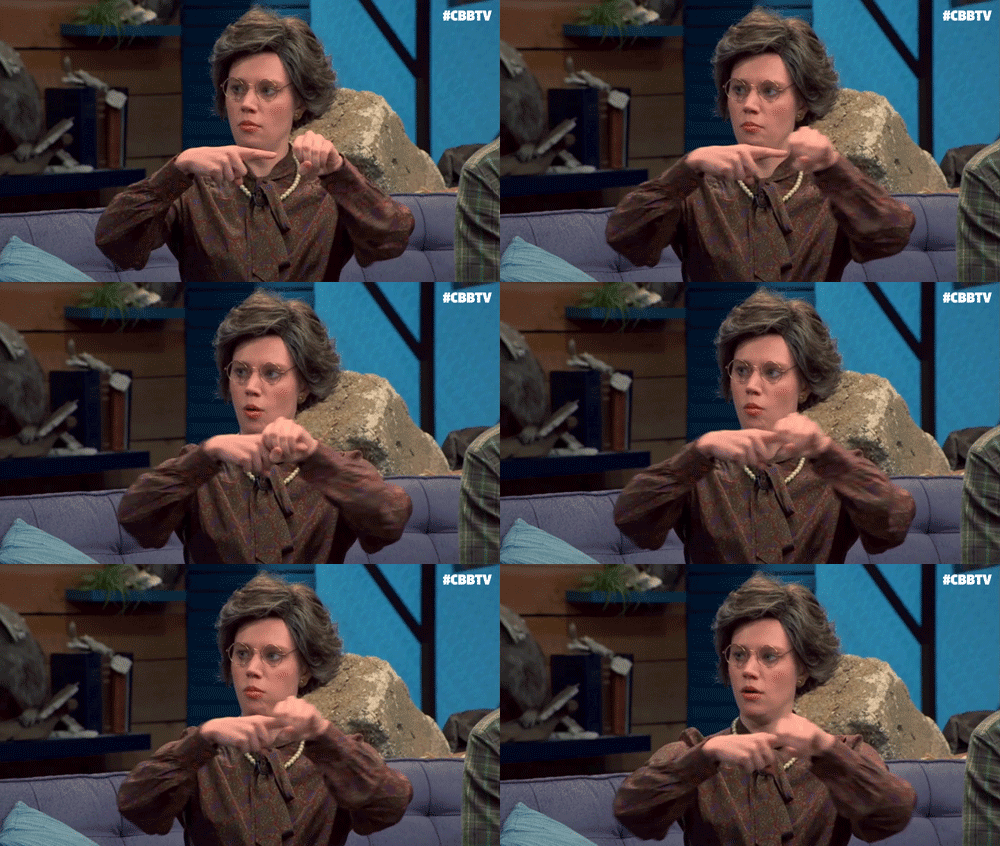
So, when the Crystal Gems are battling a threat that’s too powerful for them to take on alone, they can fuse together to form more powerful gems. Okay, hardly revolutionary. Power Rangers, Digimon and Transformers have all used a version of this trope to one degree or other. But here’s the thing. In Steven Universe fusion is very explicitly a metaphor for, well…
giphy-1
Okay, well maybe that’s a little simplistic. The metaphor is fairly elastic and, depending on the episode, fusion can be a stand in for a romantic relationship, platonic friendship or sometimes just the hard fucking. It’s also really important to remember that within the universe (heh) of the show, it’s none of those things. In the world of Steven Universe, fusion is not sex, or relationships or anything else, it’s fusion. It’s its own thing with its own rules and norms and etiquette. This is important to remember because if you treat the metaphor too literally it can go to some weird places. Like, the episode A Giant Woman where Steven first learns about fusion and sings a song about wanting to see Amethyst and Pearl fuse. If you take it to literally mean sex then it becomes the story of a creepy little boy wanting to watch his two foster mothers fuck.
So. Don’t do that.
So today we are going to be looking at three episodes from Season 2; A Cry For Help, Keystone Motel and Friend Ship. Let’s take a look. (Oh and, needless to say, there will be spoilers both for this episode and the series more generally so be warned.)
(more…)

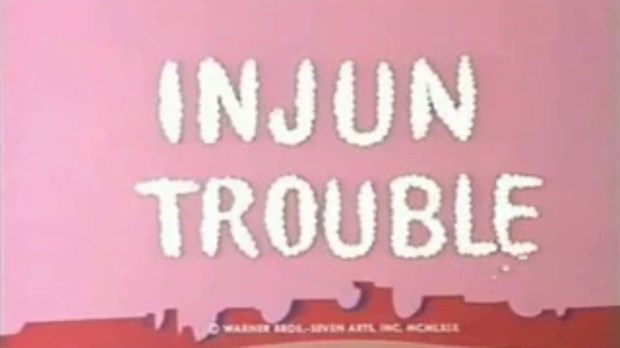
Injun Trouble (1969)

My friends, the time has come for me to tell you the tale of the last Looney Tune, and I feel less like an animation blogger and more like Red from the Shawshank Redemption. I wish I could tell you that the Looney Tunes fought the good fight. That they brought Chuck Jones and Mel Blanc and Michael Maltese back for one last time and went out with a short that could stand up with the very best of them. That when that really was all folks, those folks knew that something wonderful had gone out on a high. But animation is no fairy tale.

Well, except when it is. Look, we're getting off track.

Well, except when it is. Look, we’re getting off track.

What animation buffs call “The Dark Age of Animation” lasted from around the late fifties to the early to mid eighties (meaning the next few reviews will most likely just be me making sounds of pain and distress) and I don’t want to exaggerate it so I’ll just say that this was the worst period in human history where everything good and pure in the world was killed and hung from a gibbet. It was around this time that TV finally came into its own and starting muscling onto cinema’s turf in a big way. Facing increasing financial pressure, cinemas had to cut back on luxuries like lavishly animated cartoon shorts of pure loveliness. Cartoons in this period had to find a new home on television, where the appetite was there (boy, was it ever) but the budgets simply weren’t. The animation studios that survived in this era did so by being cheap, lean and mean. This was the age of Hanna Barbera and Filmation. A wolf age. An axe age. Hell, even the Disney movies in this era looked dog rough.

And what of the Looney Tunes? Bugs Bunny very wisely sat the sixties out after False Hare in 1964. I don’t actually know why Warners decided to retire the character after that, but in my mind he went to Italy to pursue a celebrated career as a director of independent film. It’s what he deserved.

The Looney Tunes/Merry Melodies in this decade, at least after Chuck Jones was fired in 1963 for moonlighting on UPA’s Gay-Puree, focused more on Roadrunner and Wile E. Coyote as well as Speedy Gonzales, who was now paired with Daffy Duck, thereby capitalising on the well known and established hatred between mice and…

"..."

“…”

"..."

“…”

"..."

“…”

"..."

“…”

"Begone, pond-fiend. My kind have protected the internet from your filth for generations."

“Begone, pond-fiend. My kind have protected this land from you feathered scum for generations.”

"Your numbers grow few, furred one. One day you shall let your guard down, and the webbed ones shall rule over as was foretold in the prophecy!"

“Your numbers grow few, furred one. One day you shall let your guard down, and the webbed ones shall rule over all as was foretold in the prophecy!”

"Some day, mayhap. BUT NOT THIS DAY!"

“Some day, mayhap. BUT NOT THIS DAY!”

Sorry, where was I? Oh yeah. So Warners were still using a lot of the classic Looney Tunes characters but they weren’t resting on their laurels (they were doing something else on their laurels but certainly not resting). As well as featuring older established characters, the new shorts studio  under the management of Alex Lovy* introduced such timeless household names to the Looney Tunes Pantheon as Merlin Mouse, Bunny and Claude and Cool Cat. Truly a who’s who of “Huh? Who?” It was like the Itchy and Scratchy and Friends Hour except that Disgruntled Goat did not have his moments. I don’t want to rip on Lovy or Robert McKimson (who directed this short) because they were both seasoned professionals who worked on some great cartoons over the years. But at the same time, COOL CAT IS THE GODDAMNED DEVIL AND SHOULD BE ON FIRE ALWAYS.

cool_cat

The enemy. I shall teach you to hate him.

Now, my problem is not that Cool Cat is utterly, completely, instantly dated as a concept and a character. The fact that he is a sixties pop culture creation to his very bones does not mean that he could not be a good character in his own right. Know who else is utterly a product of his time?

He’s literally a parody of a Clark Gable character from a thirties movie called It Happened One Night mixed with Groucho Marx.

He’s literally a parody of a Clark Gable character from a thirties movie called It Happened One Night mixed with Groucho Marx.

But there’s a key difference.  Bugs comes by it honestly, he is a product of thirties pop culture created by young men who consumed, enjoyed and understood that pop culture. And Cool Cat was created by a bunch of old men desperately trying to relate to the youth of the time in the most cynical and pandering way possible.

Also, his cartoons suck and are not funny.

So let’s take a look at Injun Trouble.

(more…)

The Iron Giant (1999)

When I was a wee rodent there was a book in the school library called The Iron Man that I read many times. It’s a simple little fable, about a boy named Hogarth who befriends a giant robot of mysterious origin…and then the robot saves the world from a colossal alien dragon the size of Australia.
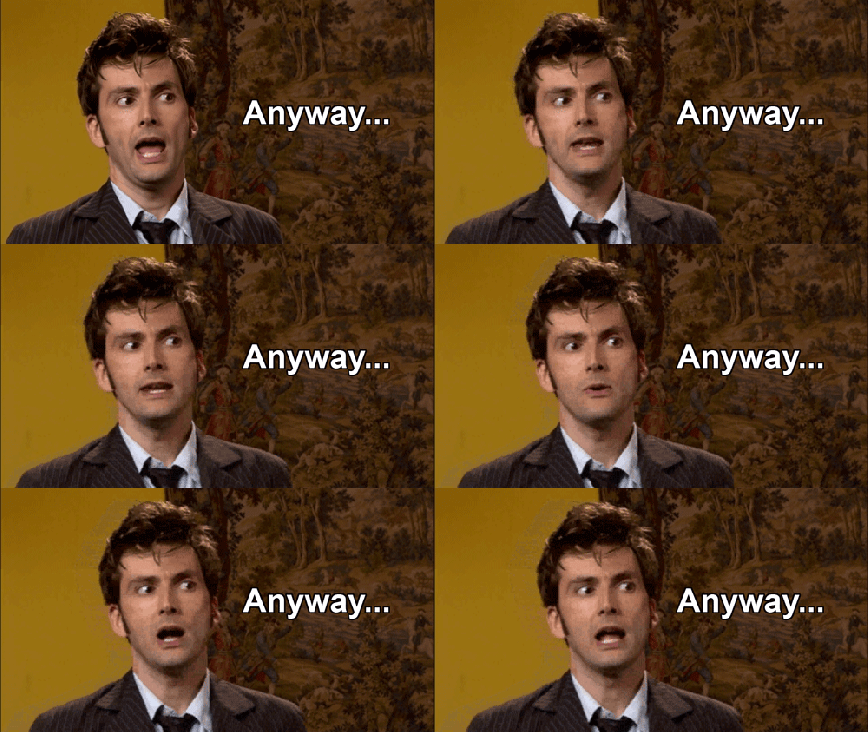
anywayyyy
I can’t honestly say I loved the book but it definitely stuck with me, as any novel featuring a continent sized extra-terrestrial dragon would and it’s picked up a largish following in the years since it was first published in 1968. One of those fans was Pete Townshend, the lead singer of that famous band.
"Who?"

“Who?”

"Yes."

“That’s them.”

Townshend adapted the story into a musical, the rights of which got picked up by Warner Bros, which had just swallowed Turner Feature Animation whole, along with most of its animators. One of those animators was a likely lad named Brad Bird, who has worked on some animation in his time and is generally understood to know what he’s doing. Bird was put in charge of adapting Townshend’s musical, which he did by making it…not a musical. ‘Kay. Regardless, when it was screened for test audiences the response was absolutely ecstatic. Unfortunately, Warner Bros had neglected to prepare any kind of marketing campaign for the movie because Quest for Camelot had tanked so badly the year before. This had convinced the excecs that audiences weren’t going to go see animated films that weren’t made by Disney.

Alice Facepalm

 Goddamit Warners. Quest for Camelot didn’t tank because audiences wouldn’t take a punt on non-Disney animation. Quest for Camelot tanked because sometimes God pays attention. So of course, released into theatres with zero publicity The Iron Giant crashed harder than a giant alien death machine falling from the sky. In the years since, it has become one of the most critically beloved animated American films of the 1990s. Does it live up to the hype? Let’s take a look.

(more…)

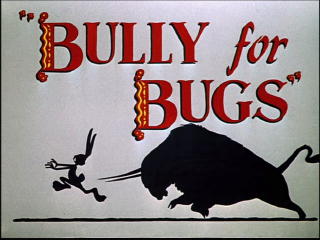
Bully for Bugs (1953)

Jiminy Christmas, hard to believe we’re already halfway through Shortstember. I’ve honestly been having a blast with these reviews and I hope you have too. The downside of focusing on only one short per decade, though, is that we’re now halfway through the twentieth century and I’ve already missed two chances to talk about Bugs Frickin’ Bunny and the Goddamn Looney Tunes and that shit ain’t right. The Looney Tunes series of shorts and its sister series Merry Melodies began in 1930 and 1931 respectively, as a naked attempt by Warner Bros to ride Disney’s coattails in the wake of Mickey Mouse and the Silly Symphonies Shorts. In case you’re wondering, the different between Looney Tunes and Merry Melodies originally was that the ‘Tunes were in black and white and the Melodies were in colour (kinda, Disney had Technicolour exclusively at the time) and certain characters were exclusive to each (Porky Pig and Bugs Bunny both started out in a Merry Melody despite now being the quintessential Looney Tune characters). By the forties though, both series were being done in colour and characters were freely crossing over from one series to the other and there wasn’t really any appreciable difference between the two. So, if I say “Looney Tunes” from here on in, just assume I’m talking about a Warners Brothers short that could have been either a Looney Tune or a Merry Melody. Makes no difference. They’re all beautiful, man.

Broadly speaking, (and I rarely speak any other way), the Looney Tunes started out as Poor Man’s Disney in the thirties, had become the sassy, irreverent anti-Disney by the forties but by the fifties Disney were completely out of the equation. Warner Bros had established an artistic and comedic sensibility that was entirely their own and was beholden to nobody. And we talk a lot about how funny these shorts were (and make no mistake, a top-tier Looney Tune is nothing less than the Platonic ideal of comedy itself) but less discussed is just how beautiful the shorts of this period had become, with special credit due to the absolutely stunning backgrounds of Maurice Noble.
noble-1
noble-2
noble-3
As for the animation, by the fifties the Looney Tunes characters had evolved from rubber limbed, bug-eyed loons to comic actors with the poise and timing of a Carey Grant or Peter Sellers. The phrase “Looney Tunes” conjures images of anarchic, bombastic violence but the fifties-era shorts are possessed of a wonderful sense of subtlety and comedic restraint. Forties era Bugs Bunny might turn to the audience and yell “Crazy, ain’t it?!”. Fifties era Bugs Bunny does the same gag with a single, perfectly raised eyebrow. This is the era where you get shorts like “One Froggy Evening”, “What’s Opera Doc?”, “Duck Amuck” and the hunting trilogy (“Duck Season! Wabbit Season!”). Every element just came into its own here, the direction, the voice acting by the incomparable Mel Blanc, the animation, the writing, the music…
To watch Looney Tunes shorts from the fifties is to be in the hands of masters at the very top of their game.
I’m not going to review one of the really big name shorts like the ones I’ve already mentioned because I try to go a little off the beaten track with this series (Steamboat Willie was an exception because its influence is so vast I knew I’d have to talk about it anyway) so instead, let’s take a look at 1953’s “Bully for Bugs”.

(more…)

“Nothing’s been the same since New York.”

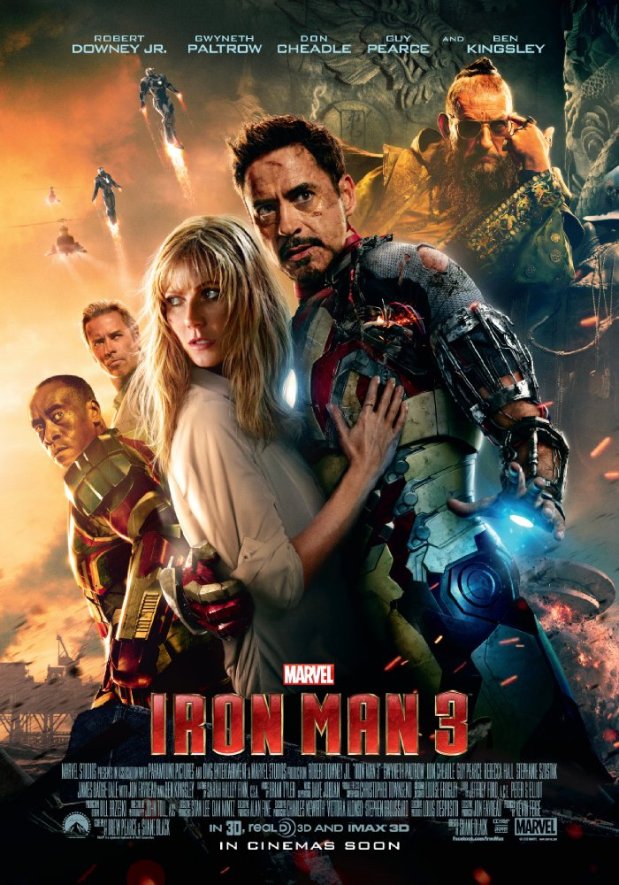
Before we get into the Iron Man 3 review, I should probably address the elephant in the room.
Dammit Francine, if I mean you I’ll use your name. Sit down.

Dammit Francine, if I mean you I’ll use your name. Sit down.

You may have noticed that the ads that were here for a few weeks have now vanished. The reason for that is that I was kindly informed by one of my American readers that the Trump Campaign had been advertising on my blog.
*CLICK*

*CLICK*

And good thing I acted quickly right? I mean, what more fertile pro-Trump ground than Unshaved Mouse? That’s the kind of savvy ad buy that gets you a 10% chance of winning the presidency. Unfortunately this loss of revenue has meant that I’ve had to turn to alternative sources of funding.
“Whoah. Wait a minute, you make MONEY of this?!”

“Whoah. Wait a minute, you make MONEY off this?!”

“No hablo Ingles.”

“No hablo Ingles.”

Thankfully, I’ve been able to secure investment from a less morally compromised source. Which is why I am proud to announce Unshaved Mouse’s new partner, the People’s Republic of China! Please give it up for new recurring character Fan Bing Bing!
“Hello decadent Westerners!”

“Hello decadent Westerners!”

It’s a rapidly emerging market, guys. We gotta move with the times. Anyway, review of movie.

 ***
Here’s a fun game to play with the MCU. Take each movie and imagine what would have happened if the villain had won.
  • Thor: Loki becomes King of Asgard and commits genocide against the Frost Giants.
  • Captain America:  Red Skull wipes out every major city on Earth and most likely ushers in an era of global HYDRA rule.
  • The Avengers: Aliens take over the world.
  • Guardians of the Galaxy: Whole alien planet gets wiped out and that’s just for starters.
  • Thor 2: Ummmmmm…something bad? With…elves? It’s bad, though.

Play the game with the Iron Man movies though and you always get the same result: “Evil rich guy becomes slightly richer.” These movies are actually kinda low-stakes when compared to other entries in the canon. That’s not a criticism. The Iron Man trilogy has always been less interested in “Can Iron Man save the day?” than “Can Tony Stark save his life from being immolated by the army of obsessions, personal demons and character flaws he has jumping around in the moshpit that is his brain?” That’s fine. Refreshing even. I just think it might help explain why this movie is had possibly the least impact on the larger Marvel universe than any other instalment. I’ve been wracking my brain to think of any elements that were introduced in this movie that got carried over into the larger MCU. Extremis? Aldridge Killian? AIM? Never so much as mentioned again in any of the movies (I am waaaay behind on Agents of SHIELD so apologies if I missed anything that showed up there). The Mandarin? Mentioned in a one-shot to keep the fanboys happy. Iron Patriot? Back as War Machine by Age of Ultron. Tony Stark destroying all his suits and giving up being Iron Man? Did not exactly take. This movie is practically in quarantine, and it’s kind of weird that it’s such a dead end at the front because it is deeply wedded to what’s gone on before, to the point that it’s kinda historic in a way I don’t think people necesarrily realise.

See, this is the fourth movie to feature Robert Downey Junior’s Tony Stark, and that’s pretty exceptional. Christopher Reeves played Superman across four movies of course, but by the third installment that series was running on negative continuity. There is no character arc for Superman from Superman I to Quest for Peace, they are just four movies with Christopher Reeves playing Superman. Again, with the Burton/Schumacher Batman movies you get a little bit of character continuity (tiny references to events in previous movies mostly), but by the time you have George Clooney resplendent in Bat-nipples it’s clear that Batman has drifted considerably from Tim Burton’s original vision. This is different. We have now had four movies featuring Tony Stark where the creators are clearly intent on holding to a consistent vision for the character. Iron Man 3 is one of the most polarising movies in the canon for reasons I will get into, but personally it’s my favourite of the trilogy because it asks a question that had never really been asked in a superhero movie before now. What happens to the superhero after he saves the world?

(more…)

Duty calls.

Hi guys. Iron Man 3 review is going to be a little late this week. Ms Mouse has been a little under the weather and I’ve been busy running back and forth between the abandoned tractor in the meadow bringing her medicine from the local cabal of genetically engineered rats. Hope to have it ready for you by Monday. Thanks for being so understanding, Mouse out.

Frog Reviews – Pete’s Dragon

BACK.

IN.

POG.

FORM.

Actually, just regular form. Yes, hello again my internet friends and internet lovers (you love the internet, I mean, not me – although hopefully you’ll come to love me. Eventually).

We’re back in action for another fresh review, this time on the actually correct day of Monday.

And what cinematic treat did I consume this week?


(more…)