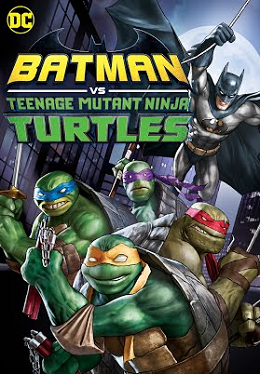
batman

“Cowabunga.”

In 1984, two broke young illustrators named Kevin Eastman and Peter Laird were trying to break into comics. Eastman randomly doodled a turtle in ninja attire and the pair decided that it was a Teenage Mutant Ninja Turtle, essentially a madlib of everything that was popular in comics at the time (except for turtles).
They then wrote a silly little issue parodying Frank Miller’s Daredevil run and that, of course, was that.

This one weird joke concept riffing on an incredibly specific moment in comic book history in a black and white indie vanished without a trace, the very definition of a flash in the pan.

Wait, no. *checks notes*

It went on to conquer the goddamn world. To this day, TMNT is quite possibly the most lucrative Western comic book property not published by either DC or Marvel. Third most successful toyline of all time. Seven TV series, seven films, multiple videogames, hundreds and hundreds of comic issues and a metric shit-ton of merch. Which, on the one hand, is crazy.

How did a concept so ridiculous, and so seemingly instantly dated become one of the most successful and enduring pop culture phenomena of the past half century? Well, success has many fathers. Firstly, I think the franchise’s longevity was sealed with this:

A theme tune that catchy only comes around once in a blue moon. Play it over NINE SEASONS and it’s practically brainwashing.

Then there’s the fact that TMNT relies on a template that has proven to be amazingly durable over the last 180 years.
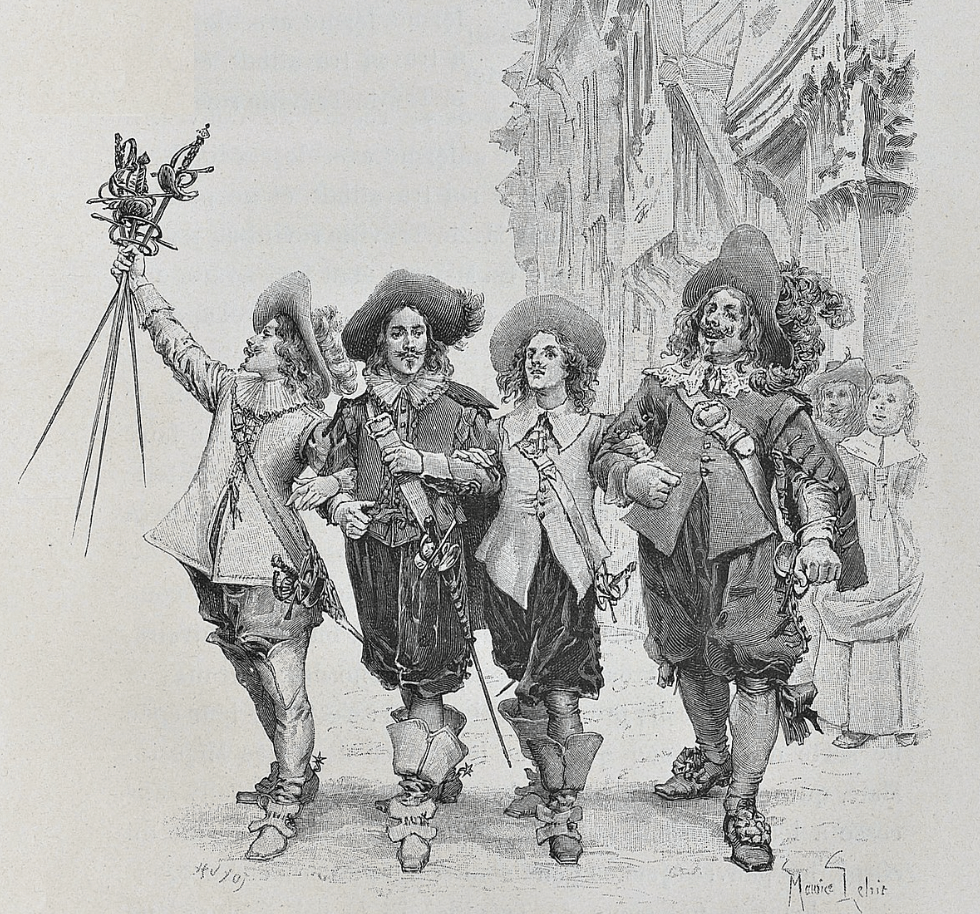
Hothead. Stoic Leader. Smart Guy. Big fun doofus.

The Musketeer Archetypes are like the Four Chords of character writing. They’re bloody everywhere, but they’re there for a reason. They work, dammit. And these character traits (Leads, Does Machines, Cool but Rude, Party Dude) hold true across virtually all interpretations of the characters which gives continuity across the franchise. But, and this is crucial, with that stability and continuity there also comes incredible plasticity. The Turtles fandom is fantastically diverse in terms of its age range and that’s because TMNT can be this:
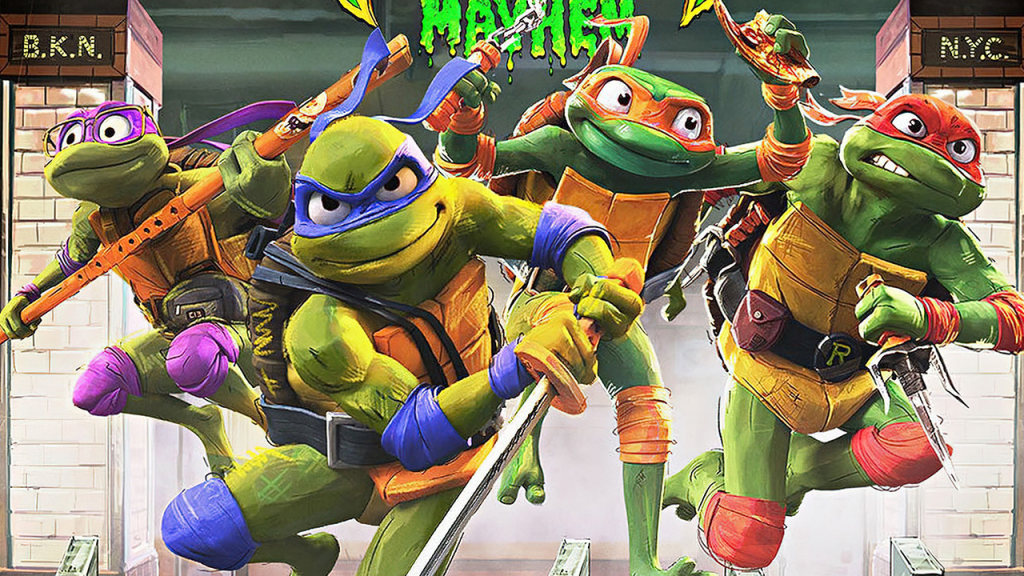
Or it can be THIS:
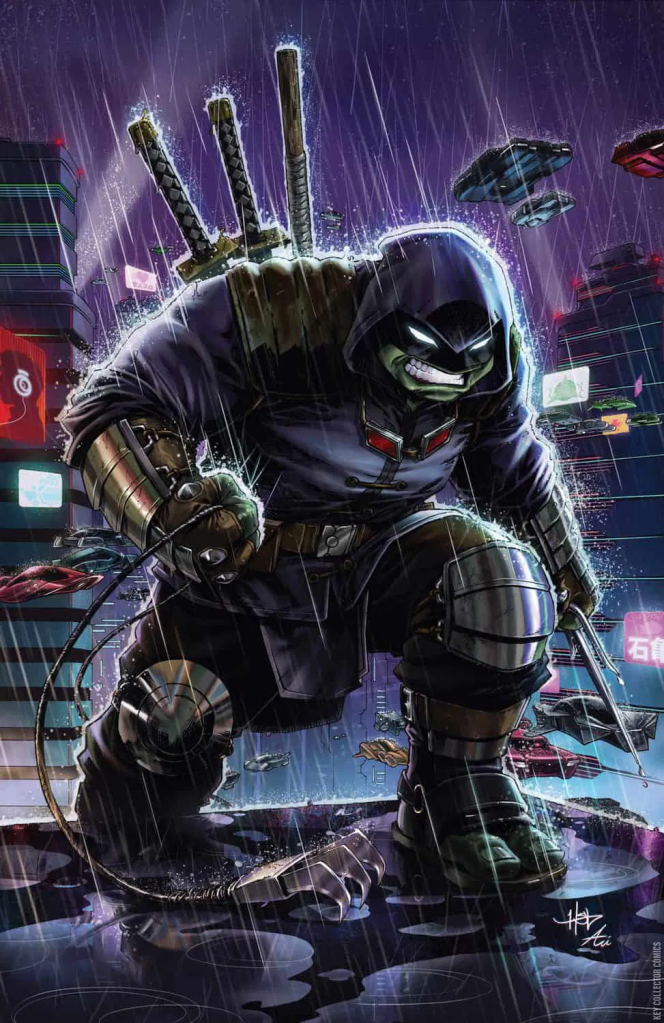
Once you get past the initially (very, very, very) silly premise, the Brothers Turtle can grow with their audience. There’s stuff for kids and there’s also stuff for adults. So, class, where have we heard that before? A character that has a rock solid core that’s also surprisingly adaptable and can tell stories for any and all ages?
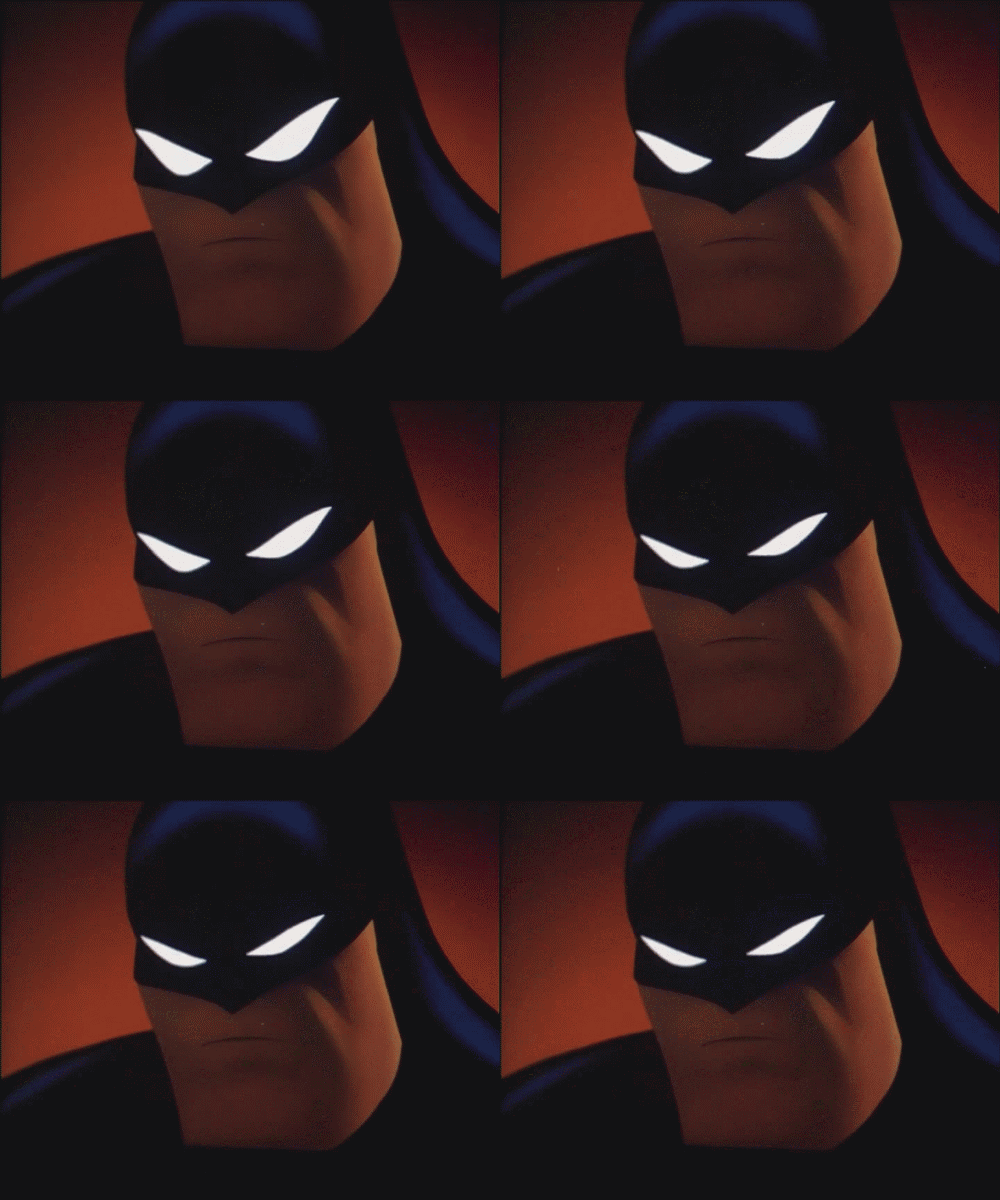
So before we go any further, I owe you all an apology. I know I said I’d be reviewing Turtles Forever but you need to know three things:

  1. My DVD of Turtles Forever didn’t arrive in time (that’ll teach me to support physical media).
  2. There’s a Turtles movie with Batman in it, how am I NOT going to review that?
  3. It is SHOCKINGLY good.
(more…)

“Vengeance won’t change the past, mine or anyone else’s. I have to become more. People need hope.”

While I know it isn’t true, I like to imagine there’s one guy in Warner Bros who was put in charge of the Batman films in 1989 despite knowing nothing about comics in general or Batman in particular and who spends every day banging his head against a desk and screaming “what the FUCK do you people even WANT?!”

Because to a casual observer, there really is no rhyme or reason to which Batman movies succeed and which fail. Why was Batman Forever a massive hit and Batman and Robin a franchise-killer? Why did audiences love Batman and largely steer clear of Batman Returns? Why is a grim and gritty Batman great with Christopher Nolan but not with Zach Snyder?

And there’s no one answer, really. Audience expectations. The marketing. The directing. The acting. The writing. The music. There are hundreds of factors that decide whether a Batman movie will succeed, same as any other movie. And added to that there is a very specific problem with adapting this character to screen: nailing the tone.

Getting the tone of a Batman story right is a damnably tricky thing, and it’s something that writers have struggled with ever since the character was introduced 85 years ago. Let’s take a moment, firstly, to acknowledge that Batman has often been campy and fun and played for laughs. And often, as in the sixties Adam West series, or Batman: The Brave and the Bold, it’s been done to great effect. But, fundamentally, this is a character rooted in a mashup of crime fiction and the horror genre. Batman stories, from their very beginning, deal with murder, corruption and violence. A child witnesses his parents’ brutal slaying and devotes his life to waging violent nocturnal war against the criminal element. It ain’t baby-town frolics. And I think what trips up a lot of Batman writers is that they succumb to the temptation to wallow in miserabilism. They lean into the violence and the horror and the awfulness of the setting to a degree that it stops being in any way enjoyable.

The best Batman stories have stakes and drama and darkness, but it’s a certain kind of darkness. A darkness that takes itself seriously, but not too seriously. There is a dusting of pulpy camp that stops the darkness becoming overwhelming. It’s a very, very tricky tone to capture and, if I’m perfectly honest, no single live action director has ever managed to capture it perfectly.

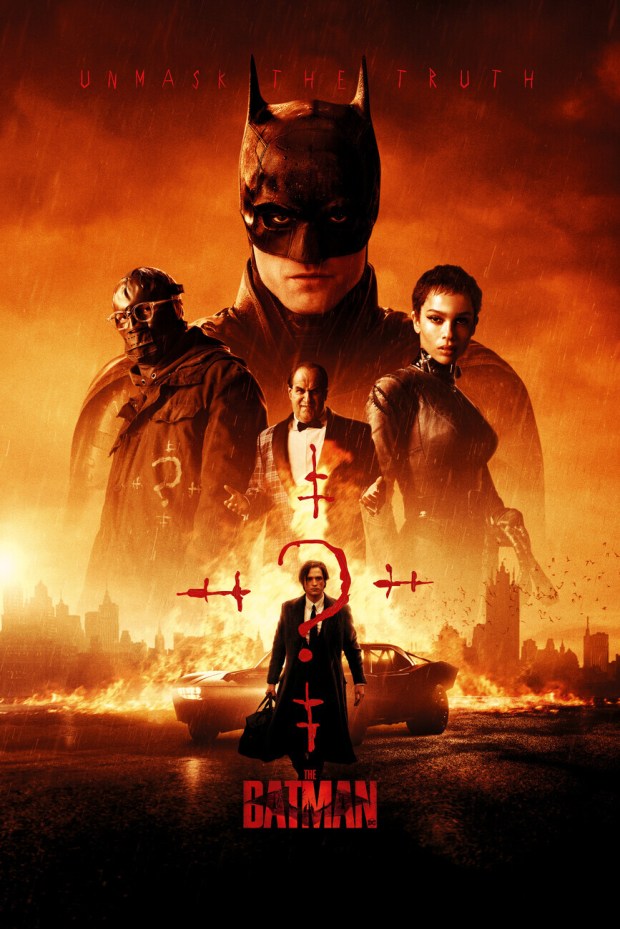
That is, until Matt Reeves knocked it out of the fucking park in 2022.

(more…)

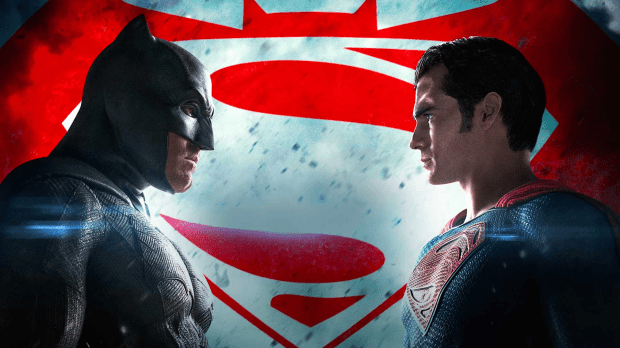
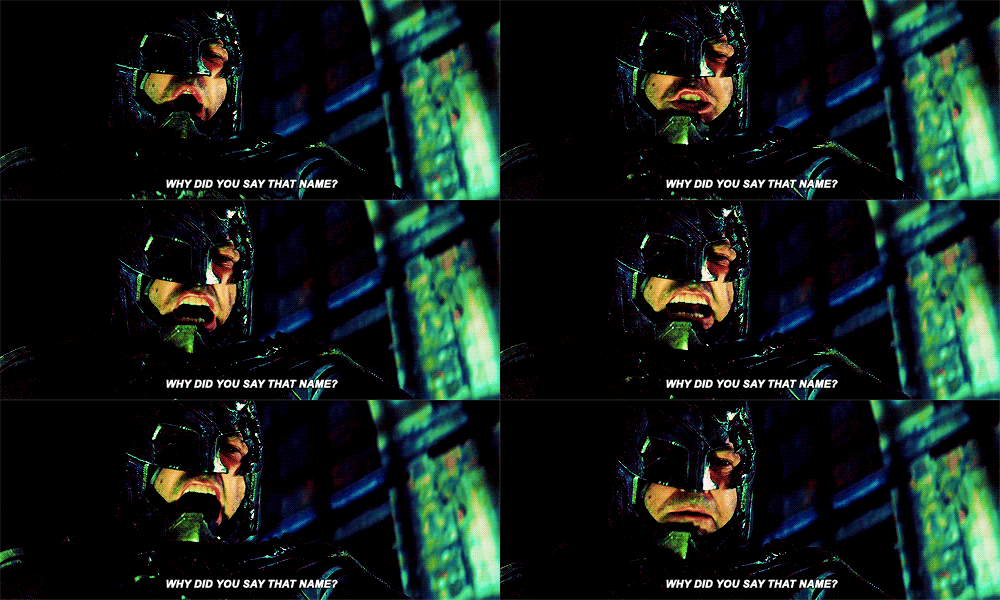
“Nobody cares about Clark Kent taking on the Batman.”

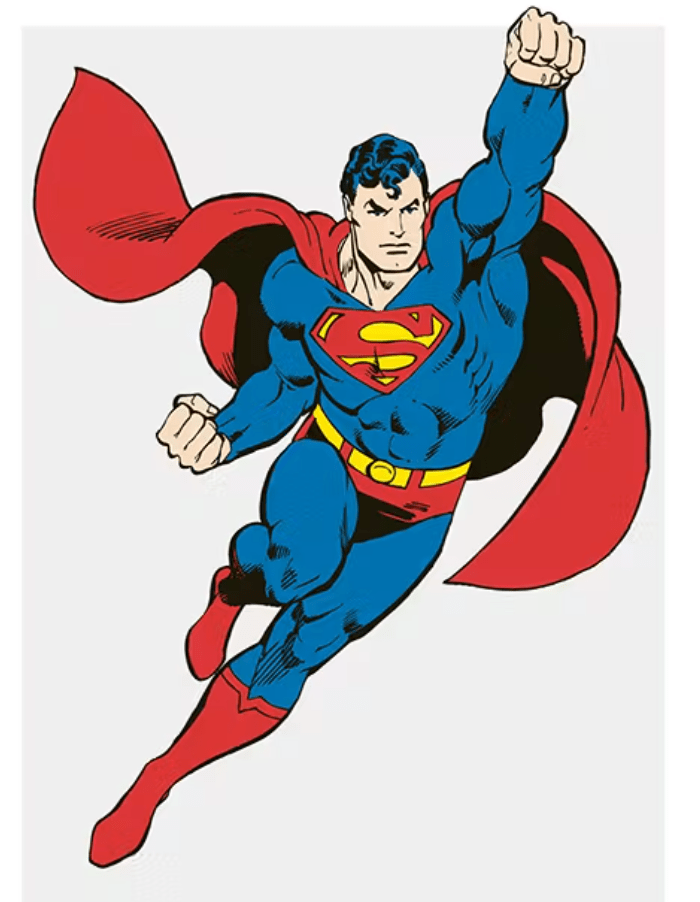
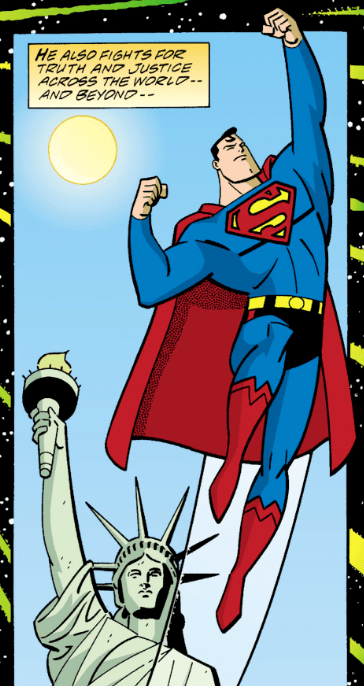
I don’t actually think it’s possible to be a little boy between the ages of 4 and 8 who is aware of Superman and not a fan of Superman. It’s like Star Wars or Transformers. You see this:

And something in your little boy soul just chimes.

So I don’t think there was ever a time where I wasn’t a fan of Superman but as I’ve gotten older I’ve certainly become more of a fan. And I have to say, on behalf of my tribe, it’s a pretty good time to be an enjoyer of Clark Kent. James Gunn is going to be bringing us a new Superman movie next year, both Superman and Action Comics have been enjoying high-quality, well-received runs and My Adventures with Superman is, in my humble opinion, the single best animated depiction of the character since the Fleischer Shorts of the forties. Yes. Better than Superman the Animated Series and Justice League Unlimited. No, I will not take that back.

My point is things are good now. We’ve come along way from…y’know.

Fuck. There really was a time there when the guy most responsible for shaping Superman’s presentation to the wider world was Zack Snyder.

Future generations won’t believe it. But I was there. It happened.

Alright, let me pull back a little bit. I know you’ve probably clicked on this hoping for some classic, old-school mid-2010s internet rage with all manner of inventive profanity and performative outrage and I won’t lie, I’m not too proud to dance. BUT I want to draw a line in the sand here and make one thing clear.

I don’t hate Zack Snyder either personally or artistically. He is, by all accounts, a lovely guy and the loyalty that he inspires in the actors who have worked with him is genuinely touching. I can’t say I understand the devotion that fans of his movies have to his work but I don’t for a minute doubt its sincerity. People do genuinely, passionately adore his films and respond to them and that can’t be ignored. This is not some studio hack. This is a man who produces works that people respond to strongly, both positively and negatively. This is an artist.

He should not be allowed near Superman. Ever.

He does not understand the character and he does not understand why he matters.

I realise that this is going to come across as just…foam-flecked fanboy ranting but please hear me out. This character is important in a way that very, very few fictional characters are or ever will be. Remember what I said about how every little boy just, instinctively loves Superman?

Okay. Now you may have heard Superman described as a power fantasy for little boys. And to that I say “yes, absolutely he is” and also “why the fuck are you saying that like it’s a bad thing?”

If Superman is a fantasy, what exactly is the fantasy?: “I want to be an all-powerful demi-god so that I can…devote every free moment of my time to protecting and helping those who have less power than me”?

So…you have generations of young boys who will grow up in a world where they will have disproportionate power (of many kinds) over others being influenced by this character and his worldview, modelling behaviours of selflessness, compassion, kindness and justice. You see why that might be, I dunno, a very, very good thing?

Now here is a quote from Zack Snyder (he’s actually responding to criticism about Batman killing people in his movies but it’s also relevant when discussing his approach to Superman):

“Once you’ve like lost your virginity to this f**king movie and then you come and say to me something about ‘oh, my superhero wouldn’t do that’, I’m like ‘are you serious?’ because I’m down the f**king road on that.

“It’s a cool point of view to be like: ‘My heroes are still innocent. My heroes didn’t f**king lie to America. My heroes didn’t embezzle money. My heroes didn’t commit any atrocities.’

“That’s cool, but you’re living in a f**king dream world, okay?”

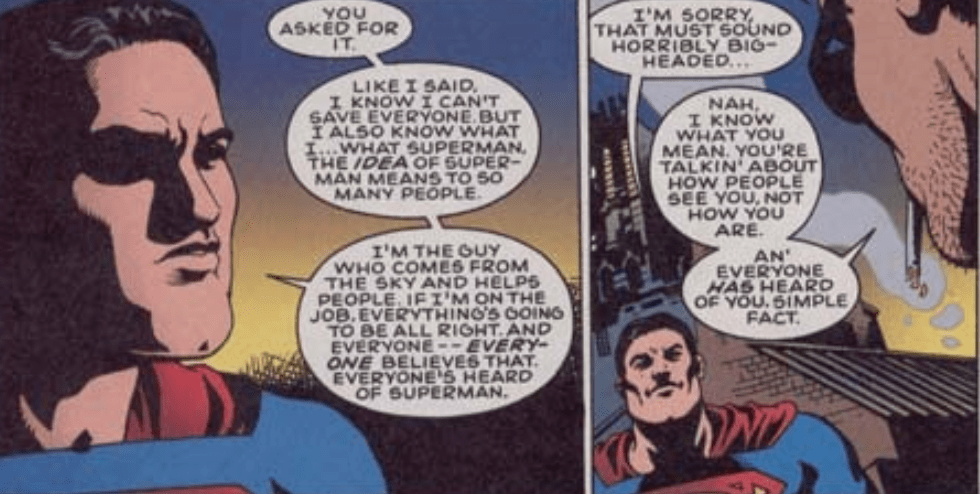
And yes, I know juxtaposing that quote with that dialogue from What’s So Funny About Truth, Justice and the American Way has been done so many times it’s cliché at this point but…I wanted to do it and it made me feel good and it’s my blog so there.

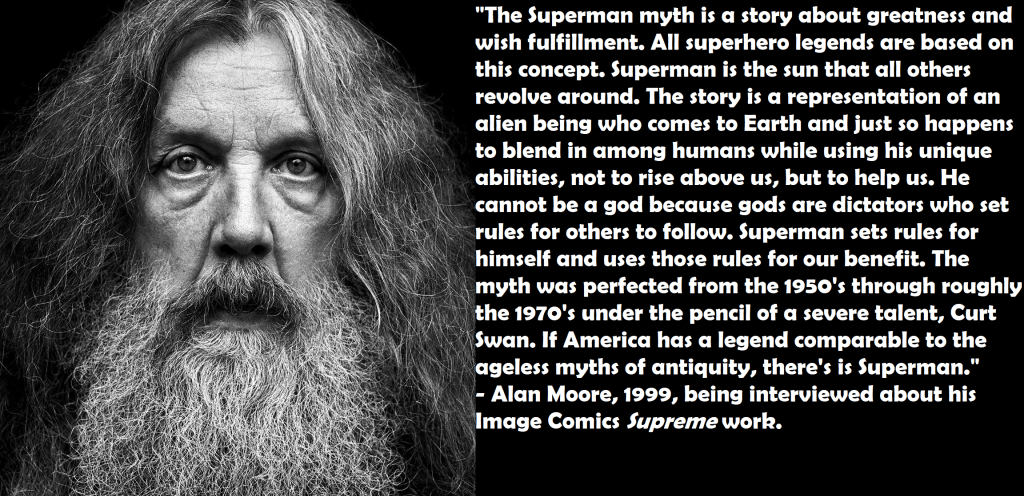
Zack Snyder claims that his approach to comics is rooted in Alan Moore’s Watchmen and sure, Moore did deconstruct the tropes of comic books and created superheroes who were deeply, deeply flawed people. But you know what he didn’t do? He didn’t try that shit with Superman.

Moore didn’t write a lot of Superman stories but the ones he did featured some of the very noblest, most selfless versions of the character.

Moore gets what makes Superman important, and that it is not something to fuck with.

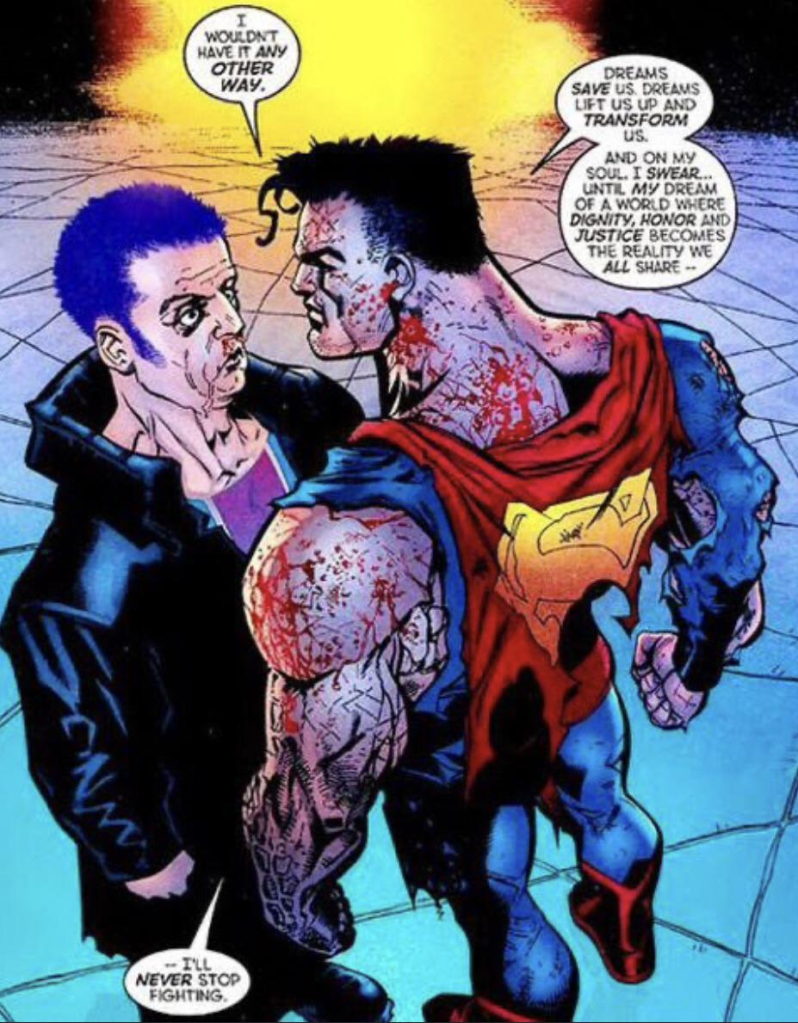
Hell, even Mark Millar and Garth Ennis, the two patron saints of the Shitty Edgelord school of superhero comics. You give them Superman, this is how they write him:

Superman is so fucking good the guy who wrote The Boys can’t hate him.

Anyway.

Hello, welcome to my regular series of movie reviews where I talk about Batman.

(more…)

“Peace has cost you your strength. Victory has defeated you.”

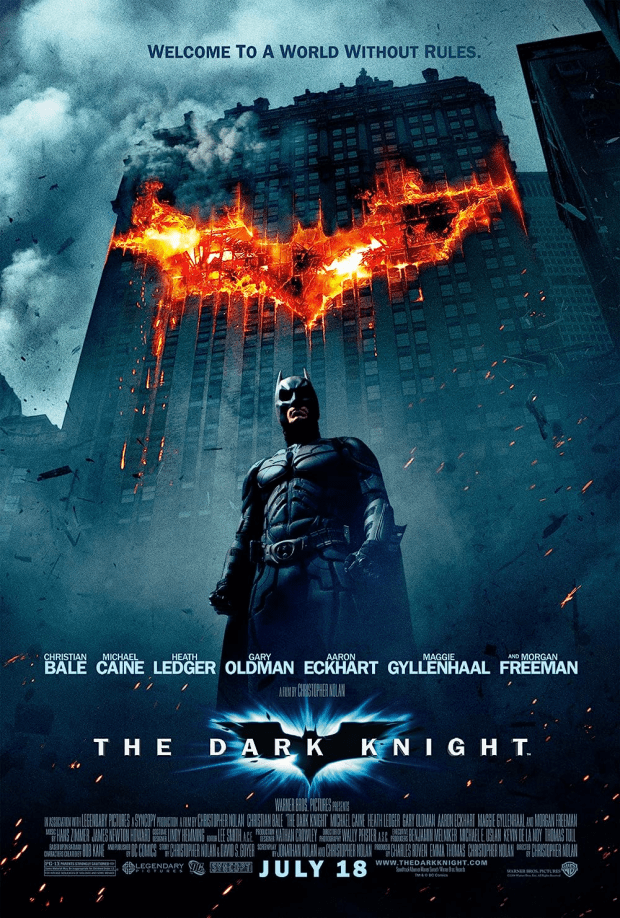
Martin Scorsese supposedly coined the expression: “one for them, one for you”, meaning you do the movies the studio wants you to do in order to do the movies you want to do. The Dark Knight Rises is, famously, one of the most open and avowed “one for them” movies in recent Hollywood history.

Nolan didn’t want to do it (especially after Heath Ledger’s tragic death) and never bothered to hide the fact that this was the hoop he had to jump through to get Warners to pony up for Inception.

But you know what? It’s a myth that great art only comes from passion projects. Plenty of good and even great films have come from people who just showed up to work that day. And look, if the price we had to pay for every Inception was a Dark Knight Rises, I’d take that deal.

But there are problems with this movie. And (bizarrely, given this is the exact same writing team that gave us the fucking GOAT of a script that was The Dark Knight) pretty much all those problems begin and end on the page.

(more…)

“We burned the forest down.”

Do you want to know how I got these scars into writing about movies?

My college had its own version of “The Onion” where I made my bones writing utterly run-of-the-mill edgy early 2000’s college humour (i.e. the kind of stuff that would get me cancelled today so fast it would break the laws of physics) and my editor asked me if I’d be interested in trying my hand at writing a movie review. And the very first movie I ever reviewed for them (if memory serves) was none other than The Dark Knight. And now you know my gritty origin story. And, if you are old enough to remember my earliest reviews (DON’T GO BACK AND READ THEM DON’T YOU DO IT I SWEAR TO GOD) you’ll remember that this movie was a BIG deal to me and those early reviews are chock full of references to it, even when they weren’t relevant or funny. Which was all the time. I see that now.

So, as you can imagine, I approached this one with a great deal of trepidation. Is it really as good as I remember?

No, actually.

In fact, in many ways, it’s better.

(more…)

“Why do we fall, Bruce? So we can learn to pick ourselves up.”

I almost didn’t write this review. I seriously toyed with the idea of putting Batman Begins off for another fortnight and devoting an entire post to the sheer insanity that was Warner’s near decade-long attempt to get a fifth Batman movie made after the neon coloured Chernobyl that was Batman and Robin.

This was right around the time I started following movie news and let me tell you, friends, listening to the proposals coming out of Warners in the late nineties was like having your ear pressed to a cell wall in a lunatic asylum.

“Coolio as Scarecrow! Ghost Joker! MADONNA AS HARLEY QUINN!!! AAAAAAHAHAHAHAHAHAHAHAAAAA!!!”

Some of these proposed films, admittedly, do sound pretty interesting, like the Batman versus Superman movie starring Colin Farrell and Josh Hartnett, Darren Arronofsky’s Batman Year One or a version of Batman Beyond with Keanu Reeves as Terry McGinnis.

But the one thing that all these proposed movies have in common is that they really, really want you to know that they were going to be DARK. Black. Psychologically tortured. Darkness. No parents.

It’s honestly a little macabre how much they wanted you to know that Batman was going to have a thoroughly shitty time when this movie finally got made. Which is unfair. I mean, Batman didn’t decide to let Akiva Goldsman write the script for Batman and Robin, why should he have to suffer?

Thankfully, we were spared the spectacle of a sobbing, psychologically scarred emo Batman by the appointment of Christopher Nolan as director, a man who has no time for your puny human emotions.

All kidding aside, I’ve seen nine of this legend’s movies and five of them are on my all time greatest list.*
(more…)

“Some of it is very much me. Some of it isn’t.”

One of the most persistent and unkillable myths in the history of comics is the “saving” of Batman by Frank Miller. You’ve probably heard it. The Batman comics were just a giggling campy mess after the sixties TV show and it was only with Frank Miller’s seminal The Dark Knight Returns in 1986 that Batman became dark and gritty again. Cool story, but complete guano (and one I’m pretty sure I helped spread at a much earlier point in my career as a semi-professional nerd rodent). Truth is, the comics had been pushing back hard against the BIF BAM KAPOW image from as early as 1970 in an attempt to bring Batman back to his roots as a grim, brooding nocturnal hero.

What The Dark Knight Returns did do was bring that darker Batman that was already present in the comics to a much wider audience. DKR was published in 1986, the year that also saw the release of Watchmen, and the release of these two comics in the still relatively new graphic novel format made about as big an impact as it is possible for comics to make.

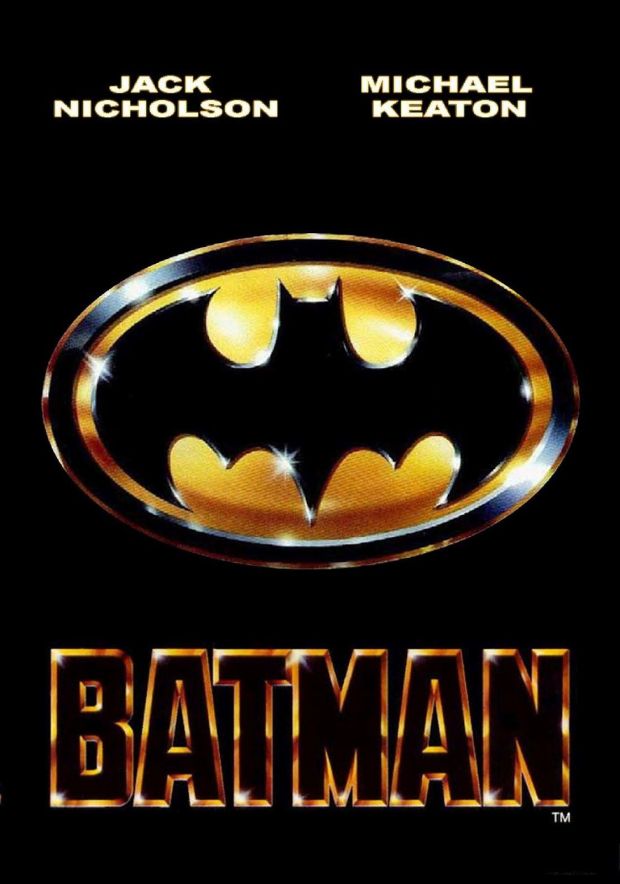
Batman was the first attempt to reframe Batman in the popular consciousness from the Adam West incarnation into something closer to his comic depictions. Did it succeed?

“Yeah. Yeah, just a bit.”

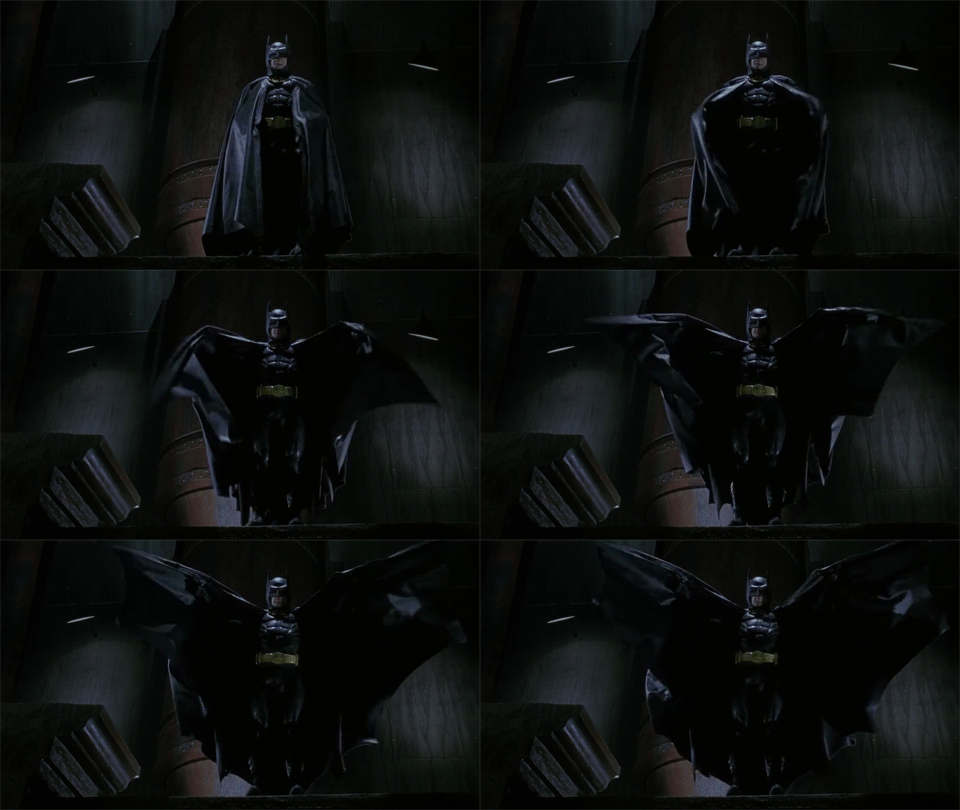
To put it another way, this is by far the single most influential depiction of Batman in any medium in the eighty year history of the character. This movie was where Batman went from “Flagship comic book character and star of a pretty popular TV show” to “Modern Secular God”. In terms of box office, merchandising revenue and pop culture impact it was on the Star Wars tier.  “Fine Mouse”, you say. “But what’s it done for us lately? Does it stand up?”

To which I say, “Yes. It does stand up. And then it flaps its wings, like a pretty, pretty butterfly.”

(more…)

“It doesn’t have to be good to be a classic.”

Let me tell you about the only comic book to ever make me cry in public.

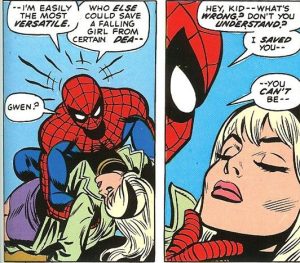
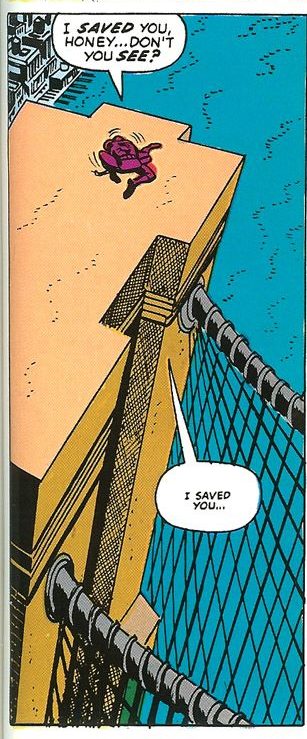
From the first page of Amazing Spider-Man #121 something is off. There’s no title. Simply a sombre note from editorial telling the reader that they won’t actually learn what the name of the story is until the end. But it’s still very much a seventies Spider-Man story; bright primary colour palette, soap opera melodrama to burn and an exclamation point/period ratio of around 90 to 1. Norman Osbourne, who used to be the Green Goblin but has forgotten the whole thing because of amnesia, is undergoing a psychological breakdown because his son Harry went on a bad acid trip (did I mention that this came out in the seventies?). Suddenly, he relapses and remembers not only that he’s the Green Goblin, but that Peter Parker is Spider-Man. Racing to Peter’s apartment to enact his revenge, he instead finds Peter’s girlfriend Gwen Stacey who he abducts. Peter desperately pursues the Goblin to a bridge (George Washington per the text, Brooklyn according to the art) and Spider-Man and Osbourne have a desperate, thrilling mid-air battle that comes to a horrific halt when Gwen Stacey is thrown of the bridge by the Goblin.

Frantically, Peter shoots his webs to catch her before she hits the ground…and he does! He’s saved her! He’s won! Good triumphs over…

No. This time it’s different. And, on the final page, we at last learn the name of the story we’ve been reading which is, of course The Night Gwen Stacey Died. This is the panel that always makes me well up. :

At this point in the comics, Peter Parker was no longer a teenager. He had graduated college, he was an adult. But he was still very much a children’s character. And I find something indescribably tragic about this child’s superhero cradling the body of the woman he loves, unable to comprehend that his world has changed and that the old rules don’t hold true anymore. Good does not always triumph over evil. The innocent are not always spared. The guilty are not always punished. The people you cannot live without will be taken nonetheless. It’s a story about the loss of innocence we all go through and it’s one of very few single issue comics that I would hold up as an absolute work of art. It’s a piece that’s moved me deeply and that I feel a real personal connection to. And I think one of the reasons why it is such a gut punch is because the brutal tragedy at the heart of story is contained in all this colourful, innocent Silver Age goofiness, like a hand grenade with a pink smiley face on it. It wouldn’t work a tenth as well if done in a moody, gritty “realistic” style.

The Night Gwen Stacey Died became an instant classic and to this day is usually considered the demarcation point between the Silver Age and the Bronze Age, a period marked by a more mature and literary style of comics that produced some of the greatest masterpieces in the genre. Unfortunately it also taught a generation of hacks that they could kill the hero’s girlfriend for some cheap drama and pathos. Nowadays, the phenomenon of female supporting characters being killed to provide motivation for the male lead is usually called “Women in Refrigerators”, a term coined by writer Gail Simone after a particularly notorious Green Lantern storyline, but before that it was called “Gwen Stacey Syndrome” because it was really this story that opened those floodgates. To be clear, this does not make The Night Gwen Stacey Died a bad story (or at least, I certainly don’t think it does). The problem is the raft of imitators who failed to realise that what made Gwen’s death so shocking and effective was that it was so rare. Hard as it might be to believe, prior to 1973 women almost never died in mainstream comics, and if they did (Batman’s mother for example) it was almost always off panel. So what does this have to do with The Killing Joke?

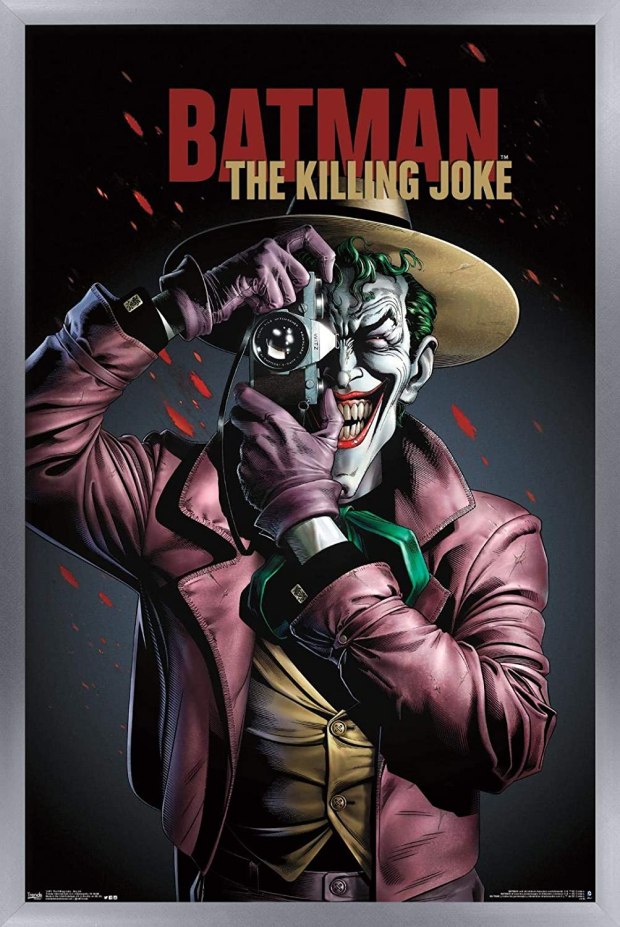
Well, The Killing Joke is a 1988 Batman story by Alan Moore with art by Brian Bolland, and since its release its been frequently lauded as one of the best Batman stories, the definitive Joker story and one of the greatest comics of all time. (thanks to Clifford who pointed out that I actually put it on my list of greatest comics which I had completely forgotten). However, it has also increasingly been viewed as being somewhat…problematic…

Frau_Blucher

Why? Well, because in the course of this story the Joker shoots Barbara Gordon, paralysing her, (possibly) sexually assaults her and then shows her father pictures of it in an attempt to break him psychologically. Like Gwen Stacey, Barbara Gordon is brutally assaulted in order to advance the story of a male character, in this case her father and Batman. So there’s quite a bit of backlash against this book, with even Alan Moore himself effectively disowning it. Although honestly, take that with a grain of salt. Despite being the most influential writer in the history of the medium not named Lee, Siegel or Finger, Alan Moore basically now regards the entire comic book industry the way Captain McAllister views the sea.

My feelings? Well…I basically feel about The Killing Joke the way I feel about 99 Problems.

Is it misogynistic? Yes.

Noticeably so for its time and compared to the rest of its genre? Not really.

To the point where it obscures its artistic merits? No.

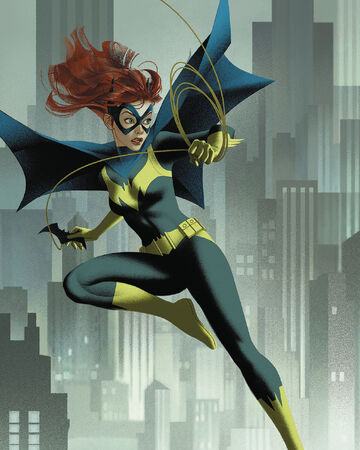
Of course, reading it now you have the benefit of knowing how the story ends. That Barbara Gordon was able to overcome this tragedy, and became Oracle, a wheel-chair bound superhero who became an inspiration to many disabled comic book fans and one of the most valued heroes not simply in the Bat family but in the DC universe as a whole.

Barbara Gordon | Batman Wiki | Fandom

And then Bruce just had her fixed so she could become Batgirl again, which was inspiring to comic book fans with billionaire friends who magically solve all their problems for them.

Ultimately, despite the problematic…

Frau_Blucher

…elements of the story I still think it deserves to be considered one of the all time great Batman yarns. And I was really pumped for this animated adaptation. Look at this line up! Bruce Timm, creator of the legendary Batman the Animated Series was producing, well-regarded Batman scribe Brian Azzaerello was writing the script and the voice cast was shit shot: Conroy! Tara Strong! MARK HAMILL COMING OUT OF RETIREMENT TO DO ALAN MOORE’S JOKER YE GODS!

But then early word had it that the animated adaptation would be greatly expanding Barbara’s role in the story and I was leery. I mean, on the one hand, it’s certainly a laudable impulse to want to address criticisms of the original by giving Barbara Gordon more agency and putting her experience front and centre. On the other hand, that is a radical change to the story. Put bluntly, The Killing Joke is not a Barbara Gordon story. Hell, it’s not even really a Batman story. It’s a story about the conflict between Moral Nihilism as represented by the Joker versus Ethical Objectivism personified by Jim Gordon. So my feeling was that if the creators doubted their source material to the point that they would make such a radical change, they probably shouldn’t be adapting it in the first place.

My worry was that we would get a more progressive, more enlightened, less problematic version of The Killing Joke but probably not a better one.

Oh, oh, oh…

I wish that was what we got.

JESUS.

(more…)

Putting the Hurt on: How Telltale broke Batman

Telltale games are no more.

Telltale was originally formed in 2004 by former disgruntled LucasArts employees to revive the flagging adventure genre. Over the next few years Telltale earned a reputation as the gold standard for excellent writing in computer games (excellence in how they treated their employees, not so much). But I don’t want to talk about how Telltale made great games or how they ground their employees into a fine snortable powder.  I want to talk about Batman, because I will never not find a way to talk about Batman, which you should keep in mind if you ever ask me to give a eulogy.

Telltale’s modus operandi was to take licenced properties (which is very common in the computer games industry) and to do genuinely interesting and original things with them (which, in the computer game industry, is as rare as catching a unicorn using a swear word). So when it was announced that Telltale were doing a Batman game? People. Were. Pumped.

Having been gifted a Nintendo Switch by my family last birthday I’ve finally played through both Batman games and I have feelings people. I have feelings that need to be expressed. So from here on in, spoilers abound.

(more…)

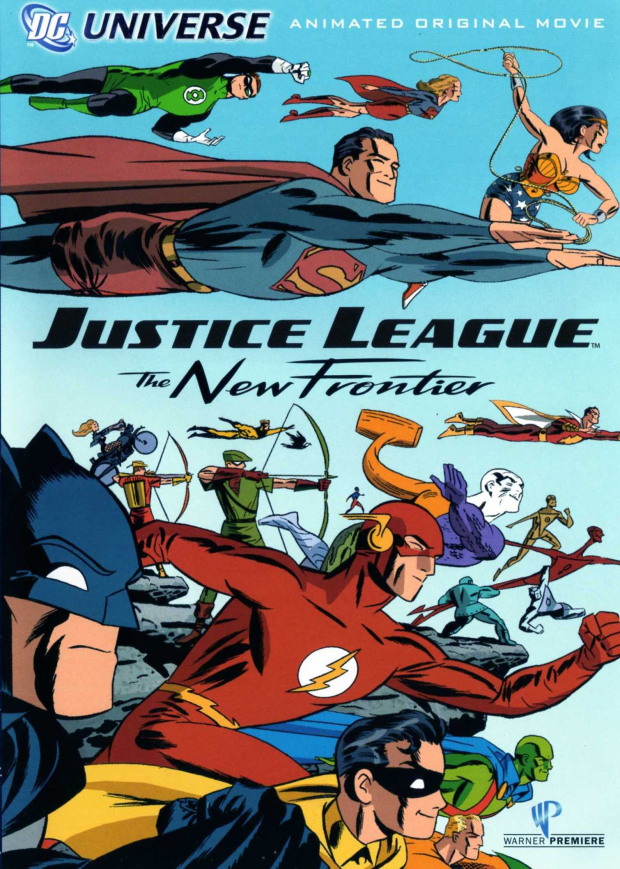
Justice League: New Frontier (2008)

Comic Book historians divide the history of superhero comics into “ages”. The Golden Age lasted from the late thirties to the end of the second world war. It began with the creation of Superman and saw the births of Batman, Wonder Woman, Captains America and Marvel, the original incarnations of the Green Lantern and the Flash as well as a host of others. Owing to the ongoing unpleasantness at the time, many of these characters were patriotic, Japanazi fighting do-gooders like the greatest superhero for all time, the Original Human Torch.

“Mouse, stop showing that panel of the Original Human torch calling Hitler a liar while burning him a…” “NEVER!”

“Mouse, stop showing that panel of the Original Human torch calling Hitler a liar while burning him a…”
“NEVER!”

Also, owing to the fact that this was a brand new genre and folks were still figuring out the rules these comics tended to be absolutely batshit insane.

In the forties we had a superhero who was a giant flying eyeball. How’s that for diversity?

In the forties we had a superhero who was a giant flying eyeball. How’s that for diversity?

And then, with the war over, the superhero fad died about as quickly as it had ignited and superheroes pretty much vanished from the shelves with the exception of a few stubborn holdouts like Superman.
Now, I want you to imagine that you wake up tomorrow and everyone is playing POGs. Like, POGS are suddenly huge again. Kids are playing POGs, college students are playing POGs,  journalists are writing long earnest think pieces about the cultural ramifications of the POGsurgance instead of doing actual work. This weird fad from fifteen or twenty years back suddenly comes roaring to prominence again and never leaves and before you know it movie studios are making massive-budget spectacle movies with inter-connected continuity and people are lining down the street to watch Pog versus Pog: Dawn of Pog.  That’s kind of what happened with the dawn of the Silver Age of comics in the late fifties/early sixties. So what happened?

“Two words. Sput! Nik!”

“Two words. Sput! Nik!”

With the dawn of the space race, America became obsessed with science and its wild, stoner little sister science fiction. Whereas Golden Age heroes tended to have magical or mythical based powers, the new crop of superheroes belonged firmly in the realm of science fiction. Instead of getting his powers from an old magic lantern, the new Green Lantern was a space cop gifted with fabulous technology by a race of all powerful aliens. The new Flash was police scientist Barry Allen who eschewed the Roman mythology inspired look of his predecessor, Jay Garrick. Even the few surviving Golden Age heroes adapted to the times; I mean look at what poor Batman had to deal with for chrissakes:

“I AM THE NIGHT!”

“I AM THE NIGHT!”

Over at Marvel, the hottest new properties were Spider-man, a science student turned superhero, and the Fantastic Four, a quartet of astronauts who literally got their powers as a result of the space race.
Much like “the sixties” doesn’t simply mean the years between 1960 and 1969 but refers to an entire cultural…thing, “silver age” has come to represent a specific attitude and aesthetic in comics. The comics of this period tended to be bright, optimistic, occasionally goofy as hell and suffused with a spirit of Moon Shot era can-do. New Frontier, Darwyn Cooke’s classic  2004 love letter to that whole era, simultaneously interrogates the period in which those stories were written while simultaneously celebrating what made them great. In 2008, Cooke teamed up with his old partner Bruce Timm (Batman the Animated Series) to adapt this story as part of Warner’s line of direct to to DVD animations. Did Cooke’s work make the transition unscathed? Let’s take a look.
Blucatt ad

(more…)