comics

Darwyn Cooke: 1962-2016

Man, 2016 can eat a big one.

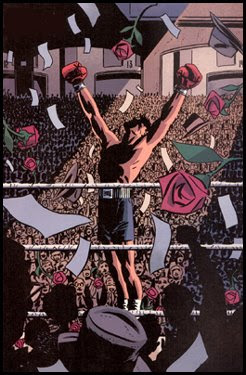
News has broken today that Darwyn Cooke, probably one of the most skilled and distinctive comic book artists of his generation lost his battle with cancer in the early hours of this morning.

He was 53.

Despite his phenomenal talent, Cooke had a hard time breaking into the comics industry. He submitted work to the major publishing houses in the early nineties because his work was simple, elegant and utterly beautiful and that’s just not what the nineties were about.

He did however, work as a storyboard artist on Batman The Animated Series, Superman the Animated series and Batman Beyond, animating the main title of the latter. He finally found success in comics in the early 21st century, with a notable run on Catwoman, creating a new visual look for the character that was instantly iconic.  He is probably most famous for New Frontier, a story featuring most of the DC comics stable set in the late fifties/early sixties which ranks with Watchmen and Kingdom Come as one of the all-time great superhero stories.

He was also, from what I hear from my friends in the comics industry, a thoroughly wonderful bloke.

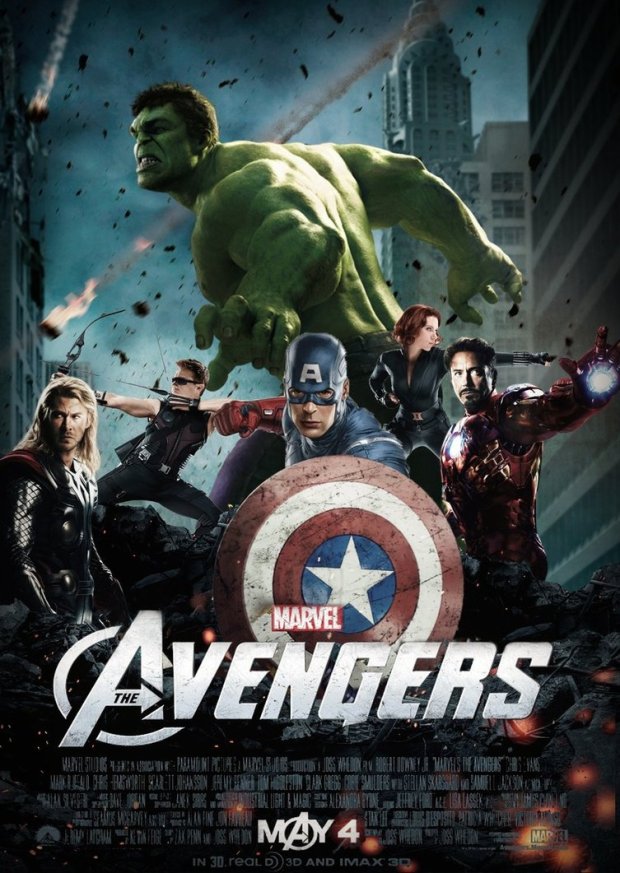
I was originally planning to review The Avengers  on the 26th. However, in light of today’s news I have decided to review a movie that I’ve been meaning to for quite some time. To commemorate the life of this remarkable artist, I will be reviewing the 2008 animated adaptation of New Frontier.

Ar dheis Dé a anam. RIP, Mr Cooke.

“I don’t want to kill anyone. I just don’t like bullies.”

True story. A few years ago now when I was getting ready to move out of my parents’ house, I was clearing out my stuff from my bedroom, the bulk of which was pretty much every issue of SFX magazine published between 1997 and 2004. And I found myself with two copies in my hand, one from August 2001 and the other from October 2001. I idly flicked through the August issue and found myself reading the comic reviews, one of which was a little quarter-page panning of Captain America # Fifty Bajillion drawn by Who Knows and written by Who Cares. The review was scathing; the art’s terrible, the writing’s appalling and worst of all, the main character’s just not interesting or relevant anymore. The review finished by noting that Marvel had been dropping hints that one of their oldest characters was going to be killed off and it didn’t take a genius to figure out that Cap was not long for this world. I then flicked through the October 2001 issue and again turned to the comics section. And there was a full page review of the new Captain America #1, with a top tier art and script team and a story about Steve Rogers defending Muslim New Yorkers from racist attackers while trying to track down an Al Qaeda cell.

Cometh the hour. Cometh the man.

For a character whose entire schtick is being a man out of time, when he was originally created Captain America was actually ahead of his time. In America in 1940 public opinion was firmly against become involved in another European war. In New York however, many of the men working in the comic book industry were  the children of Jewish immigrants who often still had family back in Europe and felt a personal connection to the horrors being committed by the Nazis. One of those men was Joe Simon who conceived of a patriotic, Nazi-battling character named “Super American”. Deciding that the name was a little too similar to a certain other superhero, he changed it to “Captain America”, a name so instantly iconic that nowadays you just have to put the word “captain” in front of any random noun and it sounds like a superhero name. Simon pitched the idea to his editor Martin Goodman who liked it so much that he ordered him to create a solo Captain America series, a big gamble to take on an untested character. Simon’s usual partner was artist Jack Kirby but Simon wanted to bring in two additional artists to deal with the workload of creating an entire book’s worth of stories based on one character. But Kirby was so invested in the character of Captain America that he insisted on drawing the entire book himself, which he did, and on time.

The first issue sold as well as any comic that features Hitler getting punched in the face should. The character was an immediate hit, becoming the first genuine superstar character of Timely comics (which would later become Marvel). Not all the attention was positive, however. American Nazis began sending threatening letters and one time even called the offices of Timely challenging Jack Kirby to come down and fight them in the foyer. Kirby ran down only to find they’d run off because it was Jack Frickin’ Kirby and they may have been Nazis but they weren’t crazy. Regardless, for a while the city of New York actually had to provide police protection to the building. After Pearl Harbour, Captain America became even more popular, with his comics distributed to American service men to boost morale. Many of the Timely artists and writers were drafted during this period. Stan Lee, for example, who got his break in Timely writing Captain America prose stories (he was the one who came up with the whole “throwing the shield as a weapon” thing) was put to work making propaganda. One day he was found breaking into the army post office, trying to mail a script off to Timely. He was told he’d be court-martialed, only to be released the next day when the editor of Timely rang his commanding officer to point out that jailing the writer of Captain Frickin’ America might be bad for the army’s morale.

Jack Kirby also joined the army but opted to serve on the front lines, becoming one of the few American soldiers who had experience fighting Nazis as a hobby before going pro.

Unfortunately, America won the war…I mean obviously not “unfortunately” in the grand scheme of things but unfortunate for Captain America. You see, Captain America was very much a reaction to the Nazi menace, which is what made the character so timely (pun!) and important. But of course, once that menace was defeated, Captain America didn’t really have a purpose anymore. In fact, the same could be said for the vast majority of superheroes who had followed in his wake. The superhero boom pretty much died with Hitler, with only a few characters like Superman, Batman and Wonder Woman surviving the decade. Timely tried repurposing Cap as a commie fighter, but it just wasn’t the same. Timely changed its name to Atlas, dropped the superhero genre entirely and started focusing on sci-fi and monster tales.

It wasn’t until the sixties that Cpatain America got his second origin story. The third issue of The Avengers had the newly formed team finding Captain America floating in the Arctic Sea in a block of ice having gone missing near the end of WW2 (all the stuff about him fighting communists was retconned as actually having…you know what, fuck it, no time). Captain America then joined the team as a man out of time, a morally pure Rip Van Winkle trying to adapt to a confusing and complex modern world, and that’s pretty much been his niche ever since.

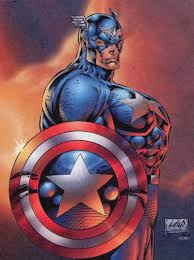
Since then, Captain America has had his share of classic runs and great stories, but there’s no denying that he’s a tricky character to do right. Like Superman and Wonder Woman, it takes a writer with skill to make him work (though it’s a truly wonderful thing when he does). For a long stretches of the twentieth century it often seemed like Marvel didn’t know what to do with Captain America, often giving him to creators who really had no business writing the character, which is how we got Rob Liefeld’s godawful Heroes Reborn Captain America.

I'd say "We do not speak of the Sentinel of Libertitty" but let's be real. We never stopped.

I’d say “We do not speak of the Sentinel of Libertitty” but let’s be real. We never stopped.

 Since the beginning of the 21st century however, Cap has once again become one Marvel’s top tier characters, attracting industry leading talent and the kind of popularity he hasn’t really known since the time of his creation. Part of that is, well, yeah, obviously…

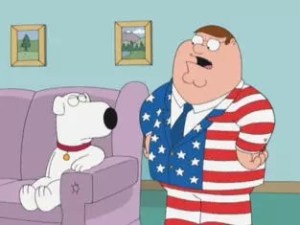
"9/11 changed EVERYTHING Brian!"

“9/11 changed EVERYTHING Brian!”

But as well as the natural impulse to rally around such a patriotic symbol in troubling times, Captain America is simply a character whose time has come again. In the forties, Cap was popular but he was by no means unique. The stands were overflowing with patriotic, square jawed do-gooders. Hell, Captain America wasn’t even the first superhero to wear the American flag and carry a shield. But the superhero genre has changed so utterly since those days that what once made Captain America almost generic now makes him almost unique. Nowadays, a superhero who’s just a genuinely decent person is refreshing and almost edgy. He may be old fashioned, but these day? Like the man said, people need a little old fashioned.

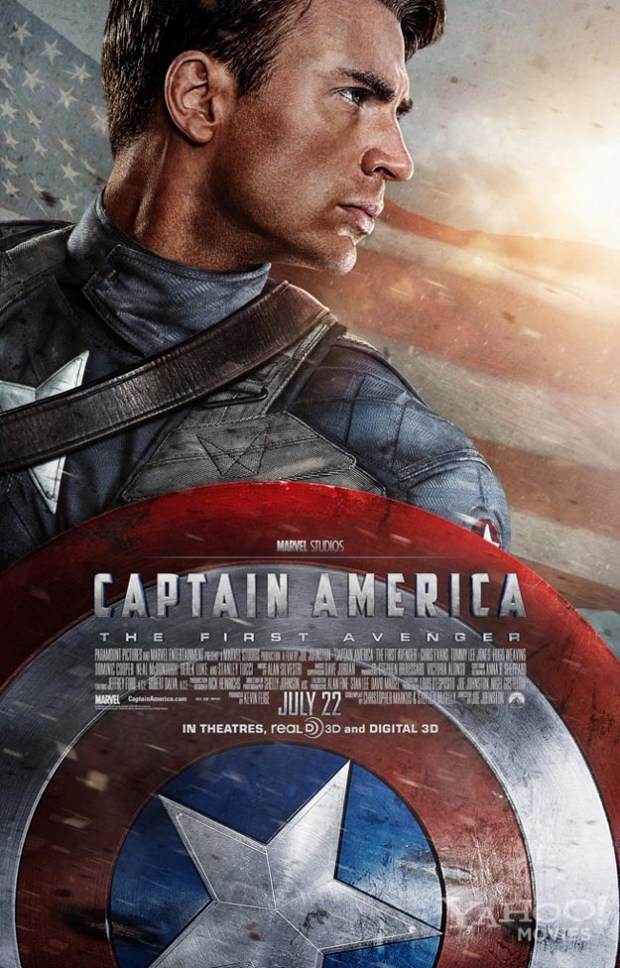
2011’s Captain America, the first movie featuring the character that fans will actually acknowledge exists, works and works so damn well, because it gets that.

Blucatt ad

(more…)

“You think me strange? Good strange, or bad strange?”

First dates are essentially scams. You sit down to dinner with someone you don’t know, and try to pretend that you’re someone else. Someone charming, and succesful, and definitely not into doing weird things with fish. No sir. Not you. The second and third dates are more or less the same. But by the time the fourth date rolls around you need to start being honest. That’s where you take your date on a long walk and say “Look. I really like you. I like where this is going. But if we’re going to have something together I’m going to have to tell you just how much of a freak I actually am.”

“This. This is me. This is what I get up to.”

“This. This is me. This is what I get up to.”

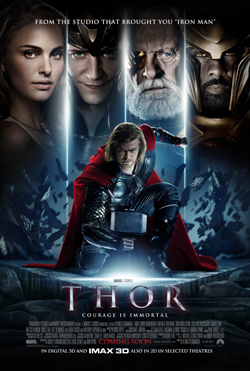
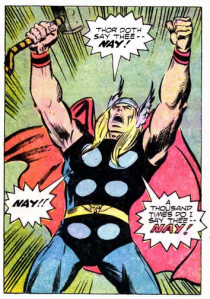
The Marvel Cinematic Universe has essentially been a long, meticulous romancing of the mainstream. Thor is the part of the relationship where Marvel finally says “I’m glad you like the snarky businessman in the robot suit and the scientist who turns into a green monster. Now here’s where we get nuts.” As a title, The Mighty Thor has always been an unapologetically melodramatic, ridiculous, camp, epic, nonsensical, glorious, mess. In short, it is one of the purest comic books ever written. It’s huge men with long flowing hair and fabulous capes yelling cod-Shakespearean insults at each other and not understanding the difference between “thee” and “thou”.
It, quite simply, does not give a fuck.
But first, a little history.
The character of Thor was created early in the first millennium by the Germanic peoples inhabiting what is now Scandinavia. Some stuff happened. Then, in 1962, the character was introduced into the Marvel universe by Stan Lee, Larry Lieber and Jack Kirby in the pages of Tales to Astonish. There’s a little bit of confusion as to who actually came up with the idea (aside from the ancient Vikings, I mean). Stan Lee claims that the idea came to him when he realised that the only way to create a character stronger than the Hulk would be to make him a god, and that rather than go with the more well-known Greek or Roman deities he decided to delve into Norse mythology.
Meanwhile, Cúchulainn sits on the damn shelf.

Meanwhile, Cúchulainn sits on the damn shelf.

Jack Kirby, on the other hand, claims that he created the character because of his love of Norse mythology and to be honest, I think the evidence is on Kirby’s side. Kirby had already created not one but two versions of Thor for DC in the golden age, so he clearly had an interest in the character. Not only that, but “comic book characters as post-industrial mythology” was kind of Jack Kirby’s whole deal. Thor’s sales have never exactly set the world on fire but this is nonetheless a character with some serious cred. There are many who consider Lee and Kirby’s run on the character the finest work of either men in the sixties (damn high praise) and he’s also had some celebrated runs, none greater than Walt Simonson’s glorious, batshit insane epic in the eighties.
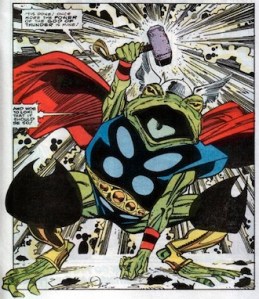
This is normally the part of the review where I would say “we do not speak of the Frog of Thunder” but even this was AWESOME.

This is normally the part of the review where I would say “we do not speak of the Frog of Thunder” but even this was AWESOME.

He’s also been a  very consistent presence in the Marvel universe, showing up in almost everyone else’s books at one time or another and, if there’s a team of Avengers that Thor’s not on, it’s probably only because he’s dead again. He’s always been one of the company’s “faces”, one of their most visible and iconic characters. And yet, Thor has always struggled outside of comics. His live action appearances before 2011 was just a single episode of The Incredible Hulk, and he hasn’t headlined his own cartoon series since the frickin’ sixties (compare that to Spider-man, who gets a new cartoon show every time Stan Lee sneezes). Same Raimi originally pitched a Thor movie to Marvel all the way back in 1990 and from there it was dropped, picked up again, briefly re-conceived as a TV show starring Tyler Mane before bouncing to Sony, then to Paramount before finally arriving back at Marvel. The decision to nominate Kenneth Branagh to direct was surprising but also kind of inspired. Branagh is famous as an interpreter of Shakespeare for the masses, and Stan Lee is of course one of the biggest Shakespeare fanboys out there.
He made Falstaff into a superhero, people.

He made Falstaff into a superhero, people.

Branagh was the perfect candidate to make the overblown, melodramatic bluster of Thor work for a mainstream audience.  Just, for the love of God, don’t subject yourself to his commentary on the DVD.
"The director's an ass."

“The director’s an ass.”

Marvel knew going in that compared to Iron Man and Hulk, this movie was the real test. This is where they’d learn if a mainstream audience could really accept all the comic book nuttiness they were about to bring. It was time to see if this relationship had legs.
Blucatt ad

(more…)

“I don’t want to control it. I want to get rid of it.”

When comic fans and writers talk about a character’s “status quo” they don’t  just mean the existing state of affairs in that character’s book. The Status Quo is sort of like the Platonic Ideal of a comic character, the version of the character that everyone thinks of when they hear the character’s name. For example, Spider-man’s status quo is:

  • Spider-man is mild-mannered Peter Parker, who gained incredible spider powers when he was bitten by a radioactive spider during a science presentation.
  • He wears a red and blue spider-suit.
  • He lives in Queens with his elderly Aunt May.
  • His love interest is Mary Jane Watson.
  • He works as a freelance photographer for the Daily Bugle, where his boss is J. Jonah Jameson.
  • His life is a never ending parade of misery.
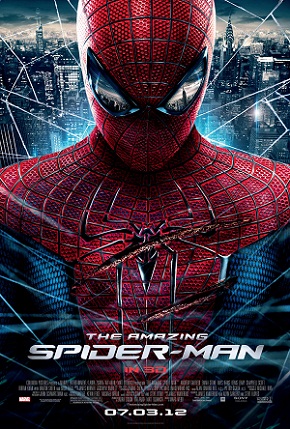
Now, you could pick up any comic featuring Spider-man since 1962 and the odds are good that at least one of those bullet points is not true for the book you’re currently reading (except the last one. That never changes). Spider-man might be dating Gwen Stacy. He might be working as a science teacher. He might not be Peter Parker at all, but instead Ben Reilly or Miles Morales or Otto Octavius or Miguel O’Hara. Aunt May might be dead again. But still, that’s the default version of the character. Whenever the comic goes off the rails, chances are they’ll return Spider-man to his roots and have him back at the Daily Bugle, back with Mary Jane, living with Aunt May. Sooner or later, he will return to status quo like he’s attached to it with a bungee cord.
The Hulk, who debuted a few months prior to Spider-man in 1962 also has a default version; When he gets angry, scientist Bruce Banner turns into the Hulk, a massive rampaging green giant with the mental capacity of a three year old who destroys everything in his path. He is a man of few words, and those words are “Hulk” and “Smash”.
This is the version of the character that everyone is familiar with, and to comic fans he’s known as “Savage Hulk”. What’s interesting about the Hulk is that I can think of very few superheroes who spend less time “at status quo” than the Hulk. And the reason for that is, there’s not really that much you can do with Savage Hulk. Savage Hulk is less a character than an event that other characters react to. He’s like Godzilla. What kind of story can you do with Godzilla? What journey can he go on? Is he going to adopt an orphaned child and raise him as his ward? No. He’s going to stomp on buildings and go “SKRONK!”. Is he going to discover a shocking secret about his past that throws everything he though he knew about himself into doubt? No. He’s going to stomp on buildings and go “SKRONK!”. Is he going to serve as an allegory for the horrors of nuclear war? Yes. While he stomps on buildings and goes “SKRONK!”

That’s basically Hulk’s problem (just swap out “SKRONK” for “HULK SMASH”) and probably why the character often had trouble maintaining a series of his own while still being a very popular guest character in the books of other superheroes. Writers have gotten around this by staying as far away from the Savage Hulk status quo as they can. Often the Hulk will be made more intelligent, or a different side of Banner’s personality will emerge as a new Hulk. Or Banner and the Hulk will merge personalities. Or they’ll swap personalities. Or the writers will huff paint and do something really stupid.
We do not speak of the time Hulk tried to bang his cousin.

We do not speak of the time Hulk tried to bang his cousin.

 Despite that, Savage Hulk retains a near total grip on the general public’s perception of the character, especially since all the non-comic depictions of the (the seventies TV Show, the two cartoon series and both movies) have been pure Savage Hulk. And the reason for that is that Savage Hulk, despite the limitations he brings from a story-telling point of view, is a fanastic concept because he is so universal. Everyone can relate to the Hulk. When we see Bruce Banner finally lose his temper and transform into a huge, rampaging monster it’s cathartic as all hell because on some level we all wish we could do that.
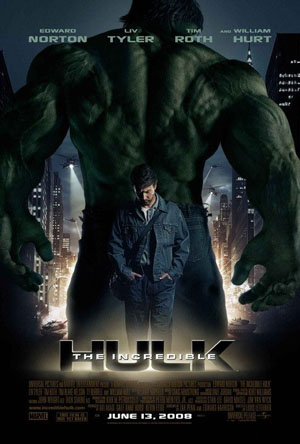
Following the success of Iron Man it was time for the difficult second album and Hulk seemed an obvious candidate for the studio’s sophomore effort. He was, without question, the highest profile character in Marvel’s stable that they owned the movie rights to, thanks to the success of the Bill Bixby series. But there was a problem, looming over the production like a big hulking…hulk.
 p32133_p_v8_aa
In a way, it would have been easier if Ang Lee’s 2003 Hulk: A Mediation on Moss has been an out and out flop. That way Marvel could have simply said “Don’t worry, we’ll fix it! The grownups are in charge now!” and completely ignore it other than to work a few sarcastic swipes at it into to the script. But here’s the thing, Lee’s Hulk might not have been popular with comic fans but it actually did fairly decently at the box office and got not a little critical love. Personally, I appreciate what Lee was going for and think that there are some beautiful moments and really good performances but yeah, the movie is kind of a snooze fest. It has its fans though, putting Marvel in a bit of a tricky position. Should they embrace Lee’s Hulk and make their version a straight up sequel, or start again with a new origin story that firmly established their Hulk as a new, separate beast?  In the end, they did neither.

(more…)

Disney Reviews with the Unshaved Mouse #54: Big Hero 6

(DISCLAIMER: This blog is not for profit. All images and footage used below are property of their respective companies unless stated otherwise. I do not claim ownership of this material. New to the blog? Start at the start with Snow White.)
And so, like putting on an old comfortable pair of shoes, I return again to the Disney canon. Good to be back everyone, feels like I never left. Unshaved Mouse doing what he was always meant to do, reviewing Disney movies! Put the Disney dance party album on repeat because the whole gang’s here! Including my collection of traitorous good for nothing maps who betrayed and abandoned me the very second things got rough and have now come crawling back like the worms they are.
“Hooray!”

“Hooray!”

“Ah, don’t be like that, Mouse.”

“Ah, don’t be like that, Mouse.”

“Don’t talk to me.”

“Don’t talk to me.”

"'S only ever love, M. You know that."

“‘S only ever love, M. You know that.”

“Where did you go anyway?”

“Where did you go anyway?”

“We just hung around with Rubber Lotus for a while. At first it was fun, but then it got a little weird. He kept asking us to call him “Mouse”. Did you know he has a shrine to you in his wardrobe?”

“We just hung around with Rubber Lotus for a while. At first it was fun, but then it got a little weird. He kept asking us to call him “Mouse”. Did you know he has a shrine to you in his wardrobe?”

“Yeah. Shrines. Never not creepy.”

“Yeah. Shrines. Never not creepy.”

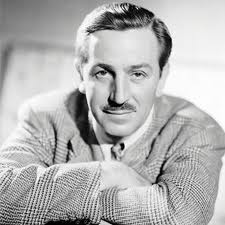
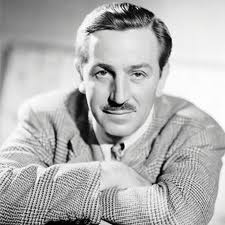
And of course, since I’ll be reviewing a Disney movie that means the return of our old pal Walt Disney!
“Hello folks! Good to be back, Mouse. Glad to see there’s no hard feelings over that whole “brainwashing” thing.”

“Hello folks! Good to be back, Mouse. Glad to see there’s no hard feelings over that whole “brainwashing you to do my dark bidding” thing.”

“None. What. So. Ever.”

“None. What. So. Ever.”

"Glad to hear it. Say, you keep gritting your teeth like that you might chip your incisors."

“Glad to hear it. Say, you keep gritting your teeth like that you might chip your incisors.”

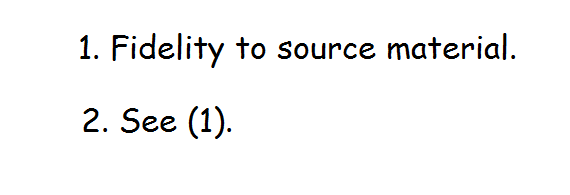
After the marriage of Disney and Marvel, the two companies did what many couples do in this situation; put their children from previous marriages in a room together and try to force them to like each other. In this case, Disney CEO Bob Iger told the Disney animators to look through Marvel’s back catalogue to see if they could find properties that would make good animated movies. Now, people who’ve followed my blog from the beginning know that when Disney adapts other properties, fidelity to the source material is not usually high on their list of priorities. Marvel fans, conversely, have a list of priorities that reads
Priorities
Marvel fans tend to get a little…um….Rain Man-esque…about movies changing even small details about their favourite characters, and films that don’t respect the source material tend to get eaten alive like a cow being dipped in a vat of piranhas.
Poor bastards never had a chance.

Poor bastards never had a chance.

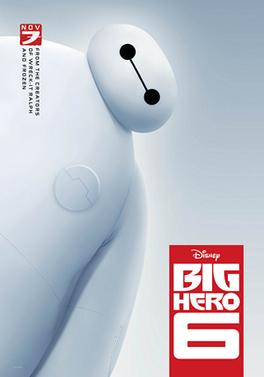
So it’s not really surprising that the comic that Don Hall (director of Winnie the Pooh and writer on most of the Lost Era movies) chose the comic Big Hero 6 to adapt instead of a better known property because…well, no one gives a piping hot shit about Big Hero 6 and this way they could mess around with it as much as they needed to. In the comics Big Hero 6 is a Japanese superhero team that operates as a parody of Japanese pop culture tropes. I haven’t read the comic myself but reading up on it raised a few red flags for me, number one being that the mini-series they first appeared in was written by Scott Lobdell, a writer whose work is (if I may be horribly blunt) not my cup of tea.
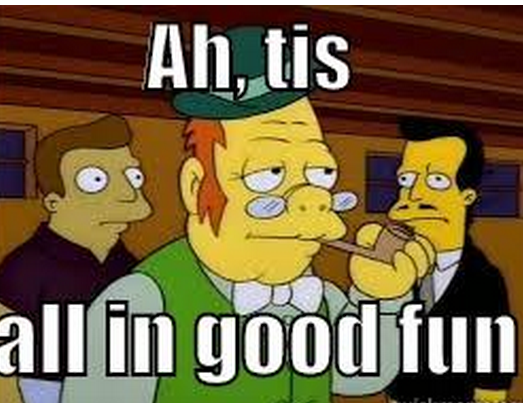
Secondly…Okay, there are those who would consider this kind of broad cultural parody to be racist in and of itself. I’m not one of them. Irish people come in for a good bit of this kind of thing and I think as a nation our general attitude is…
all in good fun
But…some of the details about this book, like the fact that one of their enemies is the embodiment of all the people who were killed in the nuclear attacks on Hiroshima and Nagasaki…
New spittake
Yeah, I think we can all agree that “loose adaptation” was probably the way to go on this one.
So much for the book. What about the movie? Oh, and while I’m not in the habit of putting up spoiler warnings I’m aware this movie only came out in 2014 so yeah, I will be discussing all major plot points just like I always do. If you haven’t seen the movie yet, get on that. The rest of you? Let’s roll.

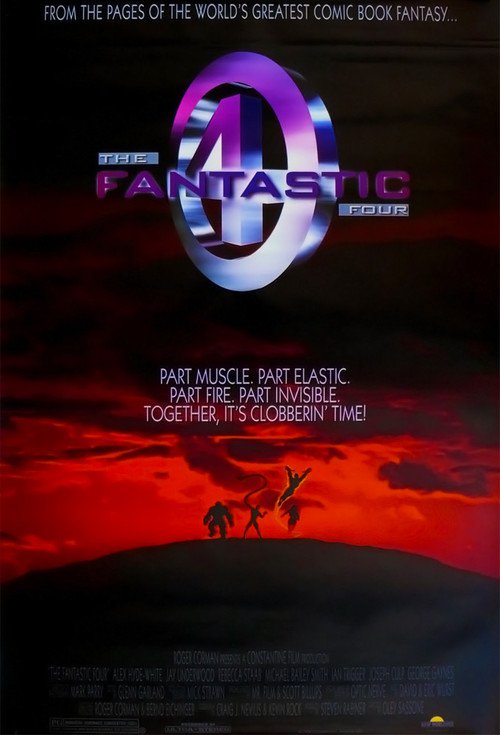
The Fantastic Four (1994)

(DISCLAIMER: This blog is not for profit. All images and footage used below are property of their respective companies unless stated otherwise. I do not claim ownership of this material. New to the blog? Start at the start with Snow White.)

Sometimes, a movie comes along that is so notorious, so terrible, so gosh-fucked appalling that no one reviewer may safely tackle it alone. To that end, Unshaved Mouse has teamed up with the illustrious NewtCave and Erik Copper to review the never-released Roger Corman-produced superhero movie; The Fantastic Four. 

UM: Hi guys and welcome to Unshaved Mouse. Make yourselves comfortable, don’t touch the continents. They bite.

“Hssssssssssss!”


UM: So. Erik. Newt. What the fuck did we just watch?

EC: I was under the impression that we were just witness to the birth of the anti-christ of comic book movies.

NC: Pretty much. This thing gets my vote for “Worst Marvel Film.” Including Howard the Duck.

UM: Was it though? I mean, can’t we grade of a curve? There were extenuating circumstances here.

NC: Fair point, furry one. But let me put it this way. Elektra? Released in theatres. Hulk? Released in theatres. Howard the Duck? For some reason, still released in theatres. Roger Corman’s Fantastic Four? Kept secret. Kept safe.

EC: Gandalf’s wise words were still not strong enough to keep this mess off of the internet, though. Because as we all know, technology is the MOST powerful of the dark arts.

UM: Speaking of dark arts, Erik, aren’t you supposed to be dead? 

EC: Huh?

UM: Yeah. I totally fed you to a shark at the end of our last review.

EC: Oh yeah. Dick! That was the single most tortorous experience of my life! I had to chew my way out of the shark’s stomach! I still have nightmares! I

UM: Heh.

EC: It’s not funny!

UM: It was funny to everyone who wasn’t you. Which, y’know, was the entire human race. Needs of the many, Erik.

NC: Should I step outside while you two work through your prior history?

UM: Nah baby, we cool. Let’s get started. Newt, as our resident Marvel buff, what can you tell us about the good ol’ Fantastic Four?

NC: Probably more than is either necessary or interesting. But, limiting myself to relevant information, the Fantastic Four have often been referred to as “Marvel’s First Family.” and that’s only because that’s exactly what they are. Back in the ancient past of 1961, Stan Lee took it upon himself to create a team of superheroes like none that had come before. Instead of a bunch of square-jawed Super Friends, he elected to make a team that was more like a family trying to make the best of a bad situation.

UM: With Square Jaws.

EC: Rather rubbery and slightly malleable jaws, too.

NC: When The Fantastic Four #1 hit newsstands, they didn’t even have costumes or secret identities. They were all about breaking the norms of what people had come to expect from the superhero genre.

UM: I think the FF was really the big bang of the modern Marvel universe. So many of the characters and concepts that make up that world got their start in the pages of Fantastic Four. Doctor Doom, Black Panther, the Inhumans, the Skrulls, the Kree, the list just goes on and on.

NC: Exactly. The company wasn’t even called “Marvel” before the FF came along. Anything before that was published under the not-so-timeless brand of “Timely.”

EC: It was incredible how fast the superhero boom took off. Most of the heroes we know today didn’t even start off as anything other than one-off stories that were just too popular to remain that way. Spider-Man? He first appeared in Amazing Fantasy #15. Thor? He was first introduced in Journey into Mystery. Iron Man? Tales of Suspense. These heroes didn’t start off timeless, but they slowly captured our hearts. The Fantastic Four is no different.

UM: Which is kind of why it’s so sickening how Marvel are treating this title now, basically sweeping it under the rug because they can’t get the movie rights back from Fox.

NC: Well, to be fair, they’re doing that with ALL the properties they haven’t regained the movie rights to, which seems a bit like dirty pool to me.

UM: I dunno dude. The day I see Wolverine and Spidey at the dole office maybe. It seems like the Fantastic Four have gotten it worse than anyone.

EC: I don’t even know who’s side to be on. Fox is being a child not willing to share its toy, and Marvel is being a child throwing a tantrum because they want that toy SO VERY BAD.

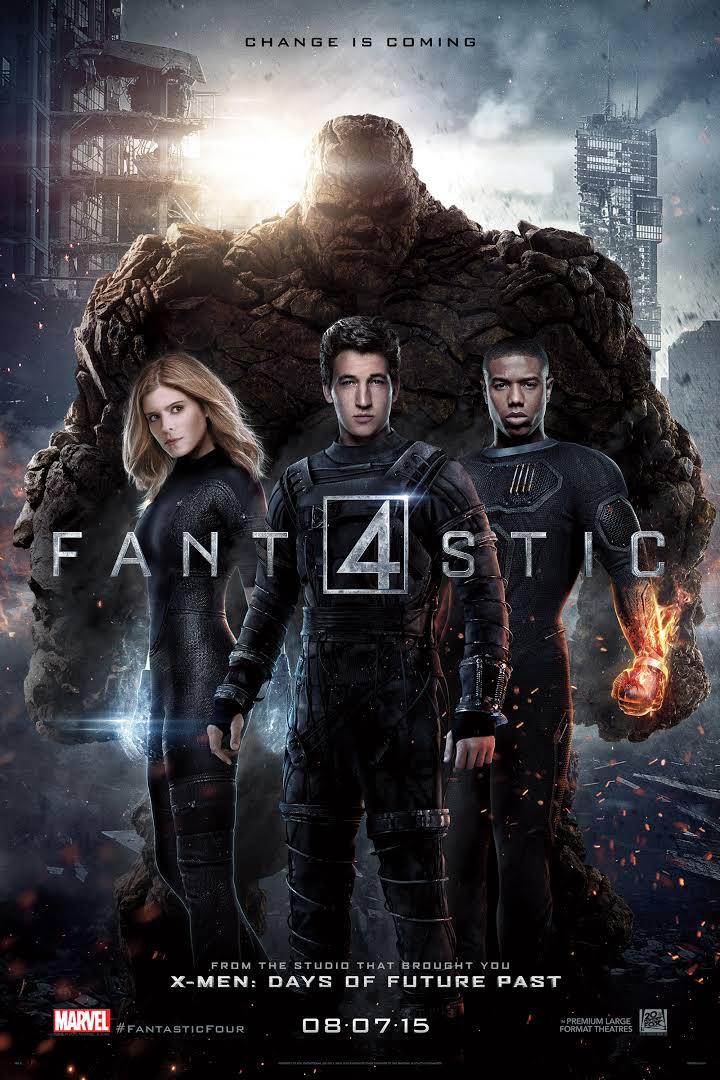
NC: It’s a crappy situation, and I think everybody involved lost. I mean, I know we’re supposed to reserve judgement on Fant-four-stic… but yeah. ‘Nuff said, am I right?

UM: I will lay good money on it being the best Fantastic Four film ever.

EC: I will lay good money on it being an attempt. And that’s about all I can give it.

NC: I will lay good money on the team being rebooted with the SAME DAMN STORY enough times that the filmmakers all throw their hands in the air and finally adapt Neil Gaiman’s Marvel 1602.

UM: Ah, the Fantastick Four!

EC: Yes, and Peter Parquagh! (GOD WHY?!)

UM: Okay, but what about today’s movie? If I may?

NC: Go right ahead.

UM: I thank ye. So, back before Marvel decided to stop letting other companies fuck up their characters and just do it right themselves, they sold the movie rights to the Fantastic Four for a song and a wink to a German producer named Bernd Eichinger. Eichinger had a limited amount of time to make the movie or else the rights would revert to Marvel so, when he couldn’t get the money in time, he teamed up with legendary cheapo movie-maker Roger Corman to make a superhero movie in three weeks with $1 million. The resulting…thing…was never meant to be seen by human eyes. It was solely created to allow the company to hold on to the movie rights. Thankfully, such shady business practices would never occur in Hollywood today.

Ha! It's a joke! Because it happens all the damn time!

Now how did that get there?

UM: So, just how bad can it be?

(more…)

Patron Saints of America (Mouse wrote a movie! Apparently…)

Back in college I wrote a play called Patron Saints of America which holds a unique position as being the oldest thing I’ve written for stage that I can now look back on and not shudder. In hindsight, while I don’t think it’s perfect by any stretch, it’s probably the first thing that I wrote that reads like something I’d write today. It’s where I think I found my voice, I guess you could say (prior to this I was just making exaggerated hand gestures). Now, that play was directed by two friends of mine Finbarr Doyle and Jimmy McNulty.
He is probably the only person on earth who hates The Wire for that very reason.

Who is probably the only person on earth who hates The Wire.

Not too long ago, Jimmy and another friend of mine, Keith Thompsons (who played the character of Bruce onstage) arrived at my house to tell me that, as a birthday present to me, they actually went and turned Patron Saints of America into a short film that they managed to shoot in one night. I know, right? Happy birthday, here is a motion picture.
Now, while I’m obviously biased, I think this turned out kind of amazing. The movie’s below, let me know what you think.

The Unmitigated Gall

Alright, you’re all  probably wondering why there’s going to be such a long break between now and the next review. So I thought I’d do what I usually do in these situations; hold a hypothetical conversation with a mysterious person who only speaks in boldface.
Hey Mouse, why you no review long time?
Good, if rather ungrammatically worded, question MPWOSIB.
To answer that I need to explain something about me.
If the only information you were provided about me was a list of what I eat in a given week, you would conclude the following: This person is not merely fat. He is SO fat that he can neither lift his arms nor fit in a bathtub, meaning that the only way he can bathe is to get the elephants in the carnival that he tours with as an attraction to stand in a circle around him and douse him with their trunks. The delivery guys know me by name, sight and scent. You name it, I have had it delivered to my door; Chinese Food, Pizza, Fish and Chips, this new restaurant down the road that just brings a barrel of lard to your house and pumps it straight into your stomach…
But, oddly enough, I’m pretty much at my ideal weight for a male of my age and height and have been for pretty much all my adult life. For whatever reason, I kinda just don’t put on weight and you hate me now and that’s good.
"Hate keeps a man alive."

“Hate keeps a man alive.”


(more…)

The fault in our shades

I have this idea for a non-fiction book that I may write sometime, tentatively called Everything I know about God I learned from Comic Books. It would be a look at how the history of superhero comics so often parallels that of the major world religions, like how issues of canonicity are decided (The First Council of Nicaea/Crisis on Infinite Earths), how older belief systems get incorporated into newer ones (Celtic deities becoming saints in Gaelic Christianity/ Captain Marvel becoming part of DC continuity), the violent schisms that can erupt between adherents of different sects (the Crusades/Cassandra Cain versus Stephanie Browne) and how they deal with the Problem of Evil/Frank Millar. I bring this up because, oddly, one of the best and simplest pieces of moral advice I ever received was from a comic book. It was an issue of X-Men where Bishop, a mutant cop from the future, almost kills the man who murdered his sister before realising that he can’t cross that line and simply arrests him. Bishop is tormented by guilt over what he almost did and Charles Xavier gives him this line (as near as I can remember it, it’s been years): “It is not our thoughts that mark us, but our deeds.”
This, I think, is a very important moral. We cannot control our thoughts, our desires, our prejudices or our emotions. And, take it from the guy with the Catholic upbringing, trying to is a real good way to go nuts. In fact, if you ever find yourself in the trenches and want to be invalided back to Blighty, don’t bother sticking underpants over your head, just try to not think about something for ten minutes and that should do the trick.  Having bad thoughts does not make you a bad person. Acting on them does.
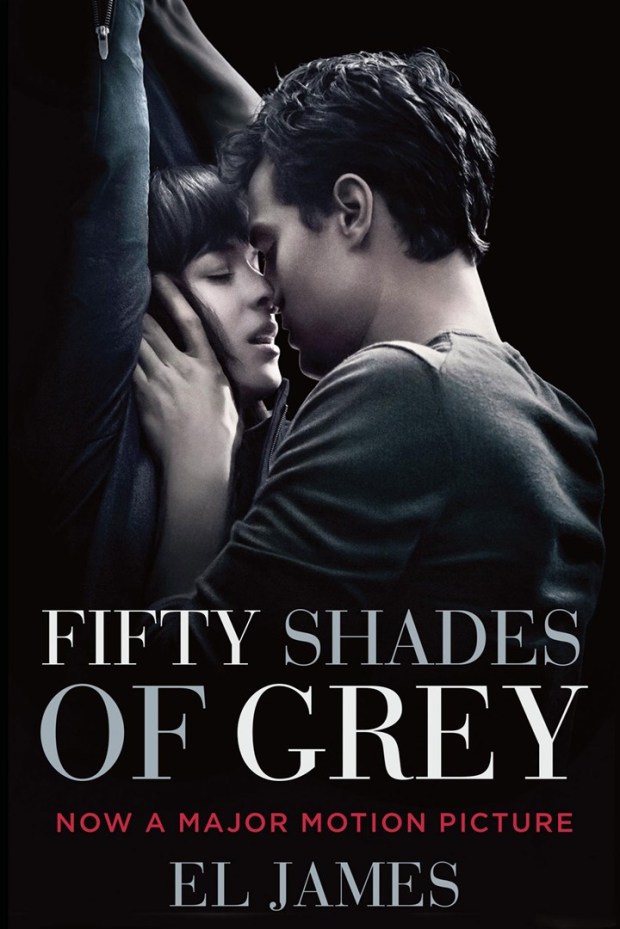
Speaking of bad people, I hardly ever read other people’s blogs, which I feel incredibly guilty about because I always want people to read mine and that makes me a rather massive hypocrite. Honestly, it’s just a question of time. Between work, family, blogging, watching movies to review and trying to keep on top of other writing projects (not to mention a rather serious gaming habit) I normally just don’t have the hours. Recently however, I made an exception and plowed through all of author Jenny Armintrout’s extensive re-cap of Fifty Shades of Grey over on Trout Nation. It’s hilarious, excellently written and I heartily endorse it.
"I am Unshaved Mouse, and I approve this blog. All my readers should check it out!"

“I am Unshaved Mouse, and I approve this blog. All my readers should check it out!”

"Huh. My stats just went up by a barely perceptible ammount. As if theyd been kicked by a tiny, tiny ant."

“Huh. My stats just went up by a barely perceptible amount. As if theyd been kicked by a tiny, tiny ant.”

Now, even though I know damn well that every last one of you knows what Fifty Shades of Grey is, blogging law stipulates that I give some background on what I’m talking about on the off chance that one of you has awoken from a coma so here we go. Fifty Shades of Grey is E.L. James’ re-purposed  Twilight fanfiction where mousey milquetoast Anastasia Steele (Yes. Yes, really.) becomes involved with chiselled blonde billionaire Christian Grey and they have lots of badly punctuated sex. It was famously described by Salman Rushdie as the worst-written novel to ever be released by a major publishing house and so naturally became a huge commercial success.
"Welp, I guess they proved ME wrong."

“Welp, I guess they proved ME wrong.”

It is also porn.
And that’s not a criticism. It’s simply a statement of fact. It’s a piece of fiction written to get the reader off. Simple as. Now, during the course of the book Christian Grey does a lot of incredibly awful things. He emotionally manipulates Ana, plies her with alcohol, coerces her into sexual acts that she really does not want, beats her, threatens her, demeans her, isolates her from her friends and family and literally checks every item on the list for being an abusive partner (not hyperbole, Jenny actually did that very thing).

(more…)

The Unshaved Mouse’s Greatest Comics of All Time

Soon, I hope, issue Number 2 of my arc on League of Volunteers will be hitting the stands and will shortly thereafter, I have no doubt*, be acclaimed as the greatest comic ever. Before that happens, let’s take a look at some of the other greatest comics ever, before they are consigned to the ash pile of history.
 
Apologies gentlemen. C'est la guerre.

Apologies gentlemen.
C’est la guerre.

So here is The Unshaved Mouse’s Top 17 Greatest Comics of all Time. Why 17? Because I wrote the list and then realized I’d left off Bone and Maus (which would have been both hugely unfair and, in the case of Maus, also weirdly ironic).

(more…)